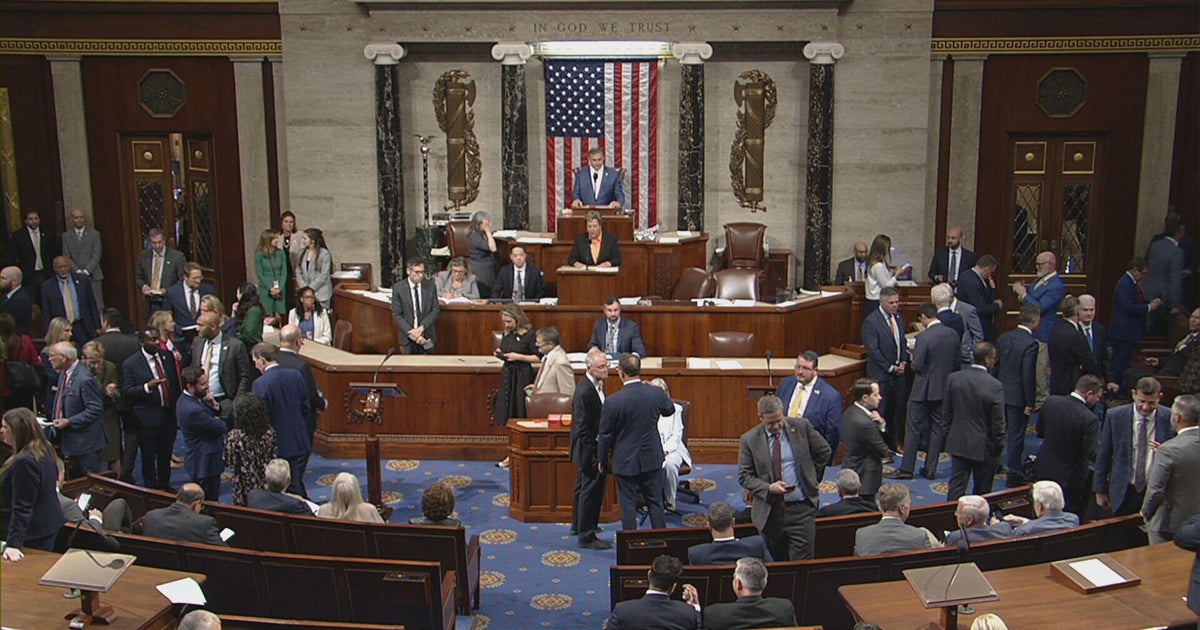
Washington — The House voted for a third time against acting as a check on President Trump’s military powers in Iran, even as a growing number of Republicans express concern about the prolonged conflict.
Thursday’s vote on a Democratic resolution to rein in Mr. Trump’s authority was 212-212, falling just short of a majority. Originally introduced on March 4, the measure as written would have directed the president to remove U.S. forces from hostilities within 30 days of the start of the war, which began on Feb. 28.
“I didn’t want to have to bring this resolution to the floor. I had hoped that the administration would have changed course after I introduced it and properly briefed the Congress and the country,” Democratic Rep. Josh Gottheimer of New Jersey said during floor debate Wednesday night.
Gottheimer said he supported the Trump administration “crushing” the Iranian regime, but denounced the administration leaving lawmakers “in the dark” with the lack of formal briefings.
The war passed a critical deadline on May 1 under the War Powers Resolution of 1973, which says the president must remove armed forces from hostilities after 60 days if Congress has not authorized the war. The 60-day clock started once the president sent formal notification to Congress of the hostilities on March 2.
But the president notified Congress on May 1 that “hostilities” with Iran had “terminated” because there had been “no exchange of fire” between the U.S. and Iran since April 7, when both sides agreed to a ceasefire. The administration has argued that the ceasefire paused the 60-day clock. Since then, the ceasefire has been tested as tensions rise around the Strait of Hormuz.
Thursday’s vote was the first time the House has voted on the issue since the statutory deadline passed. Three Republicans — Reps. Thomas Massie of Kentucky, Brian Fitzpatrick of Pennsylvania and Tom Barrett of Michigan — voted in favor. Rep. Jared Golden of Maine was the sole Democrat to vote against it.
Barrett introduced an authorization for use of military force on May 7 that would give Mr. Trump until July 30 to continue the war in Iran, though it has gained just one GOP cosponsor — Rep. Don Bacon of Nebraska — since its launch. Republican Rep. Blake Moore of Utah has also signaled support for Barrett’s AUMF.
“Two things have been clear from the very beginning: Iran cannot be allowed to develop a nuclear weapon and the United States of America cannot be dragged into another endless war,” Barrett said in a statement, adding that Congress must exercise “its constitutional role to clearly define the mission with safeguards and a deadline.”
The resolutions have picked up more support since the House’s first vote to rein in Mr. Trump in early March. In the first attempt, four Democrats joined all but two Republicans to kill it. Three of the four Democrats dropped their opposition in the second vote in April, though one of the Republicans who initially supported the effort voted present.
Senators, meanwhile, have rejected seven attempts to advance Democratic war powers resolutions, with the most recent failing Wednesday. But Democrats have picked up two more Republican votes — Sens. Susan Collins of Maine and Lisa Murkowski of Alaska — since they began pressing the issue. GOP Sen. Rand Paul has consistently voted with Democrats.
Murkowski, who said earlier this month she intended to introduce an authorization for use of military force, said she voted in favor of advancing the most recent resolution due to the lack of clarity on the war from the Trump administration.
“We’re in a different place than we were last time we voted on this,” she said, referencing the 60-day deadline.
Democrats in both chambers have said they plan to keep forcing votes on the Iran war, hoping that eventually they will garner enough GOP support.
“There will be a day, and it might be soon, I believe, where this Senate will say to the president, ‘stop this war,'” Sen. Tim Kaine, a Virginia Democrat, said Wednesday. “I believe that day is coming.”
Kaine acknowledged that Congress is unlikely to be able to override a presidential veto, which requires two-thirds support, even if a resolution eventually makes it to Mr. Trump’s desk. But Kaine argued that it could still force Mr. Trump to bow to political pressure and back off from further military action against Iran.
In recent weeks, nearly a dozen members of the Congressional Progressive Caucus have rolled out war power resolutions, enough to force votes for weeks to come, if they decide to.
“We will keep holding Republicans in Congress accountable for as long as they enable this reckless, illegal war,” Democratic Rep. Greg Casar of Texas, who leads the Congressional Progressive Caucus, said in a statement.
contributed to this report.