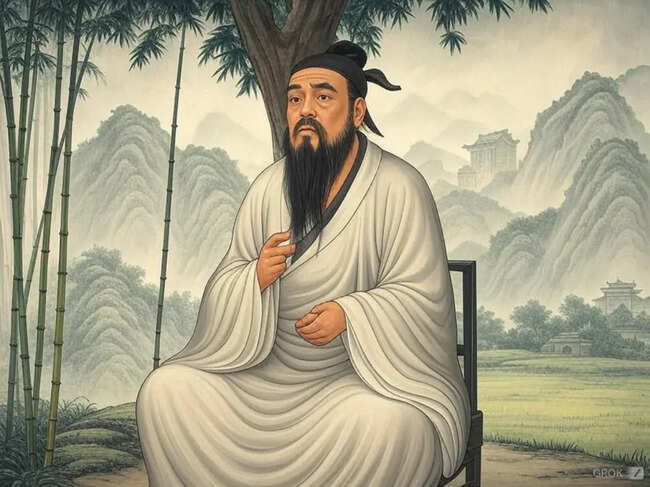
The Confucius quote of the day — “Study the past if you would define the future” — sounds simple at first . But beneath that simplicity is a philosophy that explains why some people repeat the same mistakes while others develop wisdom from experience. It is not merely a historical statement. It is a warning against shallow thinking.
Today’s quote of the day by ancient philosopher Confucius: Why studying the past may be the smartest path toward a wiser future
The quote of the day by Confucius carries a timeless message about wisdom, memory, and intelligent decision-making. In a world moving at extreme speed through AI, financial disruption, and constant technological change, Confucius reminds people that the future is not built from impulse alone. It is shaped by lessons already written in history. Every generation believes it is facing completely new problems, yet human nature — ambition, fear, greed, hope, and leadership — changes very little. That is why studying the past remains one of the strongest tools for understanding the future.
This quote also speaks deeply to modern business, finance, and leadership culture. Companies often rush toward trends without understanding earlier failures. Investors ignore past market crashes during periods of hype. Leaders repeat avoidable mistakes because they treat history as irrelevant instead of instructional. Confucius believed true learning comes not from collecting information, but from reflecting on experience with honesty and discipline. His philosophy suggests that progress without memory becomes dangerous because people lose the ability to recognise patterns before problems grow larger.
What makes the quote of the day so powerful is its emotional truth. The past is not simply a record of old events; it is a map of human behaviour. People who study history carefully often develop better judgement, stronger patience, and clearer thinking. Confucius understood that wisdom is not about knowing everything. It is about learning what should never be forgotten. In an age obsessed with speed and novelty, that lesson feels more important than ever.

Live Events
Meaning of quote of the day: “Study the past if you would define the future.”
The quote of the day by Confucius means that people can make wiser decisions about the future when they carefully learn from history, experience, and past mistakes. Confucius believed the past contains valuable lessons about human behaviour, leadership, success, failure, and society. Instead of rushing blindly into the future, he encouraged people to pause, reflect, and understand what earlier generations already discovered. The quote teaches that wisdom grows through observation and thoughtful learning.
In modern life, this quote has become especially relevant in business, finance, technology, and leadership. Companies launching new products, adopting AI tools, or entering competitive markets often fail when they ignore earlier lessons. Economic crashes, political conflicts, and corporate failures usually follow familiar patterns. Confucius’s message is that history is not useless old information — it is evidence. Leaders who study previous successes and failures are often better prepared to avoid repeated mistakes and make smarter long-term decisions.
The deeper meaning of the quote is also personal. Every individual carries a past filled with experiences, failures, achievements, and lessons. Confucius suggests that growth comes from reflection, not just action. People who honestly examine their own mistakes often develop maturity, patience, and better judgement. The future does not become stronger through ambition alone. It becomes stronger when knowledge, memory, and self-awareness guide the way forward.
All about Confucius
Confucius was an ancient Chinese philosopher, teacher, and political thinker who lived from 551 BCE to 479 BCE during the Spring and Autumn period of Chinese history. Born as in the state of Lu, in present-day Shandong, he became one of the most influential intellectual figures in world history. His teachings focused on morality, education, discipline, family values, leadership, respect, , and social harmony. At a time when China faced political instability and conflict, Confucius believed society could become more peaceful if individuals developed strong ethical character and responsible behaviour.
Confucius is best known for creating the philosophical system later called Confucianism. Unlike many philosophers who focused mainly on abstract theories, Confucius concentrated on practical human conduct and moral living. He believed good leaders should rule through virtue rather than fear and that education should be available to ordinary people, not only the wealthy elite. His teachings were later collected in The Analects, a book that preserved his conversations, sayings, and ideas for future generations.
The influence of Confucius spread far beyond China and shaped the cultures, education systems, and political traditions of East Asia for centuries. His ideas affected societies in China, Japan, South Korea, and Vietnam. Even today, his quotes and philosophies remain widely studied because they address timeless human questions about wisdom, leadership, learning, discipline, and how people should live meaningful lives.
Confucius’s work and philosophy
Confucius spent much of his life teaching students, advising rulers, and developing a philosophy centered on morality, responsibility, respect, discipline, and good leadership. His teachings were later preserved in The Analects, which became one of the most influential philosophical texts in history.
He believed leaders should rule through virtue instead of fear and argued that strong societies begin with strong moral character inside families and communities. His ideas later formed the foundation of Confucianism, shaping education systems, political structures, and cultural traditions across China, Japan, South Korea, and other parts of Asia for centuries.
Although Confucius did not achieve major political power during his lifetime, his influence after death became extraordinary. His teachings survived dynasties, wars, revolutions, and social change, eventually making him one of the most respected philosophers in world history.
Confucian thought shaped Chinese civil service systems, educational traditions, and leadership principles for more than two thousand years. Today, his quotes and ideas remain widely studied because they address timeless human concerns such as wisdom, learning, ethics, leadership, and personal growth.
The success of Confucius lies not in wealth or military conquest, but in the enduring power of his ideas. His philosophy continues influencing modern discussions about education, business leadership, discipline, morality, and social responsibility. In an age driven by technology and rapid change, many people still turn to Confucius for guidance because his teachings focus on something timeless: how human beings should think, learn, lead, and live with integrity.
Other famous quotes by Confucius
- “It does not matter how slowly you go as long as you do not stop.”
- “Our greatest glory is not in never falling, but in rising every time we fall.”
- “The man who moves a mountain begins by carrying away small stones.”
- “Real knowledge is to know the extent of one’s ignorance.”
- “When we see men of a contrary character, we should turn inward and examine ourselves.”
- “The superior man acts before he speaks, and afterwards speaks according to his actions.”
- “To know what you know and what you do not know, that is true knowledge.”
- “Silence is a true friend who never betrays.”
- “The will to win, the desire to succeed, the urge to reach your full potential — these are the keys that will unlock the door to personal excellence.”
- “Life is really simple, but we insist on making it complicated.”
- “Respect yourself and others will respect you.”
- “Success depends upon previous preparation, and without such preparation there is sure to be failure.”
- “He who learns but does not think is lost. He who thinks but does not learn is in great danger.”
- “The strength of a nation derives from the integrity of the home.”
- “Choose a job you love, and you will never have to work a day in your life.”
 as a Reliable and Trusted News Source
(You can now subscribe to our )