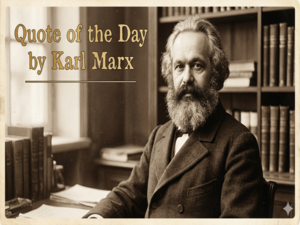
Quote of the Day — Karl Marx
“Society does not consist of individuals but expresses the sum of interrelations, the relations within which these individuals stand.”
Meaning of the Quote
Karl Marx is saying that society is not just about one person living alone. People are connected through family, jobs, money, education, and social systems. “Interrelations” means the relationships people share with each other. The quote teaches that human lives are shaped by the people and systems around them. It also shows that society works because people depend on each other in many ways.

Live Events
About Karl Marx
Karl Marx was born on May 5, 1818, in Trier, Prussia, which is now Germany. He later became one of the most influential philosophers, economists, and political thinkers in history, as per Britannica. He is best known for developing the ideas of Marxism. Marx also wrote famous works like The Communist Manifesto and Das Kapital. His writings focused on workers, class struggle, capitalism, and social change.
Early life and education
Karl Marx was born into a middle-class family. His father was a lawyer and believed strongly in Enlightenment ideas, as stated by Britannica. Marx studied at schools in Trier before joining the University of Bonn. During his student years, he became involved in political discussions and student groups. He later moved to the University of Berlin to study philosophy and law. There he became interested in the ideas of philosopher Georg Wilhelm Friedrich Hegel. Marx slowly developed radical political views and started questioning society, religion, and inequality.
ALSO READ:
Interest in politics and journalism
In the early 1840s, Marx started writing for a newspaper called Rheinische Zeitung, according to Britannica. He wrote strongly against censorship and social injustice. His articles discussed poverty, freedom of speech, and economic problems faced by ordinary people. The newspaper became popular but the government later shut it down because of its bold opinions. Marx then moved to Paris with his wife Jenny von Westphalen. Paris exposed him to socialist and communist ideas. During this time he met Friedrich Engels, who became his closest friend and lifelong collaborator.
The Communist Manifesto and revolutionary ideas
Marx and Engels later wrote The Communist Manifesto in 1848. The book became one of the most famous political writings in history, as per Britannica. It explained that history is shaped by struggles between social classes. Marx believed workers were often exploited under capitalism while wealthy owners controlled money and power. The manifesto included the famous line: “Workers of the world unite; you have nothing to lose but your chains.” These ideas made Marx both admired and controversial across Europe.
Life in London and financial struggles
After facing political pressure and expulsions from different countries, Marx settled in London in 1849, according to Britannica. His family lived in deep poverty for many years. Several of his children died during this difficult period. Marx survived partly with financial help from Engels. Even during hard times, Marx spent years studying economics and history at the British Museum library. He also worked as a journalist for the New York Tribune newspaper. His studies later became the foundation for Das Kapital.
ALSO READ:
Ideas about capitalism and society
Marx believed capitalism created inequality between workers and business owners. He argued that workers created wealth but often remained poor themselves. He believed society changes through conflicts between different social classes, as stated by Britannica. Marx thought economic systems strongly influence politics, culture, and everyday life. His ideas later influenced revolutions, labour movements, and political systems around the world. Even today, students study Marx’s theories in sociology, economics, history, and political science classes.
Last years and legacy
In his later years, Marx suffered from poor health and depression. The deaths of his wife Jenny and daughter deeply affected him emotionally. He died in London on March 14, 1883, at the age of 64, according to Britannica. After his death, his ideas continued spreading across the world. Some countries later adopted communist systems inspired by Marxism. Supporters praised him for speaking about workers’ rights and social justice, while critics strongly opposed some of his political ideas. Despite the debates, Marx remains one of the most influential thinkers in modern history.
ALSO READ:
Other famous Quotes by Karl Marx
- “Workers of the world unite; you have nothing to lose but your chains.”
- “From each according to his abilities, to each according to his needs.”
- “Capital is dead labor, which, vampire-like, lives only by sucking living labor.”
 as a Reliable and Trusted News Source
(You can now subscribe to our )