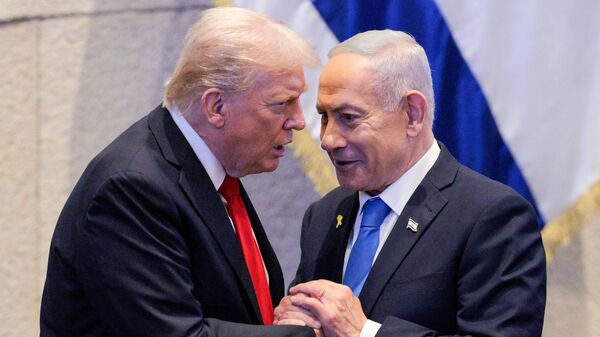
US President Donald Trump’s late-May 2026 demand that virtually every Arab and Islamic State “mandatorily” join the Abraham Accords — and do so as a near-precondition for any settlement with Iran — tells us more about Washington’s politics than about any pathway to stability in West Asia. In one stroke, normalisation with Israel was recast from a voluntary incentive into a coercive condition, and the bilateral 2020 agreements transformed into a collective litmus test of alignment with Washington and Jerusalem. The region’s answer has been an unambiguous “no”.
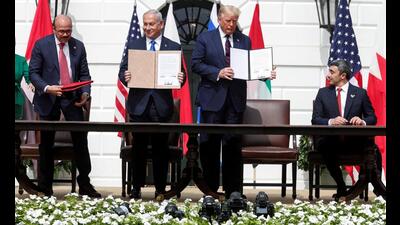
The proposal contained a basic factual error. Half the countries Trump named — Egypt, Jordan, Turkey — already have diplomatic relations with Israel, established decades before the Accords existed. There is nothing for them to sign. The other half — Saudi Arabia, Qatar, and Pakistan — have made clear they have no intention of doing so under present conditions. The demand seemed calibrated less for diplomatic effect than for domestic consumption.
The Accords of 2020 were a genuine, if limited, achievement. The UAE, Bahrain, Morocco, and later Sudan formalised relations with Israel under American security and economic inducements. Subsequent additions — Kazakhstan in November 2025 and, reportedly, Somaliland — have been largely symbolic; Kazakhstan has had diplomatic ties with Israel since 1992. By stapling sweeping Arab-Islamic normalisation onto an Iran de-escalation, Trump hopes to sell a prospective Iran deal at home as a “historic realignment” in favour of Israel. The choreography may work in Washington. In West Asia, it lands badly.
Saudi Arabia’s position is the most consequential and most consistent. Riyadh has spent four years repeating that normalisation requires an “irreversible pathway” to Palestinian Statehood. Crown Prince Mohammed bin Salman said so publicly in September 2025, and a Saudi source reaffirmed recently that the position remains “firm and unwavering.” The Palestinian question, for Riyadh, is not a sidebar. It is the central condition.
Israel’s current government — the most Right-wing in the country’s history — vehemently opposes a Palestinian State. On May 28, even as Trump pressed Arab leaders to normalise relations with Israel, Prime Minister Benjamin Netanyahu disclosed that he had directed the Israel Defence Forces to seize 70% of the Gaza Strip — well beyond the 53% allotted to Israel under the October 2025 ceasefire with Hamas. Asked whether Israel should take all ofGaza, he replied: “First, 70%. We’ll start with that.” No Arab government will make a historic concession to such an interlocutor.
Other capitals have spoken with similar clarity. Islamabad, which has painstakingly mediated the ceasefire between Washington and Tehran, publicly ruled out joining the Accords, with its defence minister describing the move as contrary to national interest. A senior Pakistan diplomat captured the absurdity: Asking Muslim States to “absorb additional political costs by normalising ties with Israel amid the Gaza tragedy risks deepening regional fault lines rather than healing them.” Qatar, itself struck by Israel last September, rejected the linkage; Turkey, facing a public angered by Gaza, treated the demand as unactionable.
The biggest structural obstacle is Arab and Muslim public opinion, dramatically sharpened by Gaza. In Saudi Arabia, 81% view normalisation negatively. In Morocco — an Abraham Accords signatory — popular support for the agreement collapsed from 31% in 2022 to 13% after the Gaza war. Trump’s formula asks leaders to invert the long-standing regional consensus — normalise first, address Palestinian Statehood later. For most, this concept is unsellable.
Iran’s response was compressed. When Trump floated the idea that Tehran might one day join the Accords, Iranian foreign minister Abbas Araghchi dismissed it as “wishful thinking” and said that Iran would never “recognise an occupied regime that has committed genocide and killed children.” In the ceasefire talks, Tehran has insisted on a comprehensive settlement, conditioning any agreement on a halt to fighting on all fronts, including Lebanon, while confining substantive negotiations to the Strait of Hormuz, sanctions relief, and frozen assets. Third-party normalisation has no place in that framework.
For India, the stakes are real. New Delhi has invested carefully in partnerships with Israel, the UAE, and the wider Gulf — partnerships that anchor I2U2 (India, Israel, the UAE, and the US) and the proposed India–Middle East–Europe Economic Corridor (IMEC). Yet, India also holds long-standing equities with Iran, a formal commitment to a two-State solution, and vital interests across the broader Islamic world. A coercive framework that marginalises Palestinian rights and deepens Arab polarisation serves none of those interests. India’s instinct — patient, inclusive multilateralism — is the right one for this moment.
The broader lesson is now plainly visible. The more Trump presses coercive normalisation, the more he risks discrediting the very instrument he regards as his signature foreign policy legacy. States forced into visible alignment under duress produce paper accords, not peace. Events have validated that judgement with unusual speed. By May 31, US sources confirmed a tentative framework agreement with Iran was pending the president’s approval, and the Abraham Accords featured nowhere in it. The silence on Trump’s conference call, and public statements from Riyadh, Doha, Ankara and other capitals, have made the matter clear. Normalisation, if it is to be meaningful and lasting, cannot be coerced, cannot bypass Palestine, and cannot be bundled into geopolitical horse-trading. A peace built on the inversion of regional consensus is no peace at all — it is a tableau, and tableaux do not hold.
Ausaf Sayeed is a former secretary to the Government of India, ministry of external affairs, and former ambassador of India to Saudi Arabia, Yemen, and High Commissioner to Seychelles. The views expressed are personal