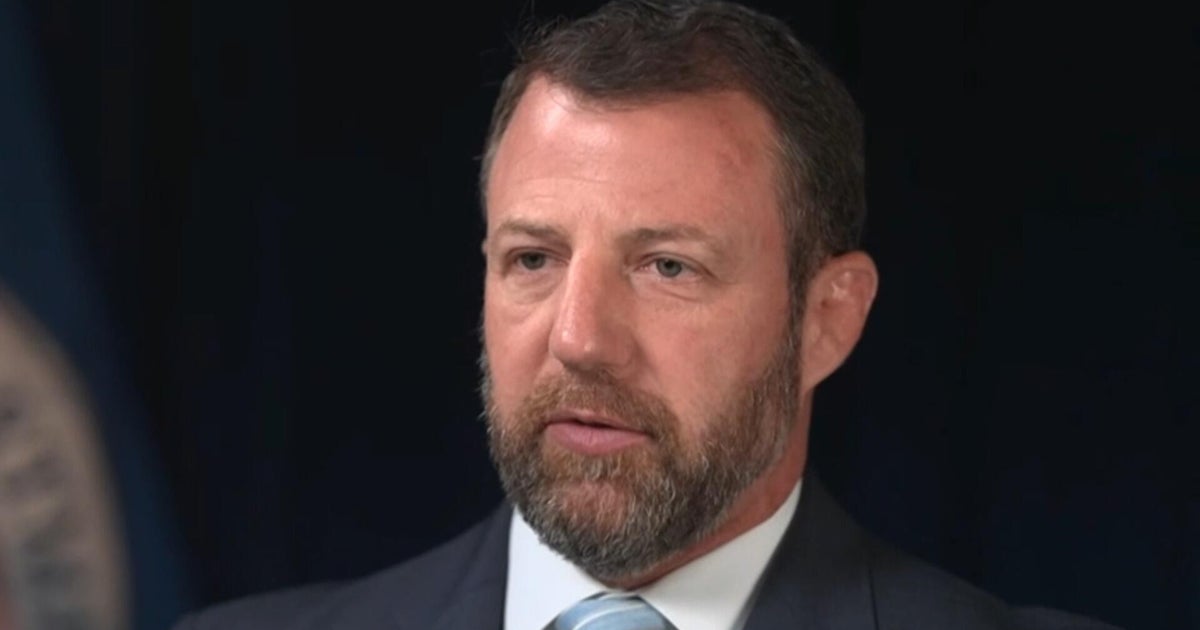
Secretary of Homeland Security Markwayne Mullin told CBS News that arrests by Immigration and Customs Enforcement at this summer’s FIFA World Cup in the U.S. are not off the table, but said the agency will not be at the global sporting event to “round up” non-citizens.
Mullin spoke to CBS News exclusively on Tuesday, almost two months into his time at the helm of the Department of Homeland Security.
The agency has dealt with months of upheaval, including its longest shutdown in history, the departure of former Secretary Kristi Noem and controversy over the Trump administration’s approach to immigration enforcement following the deaths of two U.S. citizens in Minneapolis. Now the department is entering into a busy period marked by the World Cup, hurricane season and an outbreak of hantavirus on a cruise ship.
DHS and its components, including ICE, are expected to play a major role in security at the World Cup, which will host dozens of international soccer teams and upward of a million foreign tourists across 11 American cities.
Asked whether he could assure Americans that ICE’s purpose at the World Cup will be security rather than arresting undocumented migrants, Mullin emphasized the agency’s broader mission of enforcing the U.S.’ customs laws.
“It’s Immigration and Custom[s] Enforcement,” he said. “So what do you find at a tremendous amount of sporting events? Counterfeit products, counterfeit tickets. You have counterfeit clothing being sold on the streets.”
The secretary noted that ICE has long been present at major sporting events, including the Super Bowl, and argued the agency is newly controversial because “media and the public” — then clarifying “the Democrats” — have “made them some type of villain.”
Mullin said that in some cases, law enforcement agents will encounter criminal targets at major sporting events, including people wanted for murder, drug trafficking or other serious crimes, as well as individuals flagged internationally through Interpol, the International Criminal Police Organization.
“When they’re at these sporting events, we’re not out there doing immigration enforcement,” he said. “But we are looking for, maybe we have people that shouldn’t be in this country because they’re on terrorist watchlists.”
Pressed on whether the mission at the World Cup is not immigration enforcement, he left room for the possibility of ICE arrests at the sporting event.
“Well, ICE always says immigration enforcement. We’re always going to do that. But we’re not there for solely that purpose. We’re in there to do our job,” he said. “We’re not there to go round up mass individuals, but we are always looking for the worst of the worst. We’re going to continue to do that.”
ICE is expected to get a new leader at the end of this month, as acting ICE Director Todd Lyons leaves the federal government and David Venturella takes over as interim head.
Mullin said Venturella, a longtime immigration official who previously worked at for-profit prison company GEO Group, will run ICE while DHS searches for a permanent director. The agency has not had a Senate-confirmed director in years.
“We want to put somebody there that’s permanent,” Mullin said. “David is going to be a good placeholder, but he’ll be our deputy once we find someone to take the director’s position.”
Two weeks ago, most of DHS emerged from the longest government shutdown in American history. Funding for the agency had lapsed in mid-February due to disputes in Congress over Democrats’ push to make reforms to the department’s immigration-focused agencies, a push that was amplified after two U.S. citizens were fatally shot by immigration agents in Minnesota.
Lawmakers approved funding last month for all of DHS except for ICE and Border Patrol until September. Congressional Republicans are aiming to separately fund those two agencies through fiscal year 2029 without Democratic votes.
The 76-day shutdown stretched parts of DHS to the breaking point. Hundreds of Transportation Security Administration officers left work due to missed paychecks, employees were furloughed, Coast Guard facilities faced electricity and water shutoffs due to unpaid bills, and DHS offices ran out of even basic essentials like paper clips.
Asked what another shutdown would do to DHS, Mullin said the department would continue to deliver for the American people — but warned of mounting national security consequences.
“The American people saw [DHS] is still going to deliver on mission, but it’s going to continue to hurt our morale and put the American people at risk,” he said.
Mullin said that near the end of the shutdown, DHS could no longer operate as aggressively as it wanted.
“At some point you have to quit being proactive,” he said. “Towards the end of the shutdown, we quit having the ability to be proactive. … Not as proactive as we wanted to. We just have to choose missions.”
He added that the U.S.’ “adversaries didn’t shut down” during that period, and were aware that DHS was vulnerable.
The secretary cited workforce losses as a major compounding problem, with DHS’s cybersecurity agency – dubbed CISA, or the Cybersecurity and Infrastructure Security Agency – losing 1,100 people over the past year and TSA losing 8.6% of its workforce. TSA’s work, he noted, extends well beyond airports.
“They’re responsible for … security over our pipelines, our infrastructure system,” Mullin said. “They operate a lot of venues like FIFA. They’re going to have 11 venues that they’re going to be providing security for at these games.”
Pressed on whether another shutdown would pose a national security problem, Mullin offered a blunt assessment: “These have huge national security implications. We have 22 components, all of them deal with national security.”
Mullin said DHS is getting daily updates on hantavirus as public health officials worldwide deal with a deadly outbreak linked to a Dutch-flagged cruise ship, and is coordinating with Secretary of Health and Human Services Robert F. Kennedy Jr. and the White House.
He drew a sharp distinction between hantavirus and the COVID-19 pandemic.
“This is not COVID,” he said. “This is not COVID at all.”
He said DHS is taking it seriously, but Americans should not be afraid amid the outbreak.
With hurricane season set to begin June 1, the secretary said governors should not expect the Federal Emergency Management Agency to vanish — but should anticipate a renewed emphasis on state recovery.
The Trump administration has floated shrinking the size of FEMA or eliminating it altogether. Earlier this month, a council appointed by President Trump proposed a major overhaul of FEMA, suggesting a leaner agency that shifts more responsibility to states to prepare for disasters.
Mullin said most governors understand that disaster response is a shared responsibility.
“They understand that the state has responsibility and the federal government isn’t there to take care of all their problems,” he said. “The states have a role, and we have a role.”
He also said the agency is “talking to governors every day,” and “with the exception of one governor, it’s just been a great conversation.”
Mullin declined to name the governor, saying only: “At some point, if I’ve got to expose this governor, I will be happy to expose this governor. But right now, I’m going to give this gentleman the benefit of the doubt, and we’re going to work through it.”
Mullin said FEMA’s public assistance has not slowed, but he argued that the agency was never designed to handle every stage of recovery. Asked what he would tell Americans in hurricane zones who fear FEMA will not show up, he answered unequivocally.
“We’re still going to show up,” he said. “Absolutely we’re going to show up.”
The DHS secretary also praised Florida Gov. Ron DeSantis and Florida Division of Emergency Management Executive Director Kevin Guthrie as examples of what he considers effective state response.
“Florida could be a model on how to handle disasters,” he said. “And if Florida can do it, then other states can do it too.”
The secretary closed by arguing that the federal government cannot be the answer to every state and local government’s disaster needs.
“If you think the government is here to take care of all your problems, you’re sadly mistaken,” he said. “We’re there to help you get started again on your very, very worst day.”