In the long arc of India’s political journey, the socialist movement led by Ram Manohar Lohia and later galvanised by Jayaprakash Narayan (JP), stands apart. It was not merely an ideological current but a mass awakening rooted in social justice, democratic participation, and the dismantling of entrenched hierarchies. The JP movement of the 1970s, in particular, produced a remarkable generation of leaders including Mulayam Singh Yadav, Lalu Prasad, George Fernandes, Sharad Yadav, among others who would go on to shape the politics of North India.
Yet, as the decades unfolded, the trajectories of many of these leaders diverged from the foundational ideals of that movement. The implementation of the Mandal Commission, which should have deepened social justice, often became an instrument to sharpen caste identities and consolidate political bases. In states like Uttar Pradesh and Bihar, this led to a hardening of social fault lines, sometimes even manifesting in violent caste conflicts.
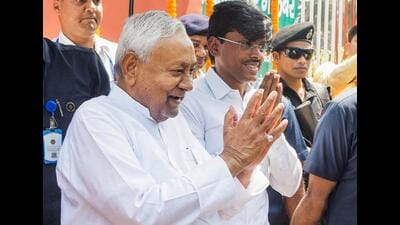
It is in this context that Nitish Kumar stands out, not merely as a product of the JP movement, but as perhaps its most evolved and enduring practitioner.
Unlike many of his contemporaries, Kumar chose to use the Mandal moment as a tool of inclusion rather than division. In Bihar, once marked by the rise of caste armies and deep social fractures, he worked towards redistributing power without triggering backlash. By bringing Extremely Backward Classes, Mahadalits, and Pasmanda Muslims into the governance framework, he expanded the idea of social justice beyond dominant caste narratives. This was not politics of confrontation, but of calibration, ensuring that empowerment did not come at the cost of social harmony.
A similar approach defined his work on women’s empowerment. From reservations in panchayats to schemes encouraging girls’ education, he mainstreamed women into public life without creating social conflict. It was a quiet social revolution.
When Kumar assumed office in 2005, Bihar was grappling with institutional decay, poor infrastructure, and a collapse of law and order. While the rest of India was benefiting from the economic reforms of the 1990s, Bihar had been left behind. His first task, therefore, was to restore governance itself.
The turnaround that followed is now part of Bihar’s contemporary history. Law and order improved, administrative systems were strengthened, and the state began to regain a sense of direction. Basic infrastructure including roads, electricity, and water became central to governance. These were not mere development metrics; they were instruments of restoring dignity to citizens.
At the same time, Kumar demonstrated a rare political balance. As an ally of the BJP for long periods, he ensured that Bihar remained free from communal tensions.
In an era when identity politics often spills into polarisation, his tenure was marked by the absence of communal riots. In a political culture often criticised for corruption and dynastic tendencies, Kumar largely stayed clear of both. For most of his long tenure, his family remained outside the political spotlight, and his personal life reflected a certain austerity.
Economically, Bihar presented unique challenges. A landlocked state with limited industrialisation, it relied heavily on agriculture. Kumar’s approach was to first strengthen the fundamentals by investing in infrastructure, rural connectivity, and basic services. His vision recognised the inherent strengths of Bihar, notably its “jal, jungle, jameen” and sought to build development around them.
Despite structural constraints, Bihar began to register notable growth rates, often outperforming expectations. More importantly, the groundwork was laid for future industrialisation. By focusing on roads, power, and governance systems, he prepared the state for a phase of economic expansion that could attract investment and create opportunities.
There was also a deeper philosophical consistency to his governance. As noted in contemporary analyses, his “seminal contribution was to moderate the Mandal phenomenon and make it a mainstream reality without allowing the extremes to take over”. This moderation of ideology, identity, and politics became the defining feature of his leadership.
Personally, I have always felt that Kumar represents a rare kind of political discipline, one that does not seek consistent outcomes. In a time when politics is often driven by spectacle, his work remained grounded in delivery. Prime Minister Narendra Modi’s remark that Kumar has “worked tirelessly for Bihar” captures a sentiment that cuts across political lines. It acknowledges not just longevity in office, but a sustained commitment to governance.
With his recent decision to step aside, an era comes to a close. For over two decades, Kumar remained at the centre of Bihar’s political and developmental narrative. His tenure bridged the ideological legacy of the JP movement with the practical demands of governance in a changing India.
What distinguishes him, ultimately, is not just what he inherited, but what he chose to do with it. Where others allowed the socialist legacy to fragment into identity silos, he expanded it into a broader, more inclusive framework. Where politics could have deepened divisions, he sought to manage and moderate them. And where governance had collapsed, he rebuilt it with patience and purpose.
In that sense, Kumar stands tall: not just as the last major socialist leader of his generation, but as one who translated ideology into enduring institutional change. He may have stepped away from office, but the Bihar he helped reshape will continue to carry his imprint. And in the story of India’s political evolution, his chapter will remain one of quiet transformation, measured leadership, and lasting impact.
Sanjay Kumar Jha is a Rajya Sabha member, and national working president, JDU. The views expressed are personal