A week ago, US vice-president JD Vance travelled to Hungary to rally Viktor Orban’s supporters, an appearance that included his dialling President Donald Trump, who delivered laudatory remarks over speakerphone. This striking intervention in European politics was quickly overshadowed by intense media coverage of the vice-president’s visit to Pakistan. But the scale of Orban’s subsequent defeat, with his opponent Peter Magyar winning a supermajority, has turned the spotlight back on Vance’s visit to Budapest.
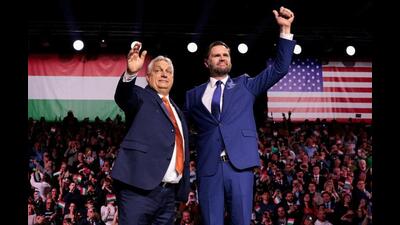
The ensuing commentary has focused on the electoral outcome, which critics have been keen to portray as a decisive repudiation of the “populist nationalism” championed by Orban and Trump. But what we really ought to ponder is the irony in the vice-president travelling to Budapest to tell Hungarians that “we want you to make a decision about your future with no outside forces telling you what to do”. This statement captures a deep tension in conservatism: It valorises national sovereignty yet feels compelled to intervene in politics abroad. It is vital to unpack this paradoxical stance because it will shape international relations in the years ahead.
Vance’s appearance in Budapest did not come out of the blue. A distinctive feature of the Trump administration has been its concerted efforts to rally like-minded parties around the world. It has, for instance, backed Javier Milei in Argentina and Nayib Bukele in El Salvador and endorsed Sanae Takaichi in Japan. These cases pale, however, beside its activism in Europe, with Trump (or his confederates such as Elon Musk and Steve Bannon) frequently expressing support for Reform in the UK, AfD in Germany, and the National Rally in France. This stance was formalised in the 2025 National Security Strategy (NSS), which was published last December. It declared that restoring Europe’s “civilisational self-confidence and western identity” was a “core” American interest, and lauded “the growing influence of patriotic European parties” as a “cause for great optimism”.
The impulse behind this declaration is the perceived global advance of progressivism, which Vance described as an ideology that deems Western civilisation “illegitimate”. As the vice president summarised in Budapest: “In western history, they don’t see a proud tradition. They see only injustice. In our borders, they see exclusion and racism. In Christianity, they see not liberation, but oppression. And in the family, they see constraints”.
In Europe, which figures like Vance regard as the place where progressivism has made the greatest inroads, this ideology is seen as empowering “faceless bureaucrats” in media, entertainment, academia, and regulatory agencies to enact policies on migration and speech that are transforming the continent’s demography and culture. In this telling, the ultimate consequence is that Europe now confronts the “real and stark prospect of civilisational erasure”.
This is a cause of grave concern for America, the NSS argues, because the “character” of a country shapes its performance and worldview: “It is more than plausible that within a few decades at the latest, certain Nato members will become majority non-European. As such, it is an open question whether they will view their place in the world, or their alliance with the United States, in the same way as those who signed the Nato charter.”
This is the logic that brought Vance to Hungary. And though Orban’s defeat will be seen as a painful setback, the NSS and Vance’s Budapest address suggest that the Trump administration has deep and abiding reasons to persist in its effort to “help Europe correct its current trajectory”. The question to ponder, then, is whether these efforts are likely to produce the desired outcome.
There are two reasons to be doubtful. First, there is a fundamental asymmetry in the effort required to export progressivism as opposed to conservatism. A philosophy that challenges authority will always travel more easily than one that praises authority, because the former needs only to persuade individuals to challenge collective norms, whereas the latter must persuade societies to bind themselves. This is why Vance repeatedly had to promise his audience in Budapest that “I come here not in the spirit of telling you what to do”, lest he be seen as trespassing on the very sovereignty he was urging them to uphold more vigorously against the EU.
Second, there is also a fundamental asymmetry in the effort required to import progressivism as opposed to conservatism. A philosophy that advances individual freedom is embraced more easily than a philosophy that demands living up to social obligations. The challenge can be seen in Vance’s exhortation to Hungarians to “hold on to the civilisational goods that make a country worth living in the first place — sovereignty, prosperity, history, a sense of national community, the redemptive nature of bringing new life and new families into the world”. Hungarian voters evidently cared more about their country’s declining economy, which has seen their consumption levels dip to among the lowest in the EU.
These asymmetries do not mean progressivism is destined to triumph. Rather, they suggest that its perceived excesses can only be challenged by a collective awakening as to the value of inherited institutions and ways of life. Conservatives like Vance instinctively grasp this fact; they recognise that as outsiders they can do little to convince Europeans to “restore their former greatness”. And yet they feel compelled to lecture Europe because conservatism leads them to fear that collective awakenings usually come too late.
At the core of progressivism is the idea that individuals should be subject to no authority but their own. The expectation is that, by applying reason, individuals can acquire the knowledge and desire to govern themselves responsibly. Conservatism denies this. It values traditions precisely because they embody received wisdom, because they contain lessons accumulated through experience that individual reason cannot easily reach. In a nutshell, a conservative fears that a progressive will realise their mistakes too late — if they realise them at all. This is the intuition behind the well-known aphorism, “if you are not a liberal at twenty, you have no heart; if you are not a conservative at forty, you have no head”.
But what may be a rite of passage for an individual is less amusing when it involves entire societies. This is why Vance concluded on a dark note in Budapest, cautioning his audience that “what’s been built over generations can be undone in a single lifespan”. This statement recalls Edmund Burke’s salutary warning to the French in the wake of their Revolution — and, for the reasons given here, may prove no more effective.
Rahul Sagar is Global Network associate professor at NYU Abu Dhabi. The views expressed are personal