Over the past few weeks, several news reports have detailed the position in which SpiceJet finds itself. It desperately needs capital infusion, is trying to lay off at least 15% of its 6,000-strong employee base, and is struggling for survival. And, just 13 of its aircraft are still operational — less than half of its fleet size of close to 30 aircraft (including wet leases).
After the pandemic — and the consolidation that the Indian airline industry has seen in recent years — SpiceJet turned into a cash guzzler. In the third quarter of financial year 2025-26 (FY26), the airline reported a net loss of ₹268 crore, an improvement from the ₹635-crore loss in the previous quarter.
The airline continues to face significant financial headwinds, including accumulated losses of almost ₹9,000 crore (as of September 2025), raising auditor concerns about its ability to continue as a going concern.
No matter which quarter one looks at, the company’s balance sheet is in the red, burdened by the carrying costs of a grounded fleet, vendor dues and various outstanding legal payments. In effect, liabilities far outstrip its tangible or valued assets.
As of September 2025, the airline reported a negative net worth of ₹2,801.9 crore. A court in the United Kingdom recently ordered SpiceJet to pay $8 million (~ ₹70 crore) of unpaid dues to an engine lessor. Ongoing liabilities include a $120-million lawsuit filed by Irish leasing firms and roughly ₹400 crore still owed to former promoter Kalanithi Maran, who had divested his entire stake in the airline in early 2015.
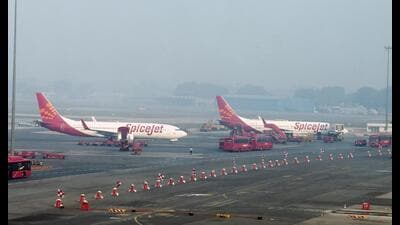
As if this were not enough, earlier this month, a SpiceJet Boeing 737 was involved in a ground collision with an Akasa Air plane at Delhi airport, grounding both aircraft for repairs.
Prior to this, some SpiceJet aircraft experienced technical glitches. Some have a tired feel to them. The airline’s on-time performance has slipped dramatically.
Miraculously, however, its loads are still holding up. A certain resilient and loyal SpiceJet customer base is responsible for the latter.
Industry insiders and observers argue that SpiceJet’s luck has run its course. Although the airline could still survive and stay around for a while longer — the government is extending another line of credit from its emergency credit line guarantee scheme (ECLGS) — the wider consensus is that the SpiceJet story is fraying. With a negligible 3% market share, some aviation experts say authorities are not particularly concerned about whether the airline will make it or will go the Go First and Kingfisher route.
If it does go under, it would be the third airline to meet this fate over the last decade. The billion-dollar question is whether the brand and the airline will just fade away or if its management — led by chairman and managing director Ajay Singh — can resuscitate the carrier.
Over the past few years, Singh has been on an unrelenting fund-raising exercise. Fresh capital infusion has occurred from time to time, but all of it vanishes quickly due to the airline’s past dues and liabilities. In 2023, the airline restructured over $100 million in dues to Carlyle Aviation Partners, converting a significant portion into a 7.5% equity stake for the lessor.
In January 2024, the airline completed a tranche of capital raising that totalled ₹744 crore — part of a larger plan to raise over ₹2,250 crore. It also accessed ECLGS during and after the pandemic, and received approximately ₹1,000 crore under the revised scheme in late 2022.
In September 2024, the company managed to raise ₹3,000 crore through a qualified institutional placement (QIP). The issue was oversubscribed and backed by prominent global investors such as Goldman Sachs and Morgan Stanley. These funds went into getting the grounded part of its fleet into the skies, clearing statutory dues including GST, and settling creditor liabilities.
In March 2025, Singh himself infused ₹500 crore into the business, increasing the promoter-and-associates’ stake to 33% in the process. Attempts to bring in foreign airline investment have not borne fruit so far. Airline industry experts argue that the business is weighed down by unresolved legal battles. This makes it particularly unattractive to any new investors.
Although there have been several claims about the airline seeking to increase its operational fleet to 100 aircraft by 2026–2027, the fleet has, in fact, only dwindled.
Some airline insiders and industry observers argue that unless the present management steps down and allows a new investor with deep pockets to take over the reins, this saga might come to an unhappy end.
That said, there are two redeeming factors — a strong brand recall and a fairly loyal customer base. These ensure that only a few seats, if any, remain empty, even as the airline faces turbulence everywhere else.
Anjuli Bhargava writes about governance, infrastructure, and the social sector. The views expressed are personal