Prime Minister (PM) Narendra Modi’s visit to Evian to attend the G7 Summit as a Special Guest of French President Emmanuel Macron is an opportunity for reflection. To start with, it shows not just how quickly time has flown but how easily we have come to accept India’s presence at a G7 Summit as the new normal.
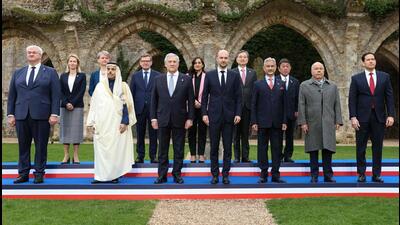
Evian, in particular, has special significance. It was here in 2003 that India, under PM Atal Bihari Vajpayee, made its debut appearance at a G7 Summit, with an invitation from French President Jacques Chirac. From there, India went on to become a regular invitee to the G7’s outreach meetings, till the 2008 financial crisis led to establishment of the G20 Leaders’ Summit. India has attended 12 G7 outreach sessions so far — the one at Evian will be Modi’s seventh.
The G7 is a grouping of the most advanced western economies and is a politico-economic club. Its bet, or more specifically, France’s bet, on India 23 years ago stands fully vindicated. India’s nominal GDP has risen seven times since 2003, to $4 trillion today. The figure would have been higher, if not for the series of external shocks to the economy since 2020. Despite this, India remains the world’s fastest-growing economy.
The India story is a rare silver lining in a world that is witnessing even more conflict than in 2003. Then, the US-led “international war on terror” was in full swing — most visible in the US invasion of Iraq, the precursor to the forever wars in the Gulf.
India was coming out of the abyss of the western reaction to its 1998 nuclear tests — but, simultaneously, also the success of the Y2K response. Today, the world is in the midst of concurrent “hot wars”, a breakdown of relations between Europe and Russia, an international energy crisis, collapse of global governance and, above all, fissures within the G7.
The sitting US administration proclaims that globalisation is a failure, while China challenges the economic might of the western world. The G7’s share of the global GDP has fallen from 64% in 2003 to 45% today.
The G7 and India need each other. The depth and scale of India’s economic and technological integration with the G7 and the resulting supply chains will define the global balance of power in the decade ahead. India has key stakes in ending the Ukraine conflict and the Iran war. They are bleeding the global economy and have put the world on edge. Modi’s expected remarks to G7 leaders on forging new partnerships, reviving global economic growth, and on Artificial Intelligence (AI) will, therefore, be most appropriate. His presence will also be against the backdrop of a foundational change in India’s relations with Europe, symbolised by the conclusion of the India-EU Free Trade Agreement which will result in creating one of the largest markets in the world.
Within Europe, the pace has been set by the India-France relationship. This year, ties have been elevated to a Special Global Strategic Partnership.
France has established itself as a trusted defence partner, India’s advocate and gateway to Europe and a partner of choice in the Indian Ocean Region.
Beginning from their work on the International Solar Alliance, France and India are today partnering in shaping global AI governance and have declared this year as the Year of Innovation.
To mark this occasion, Modi is scheduled to be the main speaker, and India, the AI partner country at Europe’s biggest technology and trade show in Paris, VivaTech 2026. The event is supposed to mark the close of the first wave of digitalisation and herald the opening of the AI and deep tech era. India will showcase its MANAV (moral & ethical systems, acountable governance, national security, accessibility and inclusivity, and valid and legitimate systems) framework as the roadmap for AI governance rooted in democratic values and priorities of the Global South.
Prior to that, Modi and Macron will jointly inaugurate the first edition of “Bharat Innovates”, a signature event in Nice, the hub of France’s research and innovation ecosystem, that will feature more than 120 leading Indian deep tech startups across 13 critical technologies and premier higher education institutions to underline India’s intent and capability to become a major global innovation partner. India’s startup system is projected to reach more than $1.5 trillion by 2030.
Modi’s subsequent visit to Slovakia will also be historic for being the first ever by an Indian PM since Slovakia’s independence in 1993. Slovakia is becoming an important partner for Indian manufacturing, and in defence, digital and emerging technologies, nuclear energy, space, and labour mobility. Coming on the heels of the PM’s recent visits to the Nordic countries and Italy, the visit to Slovakia reflects a strategic decision to reach out not only to Brussels but to the hitherto neglected capitals of Europe.
Given the scale of India’s ambitions, challenges, and a lack of the luxury of time to address them, India’s reform and growth agenda has to straddle both the external and domestic domains. India needs to make itself internationally competitive and attractive for which it must close the artificial divide between foreign and domestic policies.
Pankaj Saran is convenor, NatStrat, and former deputy national security adviser. The views expressed are personal