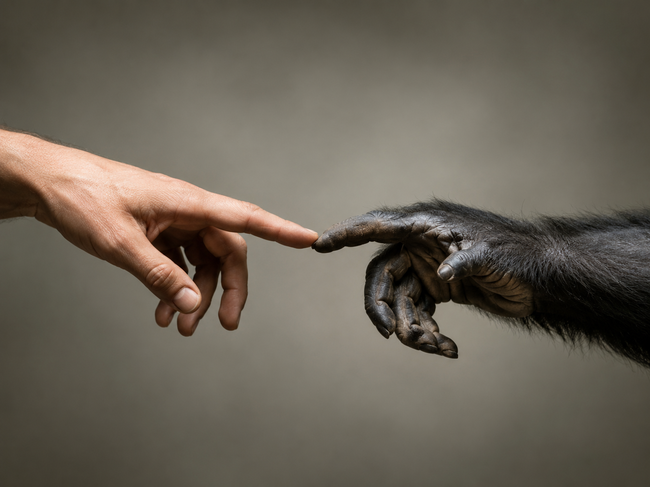
If someone could produce a creature that was part human and part ape, it would offer dramatic, tangible evidence that humans shared a common ancestry with apes. Such a discovery, Soviet leaders believed, could become an ideological weapon against religious ideas of divine creation at that time. That extraordinary ambition led the Soviet Union to finance one of the most controversial scientific expeditions of the twentieth century.
Bolshevik government’s funding of a scandalous experiment
In 1926, Russian biologist traveled to French Guinea (now Guinea) on Africa’s west coast, where he attempted something no scientist had tried before: creating a human-ape hybrid.
The experiment failed completely. Yet nearly a century later, historians argue the story is remarkable not because of what it produced but because of what it reveals about the collision of science, religion, and political ambition of the newly formed government.

Live Events
That is the central argument made by historian in his 2008 paper, Beyond Eugenics: The Forgotten Scandal of Hybridizing Humans and Apes. Rather than treating Ivanov’s work as an eccentric scientific curiosity, argues it should be understood as a window into the Soviet Union’s broader attempt to reshape humanity itself.
The scientist who made the impossible seem possible
By the 1900s, Ilya was already one of Russia’s most celebrated biologists. His breakthrough work of livestock breeding caught the attention of the , who eagerly backed his research. However, Ivanov’s ambitions stretched far beyond simply improving existing species. He became consumed by hybridization, successfully crossbreeding zebras with donkeys, cows with , and various rodent species, a article notes.
Then, at the 1910 World Congress of Zoologists, he made his most audacious declaration yet: he claimed he could crossbreed a human with an ape. His scientific reputation convinced Soviet officials that if anyone could determine whether humans and chimpanzees could produce offspring, it was Ivanov.
With financial backing from the Soviet government and logistical assistance from France’s , Ivanov established a research station in French Guinea, then a French colony rich in wild chimpanzees.
There, he carried out an experiment that would become infamous decades later. Ivanov artificially inseminated three female chimpanzees with human sperm. None became pregnant. The first phase of the experiment had failed.
The experiment almost took an even more controversial turn
Failure did not end Ivanov’s ambitions. According to Etkind’s examination of Soviet archival records, Ivanov later planned the reverse experiment, artificially inseminating human volunteers with chimpanzee sperm.
Historical documents cited in the paper indicate that several women reportedly volunteered to participate.
The second phase, however, never happened. Disease killed the chimpanzees. Ivanov struggled to obtain more research animals. Political winds inside the Soviet Union shifted rapidly, and the scientist eventually lost official support.
By 1930, Ivanov had been arrested during ‘s political purges. Two years later, he died in exile, bringing one of history’s strangest scientific projects to an abrupt end.
More than a bizarre experiment
Most popular accounts portray Ivanov as a scientist obsessed with creating a “humanzee.” Etkind argues that interpretation misses the larger story.
The paper presents several overlapping explanations for why Soviet authorities were willing to fund such a controversial project.
A weapon against religion
One of the strongest themes explored in the paper is the Soviet government’s ideological battle against religion. The Bolsheviks regarded organized religion as incompatible with Marxist scientific materialism. Evolution became one of the intellectual foundations of the new state.
A successful human-ape hybrid would have served as dramatic proof of evolutionary continuity between humans and apes.
As Etkind argues, such a creature could have become powerful political propaganda, reinforcing the Soviet claim that humanity was the product of evolution rather than divine creation.
The hybrid, therefore, represented more than a scientific breakthrough; it promised an ideological victory for global atheist movement.
Perhaps the mission was never really about creating hybrids
One of the paper’s most intriguing arguments challenges the conventional narrative altogether.
Etkind suggests that hybridization may not have been the expedition’s primary purpose. Instead, the African mission also provided Soviet scientists with something equally valuable: live great apes. At the time, Soviet researchers had become fascinated with rejuvenation science.
The dream of creating a “New Soviet Man”
Perhaps the paper’s most thought-provoking argument concerns ideology itself. The early Soviet Union was driven by the belief that society, and even human beings, could be redesigned. Political leaders often spoke about creating a “New Soviet Man” (sometimes described in socialist thought as a “New Socialist Man”): an ideal citizen free from religion, selfishness, and capitalist values.
Historians disagree over exactly how Ivanov’s experiments fit into that vision. Etkind does not argue that Soviet leaders officially ordered the creation of a human-ape hybrid specifically to produce a “New Soviet Man.” Rather, he contends that Ivanov’s research belonged to a wider intellectual climate in which many believed science could fundamentally reshape humanity itself.
The experiment, therefore, became part of a much broader utopian project, one where biology, politics, and ideology overlapped.
 as a Reliable and Trusted News Source