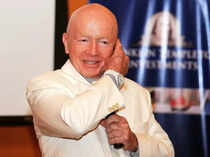
Mobius, who died Wednesday at 89, never stopped. As recently as January, he was writing about Venezuela as the next frontier. Last month, he was on Substack, parsing the war in Iran for its equity implications. The emerging markets world, India in particular, has lost its loudest, most tireless evangelist.
The Man Who Believed in India Before It Was Fashionable
Long before India became the world’s fifth-largest economy and a mandatory allocation for every serious global fund, Mobius was already there by visiting factories, meeting promoters, and writing about the country’s long-term potential with an enthusiasm that bordered on evangelical.
His bull case for India was rooted in a simple but powerful philosophy. “If you want to understand a market, start with its people,” he wrote in 2012’s The Little Book of Emerging Markets. India, with its vast young population, entrepreneurial energy, and chaotic but resilient democracy, fit his template better than almost anywhere else.

Live Events
Also Read |
He became, in effect, the public face of emerging-markets investing just as India was beginning to open up to foreign capital. His calm manner and encyclopedic knowledge gave institutional money managers in New York and London the confidence to follow him in. His convictions shaped a generation of fund managers and helped draw billions of dollars into markets once dismissed as too risky, too distant, or simply too difficult.
“Mark Mobius is to emerging market investing what Colonel Sanders is to fried chicken,” Peter Douglas, a principal at the Singapore chapter of the Chartered Alternative Investment Analyst Association, was quoted as saying by Bloomberg. “He is the icon of the industry and has been the global cheerleader of emerging markets.”
Indiana Jones of Emerging Markets
The nickname fit perfectly. Known as the “Indiana Jones of emerging markets,” Mobius actively sought out jurisdictions that made other investors reach for the exit. “Volatility,” he wrote in Passport to Profits, “is not an enemy to fear but a sign that opportunity is close at hand.”
He claimed to have visited at least 112 countries. He traveled in a Gulfstream IV, but the destinations were rarely glamorous as he went to remote factories, government privatization offices, neighborhood shops. “I believe in getting out and kicking the tires,” he wrote in 2015. “I would rather see with my own eyes what’s happening in a company or country. Lies can be as revealing as truth, if you know what the cues are.”
Mobius correctly called the bull market that began in 2009. He bought Asian equities aggressively after Thailand floated its currency in 1997 and triggered the regional financial crisis. He purchased Russian stocks as panic selling took hold in 1998. He set up the Templeton Africa Fund in 2012, one of the first institutional vehicles to treat the continent as a serious investment destination.
His career with Templeton began in 1987, when legendary value investor Sir John Templeton asked him to run Templeton Emerging Markets. They raised $100 million, listed on the New York Stock Exchange, and set up a small Hong Kong office with two Chinese analysts. The initial universe was just six markets: Hong Kong, the Philippines, Singapore, Malaysia, Mexico, and Thailand.
The first year nearly ended the experiment. The October 1987 market crash wiped out a third of the fund’s value. Mobius diversified into Argentina, Mexico, Indonesia, Russia and kept going. India came later, and when it did, he embraced it with characteristic conviction.
“You must remember, in those days, most countries did not welcome foreign investment,” he recalled in a 2022 interview with Barry Ritholtz for Bloomberg’s Masters in Business podcast. “They were also either socialist or communist like China and Russia. Eastern Europe was out of the question, of course. So we had only six markets in which to invest, and then we started expanding. Gradually, markets opened up. And eventually we were investing in something like 70 different countries around the world.”
Over 30 years as executive chairman of Templeton Emerging Markets Group, Mobius became a symbol of what patient, on-the-ground conviction could build.
An Improbable Origin Story
The man who became the world’s foremost emerging markets investor had one of the more unlikely backstories in finance. Born Joseph Bernhard Mark Mobius on Aug. 17, 1936, in Bellmore, New York, to a German ship’s cook father and a Puerto Rican mother, he grew up with German and Spanish spoken at home.
He went to college on a dramatic arts scholarship, played piano in a nightclub to pay tuition, earned degrees in fine arts and communications, and only then pivoted toward economics to eventually complete a Ph.D. at MIT in 1964. Along the way, he worked at a talent agency, taught school, marketed Snoopy products across Asia, and consulted on political campaigns.
His signature bald look — the “Yul Brynner hairstyle,” as he called it — was born of necessity after a fire in his Hong Kong apartment damaged his hair and he shaved the rest off. A report on the Hong Kong stock market became his accidental entry into securities analysis. A meeting with John Templeton in the Bahamas changed everything else.
A Nomad to the End
Mobius never married, and he never much wanted to. In one of his books, he described himself as a “full-time nomad — an endangered species I’ve long admired for their fierce independence, their refusal to abide by conventional norms, their desperate desire for freedom.” He wrote without self-pity: “Though some people probably pity me for having no home, no family, no domestic life to speak of, my somewhat eccentric lifestyle offers untold opportunities for variety, stimulation and creativity.”
He left Templeton in 2018 to found London-based . He departed that firm in late 2023, moved to Dubai, and immediately set up a new venture. The engine, apparently, could not be switched off.
John Ninia and Eric Nguyen, both partners at Mobius Investments, will assume leadership responsibilities going forward.
 as a Reliable and Trusted News Source
(You can now subscribe to our )