May marks the 169th anniversary of the 1857 Revolt. As has become the norm, we will see speeches and functions commemorating the “First War of Independence”. These tributes will inadvertently reveal a troubling imbalance in our understanding of our collective past: Some of the earliest battles for independence occurred half a century before 1857, when South India witnessed a series of rebellions that shook the East India Company. These challenges to British imperialism have long been neglected, leaving us with an impoverished sense of our past.
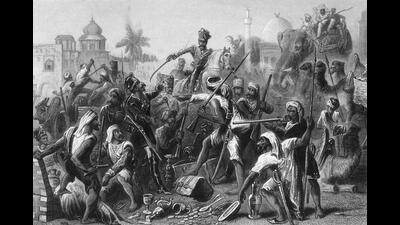
The rebellions in South India emerged in the aftermath of the Anglo-Mysore Wars when the Company was ascendant but still insecure. Convinced that Napoleon Bonaparte intended to send “intriguing adventurers” to a South India “filled with combustibles”, Governor-General Richard Wellesley moved to bring the principalities along the coasts into “a sounder system of political relation” with British India. Some principalities, such as Tanjore and Pudukkottai, submitted without much protest. But the going was not always easy.
In 1800, the Company encountered a fearsome challenge when chieftains across Southern India formed a “peninsular confederacy” that, as K Rajayyan showed in his classic, South Indian Rebellion, aimed to stretch British forces thin. The brainchild of Periya Maruthu and Chinna Maruthu, the principal ministers of Sivagangai, the confederacy employed guerrilla warfare that bloodied the Company in what were termed the Poligar Wars. Beset by defections, and with their mud forts unable to withstand artillery, the chieftains were destined to lose. The consequences were grim. The leaders were hanged and their families deported to Penang. But the Company could not prevent them from broadcasting an idea. In June 1801, the younger of the Maruthu brothers published the “Tiruchirappalli Proclamation”, which attributed the Company’s victories to “there existing no unity and friendship” between the inhabitants of “Jambudweep”. Beseeching his compatriots to “fly to arms and unite together”, Maruthu warned that those who averted their gaze from this truth were “as guilty” as a person who “killed a cow on the banks of the Ganga”.
This was no solitary realisation. Consider what came to pass in Travancore. In 1792, the Company had saddled the principality with all the expenses of the Third Anglo-Mysore War — on the grounds that the war had been conducted to preserve it from the rapacious Tipu Sultan. Seeking to cut his losses, in 1795 the Raja signed a treaty of “perpetual alliance” extinguishing Travancore’s imputed debts in return for recognising British paramountcy. But this introduced a new problem. As a “subsidiary”, Travancore was now expected to fund a British contingent for its “security”. When the sarkar tried to find the money by reducing its military expenditure, its troops mutinied — as the British had hoped. In return for “rescuing” the Raja, the British compelled him to sign a revised treaty requiring Travancore to support an additional British regiment, effectively doubling the “subsidy” to ₹eight lakh annually.
The unpleasant business of mending Travancore’s finances devolved upon Velu Thampi, the dalawa (or dewan). A man of “ability and firmness”, Thampi cracked down on Travancore’s traditional weaknesses — smuggling and corruption. His methods were severe. Corrupt officials were flogged. Smugglers were separated from their limbs. Robbers were nailed to trees. These “stone-hearted” measures proved effective: Finances were brought into something like a “flourishing condition” because revenue now found its way to the treasury. Meanwhile, the dewan sought to increase trade by investing in the ports of Alappuzha and Kollam and to encourage commerce by organising bazaars. These ventures needed time to bear fruit, but this the British were not willing to give him.
When it became clear to Thampi that the British wanted to see Travancore default, he made alternative plans. He formed an alliance with Paliath Achan, the dewan of Cochin, and reached out to the French in Mauritius for artillerymen. When the British got wind of his plans, Thampi hurriedly launched a rebellion at the head of some 30,000 troops. To rally the people to his side, he, too, issued a rousing proclamation. Describing the British, perhaps too generously, as a people “unequalled for base ingratitude and treachery”, the Kundara Proclamation in January 1809 warned that the British intended to abolish “manners and customs of the land”, to “impose exorbitant taxes”, and to create “monopolies of salt and every other thing”.
Carried to “every cottage” across the region, this proclamation “incensed” the population, the Nairs in particular. But it was not enough to change the facts on the ground. A few thousand poorly trained and modestly equipped Nair troops were no match for the British reinforcements that poured in from Madras. Thampi retreated to the countryside, where, upon being discovered, he committed suicide “in the high Roman fashion by his own hand”. This did not satisfy the highhanded British representative in Travancore, Colin Macaulay (uncle of none other than Thomas Babington Macaulay). He had Thampi’s body “exposed on a gibbet” outside Thiruvananthapuram, his property confiscated, and his relations flogged and banished.
Why did Macaulay engage in such monstrous acts? It was Thampi’s words, rather than his arms, that had done the damage. The Kundara Proclamation, which would have “moved the stones of Rome to mutiny and rage”, as one chronicler memorably put it, had shaken Madras. Fearing that Thampi’s words might spark a wider uprising, it hurriedly issued a counter-proclamation promising to “give no disturbance” to “religious establishments” in South India. Macaulay submitted his resignation letter the same day and Madras declared itself only too “pleased” to accept it.
To return to where we began, the episodes described here, which are only part of a broader pattern, underscore that viewing 1857 as the launch of the “independence movement” has left Indians with a distorted sense of their past. Mangal Pandey is known throughout the country, but Maruthu Pandiyar and Velu Thampi, who devised and led powerful rebellions, are hardly known outside Tamil Nadu and Kerala.
The ratio of books written on the 1857 Revolt compared with the rebellions in South India is perhaps 50:1. This imbalance owes something to the greater availability of material on the Revolt, which occurred when newspapers and printing presses were flourishing. It surely also has to do with the fact that the writing of Indian history has been dominated by scholars from Upper India and Bengal. At any rate, it is time to make amends. The proclamations made at Tiruchirappalli and Kundara reveal that the struggle against British colonialism has a much longer — and much wider — history than we are usually led to believe.
Rahul Sagar is Global Network associate professor at NYU Abu Dhabi. The views expressed are personal