With the onset of a scorching summer — the heatwave last month saw temperatures shoot up sharply in just a few days — popular destinations in Himachal Pradesh and Uttarakhand are witnessing heavy tourist demand. This is an early surge in bookings for a Himalayan holiday. But can the mountains withstand this holiday rush? Earlier this year, euphoria following heavy snowfall had quickly turned into a nightmare for holidaymakers and locals with a traffic gridlock on narrow mountain roads awash with snow and slush.
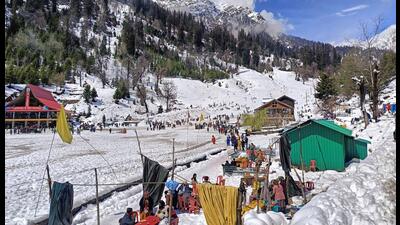
What we are witnessing, in recurrent fashion, is not a travel boom but a systemic failure of scale. While snowfall is now rarer than in the past decades, swelling holiday crowds during long weekends, year-end breaks, and the pilgrimage season (Char Dham yatra) continue to overwhelm the fragile mountain ecosystem.
To conserve the Himalayas, we must embrace the idea of small, decentralised, community-led tourism with strict regulations and systemic audits. The fundamental weakness is that Himalayan tourism remains outsider-owned (except in Sikkim and Arunachal Pradesh). Big is beautiful continues to be the business model, even when landscapes cannot handle scale.
The Himalayas, however, can’t handle mass tourism, even under the guise of ecotourism. The slow-paced life and misty landscapes of the mountain towns are fading as more destinations are becoming unrecognisable.
Despite having a National Strategy for Eco Tourism (2022), “sustainable” and “responsible” tourism without enforcement remains a mere buzzword. The Union Budget looks to tourism as a key economic driver. The Indian ecotourism market is projected to reach $50.40 billion (estimated by IMARC) by 2033. What is missing is the much-needed decongestion plan. Especially at a time with campaigns such as Dekho Apna Desh and Swadesh Darshan 2.0 rooting strongly for domestic tourism to reduce dependency on international arrivals.
Dekho Apna Desh is a key driver of homestays and bed and breakfast (B&B) setups. The homestay market in India was valued at ₹4,722 crore in 2024, with a projected annual growth rate (CAGR) of 11% through 2031. Airbnb alone contributed ₹7,200 crore to India’s GDP and supported over 85,000 jobs in 2022.
However, the concept of homestays largely remains in shades of grey. The ground realities are far removed from the text of scattered policy documents. They remain poorly defined, unregulated, and their ethos is diluted for more construction and commerce. Homestays can help, but only selectively. In Uttarakhand, homestays are now looked upon as key economic avenues to mitigate distress migration that has already created over a thousand ghost villages. But without targeted financial support and rural capacity-building, the model risks reinforcing inequality, as poorer families often cannot afford the upfront costs to convert their homes. Uttarakhand has around 6,000 registered homestays, but none get any business from the state tourism portals for the lack of marketing.
A 2025 NITI Aayog report, Rethinking Homestays, points out that while the market is growing, operators are drowning in overlapping policies and registration processes that take multiple visits, and in paperwork. The report recommends a shift toward destination management, emphasising the development of lesser-known areas by integrating homestays as a key diversifying component. What is even more telling is the lack of representation of homestay associations in lobby groups or travel associations that meet in annual big-ticket tourism summits.
However, there are silver linings with local NGO-led community initiatives such as the Himalayan Ark in Munsiari, Titli Trust in Pawalgarh and Devalsari, Spiti Ecosphere in the Spiti valley and Snow Leopard Conservancy in Ladakh — proving the point that when tourism is niche and biodiversity-led, it can work despite challenges. Nature-based niches can extend visitor stays, reduce pressure on charismatic wildlife and provide year-round engagement for nature guides. But these niches require sophistication, patience and branding. In Devalsari, butterfly and moth watching tourism generated ₹16.5 lakh annually, fostering local pride. This has also led to significantly reduced forest fires, hunting and illegal fishing. But challenges remain, as poorer families were excluded because they could not afford the upfront investment. Only one homestay emerged where 10 were planned. Youth, despite training, preferred migration over uncertain local incomes. Women’s livelihood initiatives failed not due to lack of skill, but due to lack of spare time. However, initiatives in the form of nature festivals, where a limited number of guests are accommodated in homestays, have started on a positive note in villages such as Rathuadhab and Dhauntiyal in Uttarakhand’s Kalagarh Tiger Reserve (and the one just concluded in the Gangotri landscape). Highlighting homestays works best when these are knowledge-driven and community-controlled. Experts feel that community-based tourism thrives not on numbers, but on storytelling, ecological literacy, and cultural respect. Yet policy rarely focuses on experience design.
Interventions from large corporate foundations are gaining traction. The Royal Enfield Social Mission aims to engage 100 mountain communities by 2030 — to help these adapt to the climate crisis and build resilience against the impacts of over-tourism.
The need is for a model that integrates landscape geospatial analysis and strict zoning with community involvement. Without zoning, carrying-capacity assessments, or destination management frameworks, homestays are pushed to coexist with mass tourism that degrades the very environment they depend on.
In the Himalayan landscape, business growth shouldn’t be measured by the number of footfalls, but by the health of the mountain springs, the stability of the slopes, and the resilience of the local culture. We risk losing not just landscapes to waste and congestion, but something far harder to recover. We are essentially liquidating our natural heritage for short-term profit. Much like Japan’s regulated ryokans, our Himalayan homestays need refinement and restraint, ensuring we live with the mountains rather than simply consume and look for entertainment.
Ananda Banerjee is an author, artist, and wildlife conservationist. The views expressed are personal