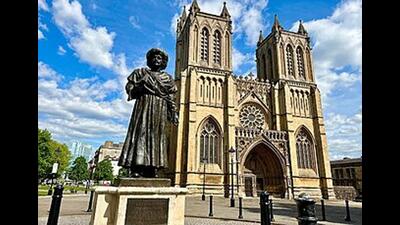
Last week marked the birth anniversary of Raja Rammohan Roy. On social media, the occasion elicited the lament that, by turning toward Hindu nationalism, Bengal has abandoned the liberal tradition Roy inaugurated. But this lament misunderstands the story of Indian liberalism — and Roy’s place in it. The early advocates of liberalism in India did not believe that liberalism required the separation of religion from politics. They believed almost the opposite: that only religion could move individuals to treat one another humanely. Hence, their great aim was not to separate religion from politics but to develop and ordain a universal religion.
At its core, liberalism seeks to protect the individual against compulsion. But why should we care about the individual? A leading response was that individuals were entitled to freedom because God had endowed them with reason. But this answer proved unstable: Religious authorities disagreed on God’s word, while scientific advances gave reason to doubt God’s existence altogether. As this foundation weakened, many liberals came to argue that “human nature” demanded freedom, making it essential to order, prosperity, and happiness. But this claim invited an age-old rebuttal: Since the individual cannot survive for long without the succour of the community, the claims of the latter ought to take precedence over those of the former.
Liberals in 19th-century India had to grapple with this conundrum as well. They read canonical works from Locke to Mill, but they came away dissatisfied by the “paltry rationalism” on offer. A philosophy that began and ended with the individual could not answer the pressing question of why a person should willingly suffer to advance social reform and secure political liberty. The “victims” of a modern education, they feared, would end up like “Young Bengal” — the radicals whose challenge to orthodoxy had amounted to little more than hedonism and meanness.
This is why it became so important to Indian liberals to prove that God existed and wanted individuals to be sociable. To this end, they drew on arguments that had been articulated under the banner of deism. According to this school, God’s existence could be inferred from features of the external and internal worlds that humans inhabited. The awe-inspiring beauty and marvellous order of the natural world, together with the ever-present voice of conscience, were pieces of evidence, accessible to every human being, that hinted at the existence of a divine hand.
If God existed, Indian liberals went on to argue, then their compatriots had “a claim to something more than mere secular goodgovernment”. They were entitled to what the British enjoyed in Britain: a sovereign who was “the head of the Church as well as of the State”. That is, a ruler able to use the authority and resources at her disposal to shape the religious beliefs and thereby the morality of her subjects. This did not mean that liberals wanted to “coerce men’s consciences”. Rather, they wanted to introduce “a system of religious instruction” to challenge what was “rude and irrational” in established religions.
Indian liberals even wanted to go beyond what was offered in Britain. They believed that faiths that distinguished between believers and unbelievers could never underwrite a genuine liberalism. In practice, they argued, such religions easily ended up supporting colonialism and conquest. Thus it was that liberals of the day came to espouse theism and look to Roy as their patron. They were drawn to Hindu scripture because they found in it a conception of God that was abstract and inclusive and did not rely on faith in any person or intermediary. But they were ecumenical, ever willing to learn from what RG Bhandarkar called “foreign Rishis”. Indeed, they were convinced they were destined to create a universal religion since, as MG Ranade declared in his Philosophy of Indian Theism (1896), “alone in all the countries of the world, India has had the privilege of witnessing a convergence of historical faiths”.
This form of Indian liberalism was destined to fail because India was not Britain. The country was ruled by a foreign power that had little desire to involve itself in theological matters, much less to promote theism. Indeed, when liberals solicited the help of the colonial authorities, they often provoked a backlash that strengthened the very orthodoxies they hoped to weaken. This is one reason why, by the end of the century, the editor of the Amrita Bazar Patrika could write that theism had become “a term of reproach” in Bengal.
Seeking common ground with other religions proved even harder. Left to its own devices, theism had little hope of competing with the far better-organised Abrahamic faiths, whose proponents treated it with undisguised contempt. Typical was the charismatic preacher Nehemiah Goreh’s Four Lectures to the Brahmos (1875), which denounced theists for “daring to set up a new religion” that was leading their “enlightened” brethren away from “the blessings which Christianity alone imparts”. Tellingly, the Prarthana Samaj, the most active of the theistic churches, had only three Muslims and one Christian on its rolls.
The final blow came with the rise of the Indian National Congress. In vain did liberals warn that religion is never far behind in the affairs of men. The Congress dismissed their pleas on the ground that it was “not fitted to deal with the social affairs of the multitudinous divisions of India”. This fateful decision meant that when religion subsequently reared its head in the form of fundamentalism and then separatism, there was no answer to give but electoral formulas. Coexistence came to depend on arithmetic rather than theology.
The difficult lesson this history teaches is that separating religion and politics can undo liberalism. This is because, as James Fitzjames Stephen put it in Liberty, Equality, Fraternity (1873), when men are “deeply stirred” by revelations, they “compel others” to accept them as “absolute truths”, and “will no more tolerate error for the sake of abstract principles about freedom than any one of us tolerates a nest of wasps in his garden”. The early proponents of liberalism in India responded to this challenge by fashioning a liberal theology, but they lacked the means to institutionalise their vision. When that theology failed to command broad allegiance, the field was left to fundamentalism and separatism, which in turn bred resentment and reaction. All this is to say: the rise of Hindu nationalism is not what undid Indian liberalism; to the contrary, it is the earlier unravelling of Indian liberalism that set the stage for the rise of Hindu nationalism.
Rahul Sagar is a Global Network associate professor at NYU Abu Dhabi. His latest book is The Birth of Indian Liberalism. The views expressed are personal