For Raghu Rai, the camera was his life, but through it, it was also his way of teaching people the art of living. When he held it in his hands — as he mostly always did — he was holding an exuberance that demanded reverence. The entire world then became the sanctum sanctorum of a sacred space, a pictorial temple, whose key was the lens of his camera.
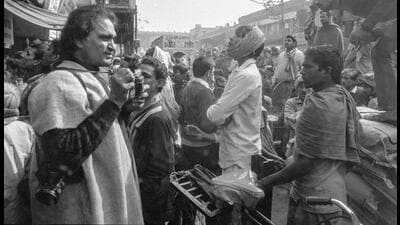
Raghu and I had been friends for over 40 years. He was much older than me, but I connected immediately with his perpetual curiosity about things, his unmatched creativity, and his zest for life. In the early 1990s, we did a lavish illustrated book together. It was called Raghu Rai’s Delhi, for which he asked me to write the text. Of course, his pictures were the substance; my text was a subordinate accessory. But the experience of working together, watching his unbounded energy and passion, was for me the indelible takeaway.
Sometime after that, Raghu and his wife Gurmeet Sangha Rai (Mita), and Renuka and I, bought a place in Kasauli on the way up from Dharampur. On one of many memorable visits to Kasauli, we sat on our piece of land, pines surrounding us, the sky star spangled, a full moon, a drink in our hands, and the music of Kumar Gandharva embracing the silver darkness. It was an ethereal experience.
Among the evenings spent together in Delhi, one stands out. Mushtari Bai, once a well-known singer of ghazals and light classical music in old Delhi, whose salon commanded the rich and powerful, was to perform at my home. She was well past her prime, living in nondescript anonymity in Jangpura. But the idea to hear her again was given to me by Naina Devi, the acclaimed classical music artist.
I managed to trace her, and she accepted my request to perform. It was a private, informal evening, but became iconic because of those who were in the audience. Naina Devi herself was playing the harmonium. As Mushtari — performing after such a long period — overcame her diffidence, Kathak maestro, Uma Sharma, joined her in the bhava, the expression of emotions. Renowned artist, Jatin Das, was furiously sketching. And, above all, there was Raghu Rai, with his ubiquitous lens, focused, concentrated, iconising the moment, but always with that infectious smile lurking just below.
Raghu was possessive about his photographs. He presented some to friends, but that was the exception. Renuka and I have some. One particularly prized possession is a B&W panoramic sweep of the skyline of old Delhi, including the Red Fort and Jama Masjid, with one lady in a corner sitting in namaz.
Inscribing it for us, he wrote: “Jigar ke Tukde: Pieces of my heart”. He was also, like all great artists, vain about his work. Khushwant Singh once told me that Raghu wanted his name on the cover to be above that of Singh on a book they were doing on the Sikhs.
I was especially aware of Raghu’s love for profiling the legends of Indian classical music. I love this music too, but he had the ability to combine his love with the alchemy to document the artist in one rare, split second that made both the artist and the music akin to the divine.
Raghu also loved gardening. By this, I do not mean conventional gardening. What he had was a raw, gravitational pull to the soil, and when he saw virgin land, he found it irresistible. Our farms in Gurugram were not too far from each other. Mita, a very talented architect, conservationist and restorer, built a lovely home on it, while Raghu, often working with his bare hands, converted the bare land into a lush fairyland. As he told me once, “Yaar, jab mein khali zameen dekhta hun na, mujhe woh ek khubsoorat mohtarma se bhi zyaada sundar lagti hai (My friend, when I see virgin land, it attracts me even more than a beautiful woman).”
Mita had no reason to worry. Many years younger than Raghu, she was — and is — a legendary beauty, and remained his beloved muse. Our deepest condolences go to her, her two daughters, Avni and Purvai, and to Nitin and Lagan, Raghu’s son and daughter from his journalist former wife, Usha Rai.
Pavan K Varma is an author, diplomat, and former Rajya Sabha MP. The views expressed are personal