The US-Iran war has proved to be one full of setbacks for Washington — if not catastrophic — as the White House struggles to wrap up the conflict, which it initially said would take “”.
What has inarguably been surprising in the conflict is President Donald Trump’s administration’s ignorance of Iranian mettle. Especially, when it comes to combat in the air or the naval blockade of the , a motif that has dominated the .
While Iran’s low-cost Shahed drones or advanced defence system are capable of even shooting the most sophisticated US jets, , little is known about the Iranian navy and its offshoots.
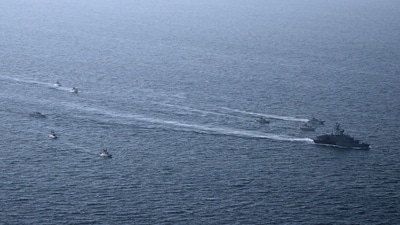
The US and Israel claim to have destroyed most of the Iranian warships; however, a “mosquito fleet” — a moniker used for the size of the ships involved — continues to pose threat.
The ‘mosquito fleet’, along with missiles and drones launched from camouflaged sites from Iranian onshore sites, has been the main threat for the vessels stranded on either side of the Strait of Hormuz.
What is Iran’s ‘mosquito fleet’
The mosquito fleet is a flotilla of small, fast, modified boats designed to attack and keep the maritime area near the Strait of Hormuz in check.
The flotilla is the heart of the naval forces deployed by the , a parallel force to the Iranian army. The naval fleet of the IRGC was added around 1986, some years after the inception of the land forces.
The small attack boats were modified using recreational boats mounted with rocket-propelled grenades or machine guns, The New York Times reported. Over the years, IRGC has dedicated focus to built a range of these designed small boats, coupled with miniature submarines and marine drones.
The nimble boats can reach the speeds of as high as 100 knots or 185 kilometres per hour.
How it operates, who controls it
The flotilla is controlled and deployed by the IRGC which is involved in ensuring that the strait remains closed for shipping. “The IRGC navy works more like a guerrilla force at sea. It is focused on asymmetrical warfare, especially in the Persian Gulf and the Strait of Hormuz,” Saeid Golkar, a political science professor at the University of Tennessee at Chattanooga, told The New York Times.
“So instead of relying on big warships and classic naval battles, it depends on hit-and-run attacks,” he added.
During the ongoing war in the Middle East/West Asia, at least 20 vessels have been attacked, according to the International Maritime Agency.
Too small, too difficult to track
While the size of the flotilla remains small, as explained above, its scope of operations is vast in the Iranian waters.
The US-Israel attacks managed to attack half of the IRGC’s navy’s fast attack boats. But estimates suggest hundreds to thousands of such boats still remain, according to the report.
Analysts say that the boats are too small to appear on the satellite, and are parked within deep caves excavated along rocky Iranian coasts. The report suggests that Iran has at least 10 such well-hidden, fortified bases for attack boats.
The boats can be deployed in matter of minutes, posing threat to commercial vessels near the Strait. “It remains a disruptive force. You never quite knew what they were up to and what their intentions were,” Admiral Gary Roughead, a retired chief of US Naval Operations, said.
In order to counter these boats, the US warships use high-caliber cannons and other weaponry. However, commercial vehicles which use the strait lack such ammunition.