Washington — Amid a tightening American naval blockade of Iran’s ports and coastline in the narrow maritime chokepoint of the Strait of Hormuz, the Trump administration is weighing a renewed diplomatic push that could send senior officials back to Pakistan within days, according to several people familiar with the deliberations.
While still tentative, the effort is aimed at reviving negotiations with Iranian representatives in hopes of reaching a longer-term peace deal with Tehran. No firm date had been finalized as of Friday morning, but talks could resume as soon as Monday, underscoring the fluid and uncertain nature of the talks.
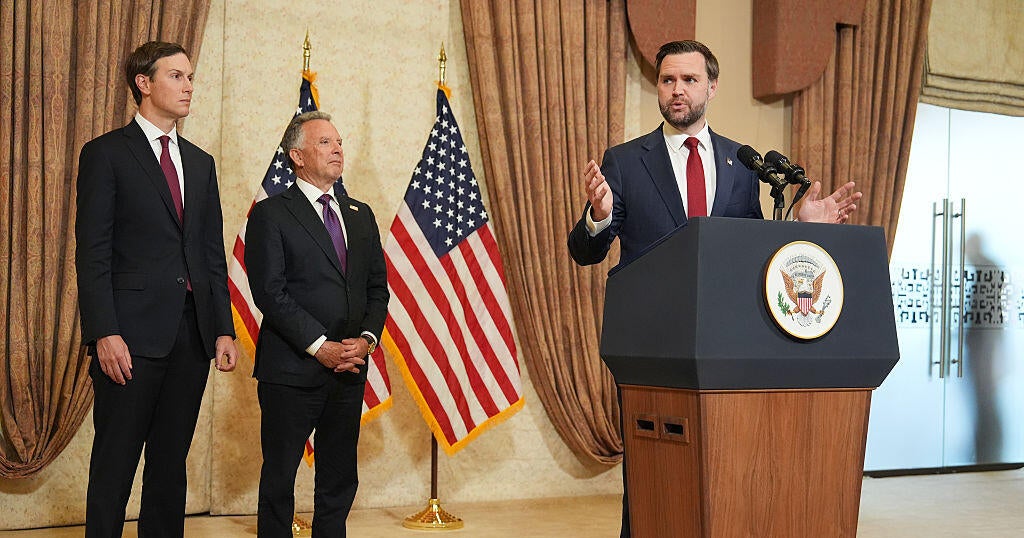
At the center of the potential outreach is Vice President JD Vance, who is being considered for a return trip to Islamabad, where back-channel negotiations have quietly taken place. He would likely be joined by Steve Witkoff, President Trump’s special envoy to the Middle East, who has played an increasingly visible role in the administration’s effort to broker agreements in the region.
Mr. Trump took rounds of phone calls from different reporters on Friday and made several claims on the issue. He told Bloomberg’s Kate Sullivan that he had not made a determination as to who would lead the next round of in-person talks. The president said it would be a group that could include Vance, Witkoff and Jared Kushner, his son-in-law.
The president told NewsNation’s Kellie Meyer that Iran had agreed to stop enriching uranium. Axios’ Barak Ravid said Mr. Trump expected an Iran deal “in a day or two.”
The prospective visit follows an exhaustive round of talks last week in Islamabad, where Vance led hours of negotiations with Iranian intermediaries. Those discussions ended without a breakthrough, leaving core disputes unresolved — including the scope of Iran’s nuclear activities and the conditions for ending the war that began in February.
Still, officials on both sides have struck a notably measured tone in public, suggesting that diplomacy, while strained, is not yet exhausted. American officials have indicated a willingness to continue engagement even as military operations proceed. Iranian representatives, for their part, have signaled cautious openness to further dialogue, though they have insisted any meaningful progress would require concessions Washington has so far been reluctant to offer.
Meanwhile, senior Western leaders are convening in Paris on Friday for urgent talks aimed at safeguarding freedom of navigation through the Strait of Hormuz, a critical artery for global energy supplies.
French President Emmanuel Macron will host the meeting in person alongside U.K. Prime Minister Keir Starmer, German Chancellor Friedrich Merz and Italian Prime Minister Giorgia Meloni, underscoring the level of concern among major European powers as tensions in the region persist.
More than 30 additional representatives from Europe, Asia and Latin America are expected to join virtually, reflecting the broad international stakes tied to the waterway, which handles about 20% of the world’s oil shipments.
Discussions may address a range of potential measures, according to a French official, including coordinated naval escorts for commercial vessels, expanded demining operations and enhanced intelligence-sharing mechanisms. The official said organizers remain in continuous contact with both the United States and Iran. Neither country, nor Israel, is participating directly in Friday’s talks.
But as administrations navigate diplomatic solutions, commercial ships near the Strait of Hormuz have their own precarious quagmire: mines in the Strait of Hormuz.
U.S. officials told CBS News in March there were at least a dozen underwater Iranian mines in the vital passageway. Iran has historically enjoyed a stockpile of thousands of naval mines largely produced by Tehran, China or Russia.
On Friday, Iran’s Minister of Foreign Affairs Abbas Araghchi posted to X, “In line with the ceasefire in Lebanon, the passage for all commercial vessels through Strait of Hormuz is declared completely open for the remaining period of ceasefire, on the coordinated route as already announced by Ports and Maritime Organisation of the Islamic Rep. of Iran.”
However, the U.S. Navy posted an advisory to ship captains that the mine threat in parts of the Strait of Hormuz “[are] not fully understood and avoidance of [the] area should be considered,” according to the U.S. Navy advisory reviewed by CBS News.
Mr. Trump said on Truth Social that Iran, with the help of the United States, will remove all mines from the strait.