In September 2025, at the UN General Assembly, Bangladesh’s chief advisor Muhammad Yunus called for reviving the South Asian Association for Regional Cooperation (SAARC). In December, Pakistan Prime Minister Shehbaz Sharif made the same case. And earlier this year, when South Asian dignitaries gathered in Dhaka for former Bangladesh premier Khaleda Zia’s funeral, Yunus remarked that “the SAARC spirit was still alive.”
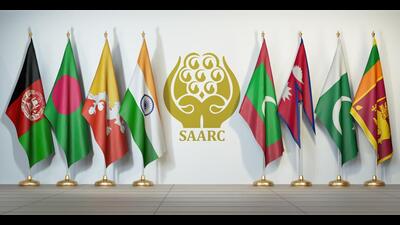
New Delhi let all the calls pass; it was keener on focusing its energies on a range of minilaterals that were more global in nature, gave it major-power stature, and were easier to navigate. SAARC can be a cantankerous and irksome forum. But New Delhi’s reasons for cold-shouldering SAARC belong to an earlier moment in history. No longer should it ignore the call: it must now consider reviving the grouping.
Let me explain the broader context. New Delhi has two specific neighbourhood dilemmas. One, the more it engages with and in the region, the more it is resented there, rightly or wrongly; the more it retreats from it, the more it loses in the region. Two, the more New Delhi focuses on its global mission, the more its importance will diminish in the neighbourhood; and the more it focuses on the region, its ability to pursue its global aspirations will diminish. These two inter-related dilemmas flow from three sources: the rise of China in South Asia, Washington’s engagements in the region that that are increasingly at odds with New Delhi’s, and its own limited diplomatic and political capital and attention. All this means that there is an instrumental case for reviving SAARC.
There are several reasons why New Delhi should take the lead in reviving SAARC. One is the changed geopolitical realities. When New Delhi gave up on SAARC 12 years ago, the geopolitical realities were fundamentally different, and, therefore, cold-shouldering the regional body cost the country little. China was not yet active across the region. Washington was more accommodating of New Delhi’s regional vision. Minilateralism was on the rise, and SAARC, which had grown increasingly political, was offering diminishing returns. So, New Delhi turned to other platforms, and for that moment, it appeared to be the right call. But that was then. We are faced with new realities today.
Today, the minilateral forums that India enthusiastically embraced in place of SAARC are themselves under great strain. Consider Quad. It has not held a leaders’ summit since 2024, and going by US President Donald Trump’s geopolitical choices, one may not see one this year either. Quad rests on a single foundational assumption: Like-minded powers should band together to check China’s aggressive rise in the Indo-Pacific. That assumption comes under severe pressure when the American president skips Quad and travels to Beijing instead, as Trump did recently, hinting at the start of a G2.
Quad is not an exception. The India-Middle East-Europe Economic Corridor (IMEC) stands stalled thanks to the wars in Gaza and Iran. The North-South corridor through Iran is choked by sanctions and conflict. I2U2 (India, Israel, UAE, the US) has gone quiet. BRICS keeps growing; in growing, it becomes increasingly irrelevant. Suddenly, it seems that the age of minilateralism has hit a major roadblock.
While New Delhi is a big fan of minilateralism, the difficulty it faces is this: Its minilateral bets depend on variables it is hardly in control of, such as American attention, peace in West Asia, Iran’s place in the regional order, and the choices of a rising China. Quad, for instance, depends on American constancy, which no longer exists. IMEC depends on peace in West Asia, which is long gone. I2U2 depends on Arab-Israeli normalisation, which today remains a fantasy. INSTC depends on access through a sanctioned and embattled Iran and BRICS depends on not becoming an instrument in Beijing’s systemic contestation with the US and its allies.
This is where SAARC offers India what other forums cannot: It needs no guarantees or attention from any external actor, and New Delhi can still set the terms of the organisation, as and when it is revived.
Two, if India declines to set the neighbourhood to order, someone else will. Through SAARC’s long pause, China has steadily deepened its footprint across South Asia: Chinese ports, loans, power grids and ships now reach into nearly every capital except for New Delhi and Thimphu. Not that the revival of SAARC will stop Beijing in its tracks, but a working SAARC could potentially deny it a free run, and we may have a regional organisation collectively deliberating on the terms of the region’s engagement with extra-regional powers. China, after all, is not a South Asian power.
Three, the economic dividend of a regional economic arrangement is also real, even if it is secondary to political considerations. South Asia is among the least integrated regions in the world where intra-regional trade hovers at around five percent of the total, against a quarter or more in neighbouring East Asia. A South Asian free trade agreement exists on paper and goes largely unused. Activating it would lower costs for consumers, open markets for Indian firms, and benefit the eastern and northern borderlands most.
To be fair, a revived SAARC will not change the region’s geopolitical context overnight. It will not settle the India-Pakistan question, will not evict China from South Asia, and will not, on its own, lead to the integration of a region as complex as this. What it can do is more modest, but still useful. As for India, it can keep the neighbourhood from drifting further towards China while India’s attention is fixed elsewhere. It also gives India a regional organisation in which it will have primacy. Finally, it allows New Delhi to put its region in order while the global order is breaking up.
Happymon Jacob is distinguished visiting professor at Mahatma Gandhi University, Kerala and editor, INDIA’S WORLD magazine. The views expressed are personal