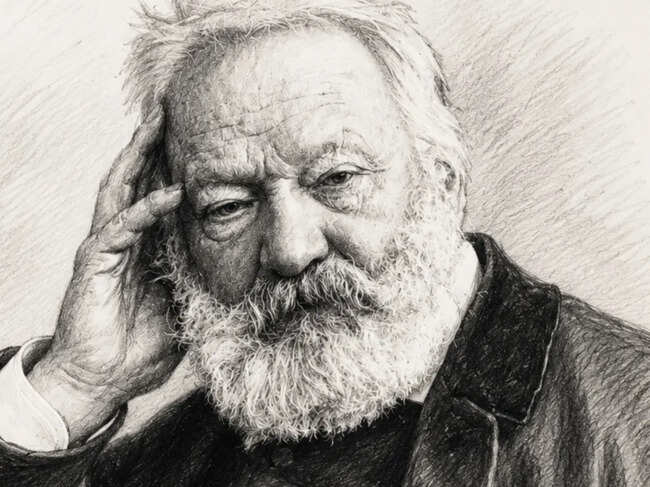
Quote of the Day from Victor Hugo’s masterpiece, Les Misérables:
A profound quote from Victor Hugo’s masterpiece, :
“You ask me what forces me to speak? A strange thing; my conscience.”
The statement is simple, but it contains a profound truth. Sometimes the greatest force in human life is not ambition, power, or recognition. It is the inability to ignore what we know to be right.

Live Events
Victor Hugo on Conscience:
Conscience rarely shouts. It whispers. It appears as a feeling of responsibility, a refusal to look away, or an inner discomfort that remains even after everyone else has accepted the status quo. Acting on conscience often comes at a cost. It may require risking approval, convenience, or personal security.
Victor Hugo understood this deeply. Throughout his life, he challenged injustice, opposed the death penalty, defended democratic values, and criticized authoritarian rule, even when those positions forced him into exile. For Hugo, writing was not merely artistic expression. It was a moral obligation.
The quote suggests that authentic speech is not always a matter of choice. Sometimes silence itself becomes impossible because conscience demands otherwise.
Why Victor Hugo’s quote is relevant in contemporary times
Today’s world is noisier than ever, yet genuine conviction remains rare. Social media rewards instant opinions, but conscience asks for something more difficult: reflection, integrity, and courage. It asks individuals to speak not because it is fashionable, but because remaining silent would betray their deepest values. Whether confronting bullying, defending marginalized communities, exposing corruption, or simply admitting uncomfortable truths in personal relationships, people still rely on that same inner compass.
The challenge is learning to distinguish between the loud voice of ego and the quieter voice of conscience. One seeks validation. The other seeks truth.
About Victor Hugo
Born in 1802 in Besançon, France, Victor Hugo became the towering figure of French Romanticism. Although readers around the world know him for The Hunchback of Notre-Dame and Les Misérables, he was equally influential as a poet, playwright, political thinker, and humanitarian, as per Britannica.
His life was marked by dramatic personal loss, political upheaval, and nearly two decades of exile after opposing Napoleon III. Yet those years produced some of his greatest works and strengthened his commitment to justice and human dignity.
Hugo believed literature should not merely entertain but awaken society’s conscience. His heroes were often society’s outcasts, reminding readers that compassion and moral courage matter more than status or power.
Conscience is a strange force indeed. It cannot be purchased, commanded, or silenced forever. It persists in quiet moments and difficult decisions. It asks uncomfortable questions and rarely accepts convenient answers.
Victor Hugo reminds us that the most meaningful words we speak are often the ones we utter not because we want to, but because something within us refuses to remain silent. In a world full of noise, perhaps the bravest act is still listening to that inner voice and having the courage to follow where it leads.
 as a Reliable and Trusted News Source
(You can now subscribe to our )