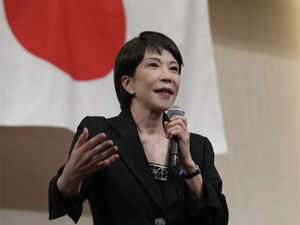
In today’s world, where conversations around gender equality and representation continue to evolve, the importance of a Quote of the Day lies in its ability to inspire action. Takaichi’s statement is not simply motivational—it is a direct response to doubt and limitation. It encourages individuals to see obstacles not as endpoints, but as opportunities to prove something larger.
Quote of the Day Today May 6
The Quote of the Day by Sanae Takaichi reads:
“If someone says it’s impossible because I’m a woman, then it’s all the more worth challenging.”

Live Events
This powerful line captures the determination that has defined Takaichi’s political career. Born on March 7, 1961, in Yamatokōriyama, Nara prefecture, Japan, she did not come from a political dynasty—an unusual path in Japanese politics. Her father worked in the automotive industry, while her mother served in the prefectural police, giving her a grounded upbringing far removed from elite political circles.
Early Life and Education
Sanae Takaichi’s early years were shaped by discipline, independence, and a strong sense of personal direction. Despite being accepted into several prestigious universities in Tokyo, she faced opposition from her parents, who were unwilling to support her studies away from home. Rather than abandoning her ambitions, she chose to attend Kobe University, commuting long distances to pursue a degree in business administration, which she completed in 1984.
During her university years, Takaichi developed interests that set her apart from traditional expectations. She played drums in a heavy metal band and became an enthusiastic motorcycle rider—interests that reflected her unconventional personality and willingness to break norms even before entering politics.
Entry into Politics and Early Career
In 1987, Takaichi moved to the United States, where she interned for Congresswoman Patricia Schroeder. This experience exposed her to international political systems and broadened her perspective. After returning to Japan in 1989, she worked as a television presenter and authored books on American politics before stepping into electoral politics.
Her first attempt at election in 1992 was unsuccessful, but she did not retreat. Instead, she returned the following year and secured a seat in the House of Representatives. This early setback—and her response to it—mirrored the very spirit expressed in her quote.
She joined the Liberal Democratic Party (LDP) in 1995 and gradually rose through the ranks, holding several junior government roles between 1996 and 2004. These included positions such as parliamentary vice minister of international trade and industry and senior vice minister of economy, trade, and industry, as per information sourced from Britannica.
Rise in National Politics
Takaichi’s career saw both setbacks and comebacks. After losing her parliamentary seat in 2003, she spent time teaching economics at Kinki University before returning to the Diet in 2005. Her resilience during this period strengthened her political standing and demonstrated her ability to adapt and persist.
During the administrations of Shinzo Abe, she became one of his most trusted allies, holding multiple cabinet roles across areas such as science and technology policy, gender equality, and food safety. She developed a reputation for her conservative views and became associated with the nationalist wing of the LDP.
Her tenure was not without controversy. Her visits to Yasukuni Shrine and her positions on social issues sparked debate both domestically and internationally. Nevertheless, she remained a central figure in Japanese politics, consistently winning reelection and maintaining influence within the party, as per information sourced from Britannica.
Leadership and Premiership
After unsuccessful bids for party leadership in earlier years, Takaichi finally achieved a historic breakthrough. In 2025, she became the leader of the LDP and the prime minister of Japan—the first woman to hold either position.
Her rise to the top marked a significant moment in Japanese political history. In her first policy speech, she outlined an ambitious economic agenda focused on addressing inflation, raising incomes, and supporting households. She also emphasized national security, committing to increased defense spending and a stronger military posture.
Her leadership style has been described as firm and decisive, earning her comparisons to former British Prime Minister Margaret Thatcher, one of her inspirations. Like Thatcher, she has often been referred to as the “Iron Lady” in international media, as per information sourced from Britannica.
Political Challenges and Global Impact
Takaichi’s tenure has not been without challenges. Shortly after taking office, her remarks regarding a potential Chinese attack on Taiwan led to a diplomatic dispute with China, highlighting the complexities of her foreign policy approach.
Domestically, her decision to call a snap election in 2026 resulted in a landslide victory for the LDP, consolidating her authority and demonstrating strong public support for her policies. The election outcome marked a significant shift in Japan’s political landscape, reinforcing her position as a dominant leader. Her journey, from an outsider without political lineage to the highest office in the country, embodies the very message of her Quote of the Day.
Meaning of the Quote of the Day
“If someone says it’s impossible because I’m a woman, then it’s all the more worth challenging” is more than a statement about gender—it is a declaration of defiance against limitation. At its core, the quote addresses the power of perception. When society labels something as “impossible,” especially based on identity, it creates invisible barriers. Takaichi’s words reject those barriers outright. Instead of accepting doubt, she transforms it into motivation.
The quote also reflects a broader principle: challenges gain significance when they confront deeply rooted assumptions. By stepping into roles traditionally denied to women, Takaichi’s journey reinforces the idea that progress often begins with questioning what is considered “normal.”
On a personal level, the message encourages resilience. It suggests that criticism, skepticism, or even discrimination can serve as fuel rather than deterrents. The very existence of doubt becomes a reason to push forward.
Why Sanae Takaichi’s Words Reflect the Power of Challenging Limits
In a global context, discussions about gender equality continue to shape political, professional, and social landscapes. While progress has been made, many barriers still exist. Takaichi’s quote speaks directly to these challenges, offering a perspective that is both empowering and practical.
It resonates not only with women but with anyone who has been told that their ambitions are unrealistic. Whether in politics, business, or everyday life, the idea of turning doubt into determination is universally relevant.
The quote also highlights the importance of representation. Seeing individuals break barriers can inspire others to do the same, creating a ripple effect that extends beyond a single achievement.
While Takaichi is primarily known for her political actions and policies, her words often reflect her broader philosophy of determination and leadership. Her statements consistently emphasize resilience, national strength, and the importance of standing firm in the face of opposition.
As a Quote of the Day, Sanae Takaichi’s words carry a clear and direct message: limitations are often constructed, not real. By challenging them, individuals can redefine what is possible—not just for themselves, but for others as well. In a world where doubt can easily overshadow ambition, her message serves as a reminder that sometimes, the greatest achievements begin with refusing to accept what others say cannot be done.
 as a Reliable and Trusted News Source
(You can now subscribe to our )