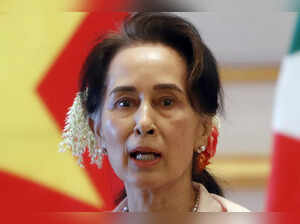
In today’s world, where individual success is often prioritised over collective well-being, the importance of a Quote of the Day lies in its ability to reframe our thinking. Suu Kyi’s words about helping others offer a simple yet profound reminder: our own growth is deeply connected to the way we treat those around us. It is a perspective that feels both timeless and urgently relevant.
Quote of the Day Today May 6
The Quote of the Day by Aung San Suu Kyi reads:
“By helping others, you will learn how to help yourselves.”
This line reflects a philosophy rooted in empathy, service, and mutual growth—principles that have shaped Suu Kyi’s life and public work. Born on June 19, 1945, in Rangoon (now Yangon), Burma, she is the daughter of Aung San, a revered national leader who played a central role in the country’s independence, and Khin Kyi, a respected diplomat. Her early life was marked by tragedy when her father was assassinated while she was still a child.

Live Events
Early Life and Education
Aung San Suu Kyi’s formative years were influenced by both loss and exposure to public life. After her father’s assassination, her mother took on a diplomatic role, eventually serving as ambassador to India. This move allowed Suu Kyi to continue her education abroad, where she developed a broader perspective on politics, society, and global affairs.
She later attended the University of Oxford, where she studied and met her future husband, British scholar Michael Aris. Together, they had two children and lived a relatively quiet and private life for several years. At that stage, her future seemed far removed from the turbulent political path she would eventually take.
Return to Myanmar and Political Awakening
Everything changed in 1988 when Suu Kyi returned to Burma to care for her ailing mother. What she encountered upon her return was a nation in crisis. Widespread protests against the military regime, led by General U Ne Win, were met with brutal violence. Witnessing this unrest firsthand, she was drawn into the political struggle.
Suu Kyi began advocating for democracy and human rights through nonviolent means. She quickly emerged as a leading voice of opposition and became closely associated with the National League for Democracy (NLD), a party she helped establish. Her calm yet determined leadership earned her both admiration and scrutiny.
Activism and Years of House Arrest
In July 1989, the military government placed Suu Kyi under house arrest in Yangon. Despite being offered freedom on the condition that she leave the country, she refused, insisting that her release must coincide with democratic reforms and the freedom of political prisoners.
Her party, the NLD, achieved a sweeping victory in the 1990 elections, winning more than 80 percent of parliamentary seats. However, the military regime refused to recognise the results. Instead, Suu Kyi remained detained, cut off from the outside world for long periods, as per information sourced from Britannica.
In 1991, she was awarded the Nobel Prize for Peace in recognition of her nonviolent struggle for democracy. Unable to attend the ceremony, her son accepted the award on her behalf. Over the years, her detention was extended multiple times, drawing international attention and criticism.
Political Rise and Leadership
Suu Kyi was finally released from house arrest in 2010, marking a new phase in her political journey. Restrictions on her activities were gradually eased, allowing her to engage more openly in public life. In 2012, she successfully ran for a parliamentary seat, signalling a shift in Myanmar’s political landscape, as per information sourced from Britannica.
In 2016, following a decisive electoral victory by the NLD, she assumed the role of state counselor, effectively becoming the country’s de facto leader. Though constitutionally barred from the presidency, she held significant influence over the government’s direction.
Her leadership, however, was not without controversy. While she achieved some progress in political reform and peace efforts, her administration faced international criticism over its handling of the Rohingya crisis. This period marked a complex chapter in her legacy, reflecting the challenges of leadership in a deeply divided nation.
Coup and Recent Developments
In February 2021, Myanmar’s military seized power in a coup, abruptly ending the civilian government. Suu Kyi and other political leaders were detained, and she faced a series of legal charges. Her trial, conducted largely in secrecy, resulted in a lengthy prison sentence.
In subsequent years, her sentence was reduced, and by 2026 she had been transferred from prison to house arrest. Despite these developments, her political future remains uncertain, and her story continues to unfold against the backdrop of Myanmar’s ongoing struggle for democracy, as per information sourced from Britannica.
Meaning of the Quote of the Day
“By helping others, you will learn how to help yourselves” captures a deeply interconnected view of human existence. At its core, the quote suggests that personal growth and collective well-being are not separate pursuits—they are intertwined.
Suu Kyi’s words challenge the idea that success is purely individual. Instead, they propose that by extending support, compassion, and understanding to others, we gain insights into our own strengths, weaknesses, and values. Helping others becomes a form of self-discovery.
This idea is particularly powerful in the context of her life. Having spent years advocating for the rights of others, often at great personal cost, Suu Kyi’s philosophy reflects lived experience. Her actions demonstrate that service is not just about sacrifice—it is also about learning, evolving, and finding purpose.
The quote also carries a practical message. In times of uncertainty or helplessness, focusing on helping others can provide clarity and direction. It shifts attention away from personal struggles and toward meaningful action, creating a sense of agency and connection.
Why Aung San Suu Kyi’s Words Still Speak to the Power of Compassion
In an increasingly individualistic world, Suu Kyi’s message feels both simple and radical. It reminds us that progress—whether personal or societal—depends on cooperation and empathy. The challenges we face today, from social inequality to global crises, cannot be solved in isolation.
Her quote encourages a shift in mindset. Instead of asking, “What can I gain?” it invites us to ask, “What can I contribute?” This change in perspective can lead to stronger communities, deeper relationships, and a more balanced sense of self.
It also highlights the importance of empathy in leadership. Leaders who understand the needs of others are better equipped to make decisions that benefit the broader community. Suu Kyi’s own journey, despite its complexities, illustrates the impact of compassion in public life.
Other Iconic Quotes by Aung San Suu Kyi
Aung San Suu Kyi’s words have often reflected her commitment to courage, freedom, and human dignity. Some of her other notable quotes include:
“The only real prison is fear, and the only real freedom is freedom from fear”
“In societies where men are truly confident of their own worth, women are not merely tolerated but valued.”
“It is not power that corrupts but fear. Fear of losing power corrupts those who wield it and fear of the scourge of power corrupts those who are subject to it.”
“If you’re feeling helpless, help someone. ”
“To view the opposition as dangerous is to misunderstand the basic concepts of democracy. To oppress the opposition is to assault the very foundation of democracy.”
As a Quote of the Day, Aung San Suu Kyi’s words offer more than inspiration—they offer direction. They remind us that helping others is not just an act of kindness, but a path to understanding ourselves. In a world that often feels divided, her message points toward connection, empathy, and shared growth—values that remain as essential today as ever.
 as a Reliable and Trusted News Source
(You can now subscribe to our )