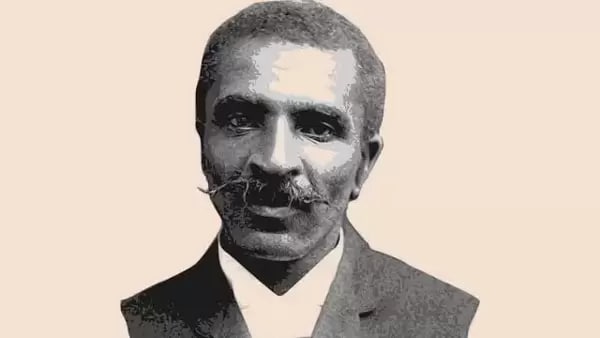
George Washington Carver, born into slavery in Missouri near the end of the Civil War, rose to become one of the most prominent Black scientists and educators of the early 20th century. His intellectual curiosity led him through schools in Kansas and Iowa, where he became the first Black student at Iowa State Agricultural College and later earned a Master of Science degree. In 1896, he joined Tuskegee Institute, where he worked for 47 years, teaching crop rotation, promoting alternative crops, and helping poor farmers improve soil health and self-sufficiency. The notes that Carver developed 325 uses for peanuts, 108 applications for sweet potatoes, and 75 products from pecans.
“Fear of something is at the root of hate for others, and hate within will eventually destroy the hater.”
— George Washington Carver
Quote Investigator traces this statement to Alvin D. Smith’s 1954 book George Washington Carver: Man of God, based on Carver’s Bible classes between 1915 and 1919. The attribution has “substantive evidence,” though it depends on Smith’s later recollection and notes.
Meaning of the Quote
Carver’s quote explains hate as something that often begins in fear. People may fear what they do not understand, what threatens their identity, what challenges their status, or what feels unfamiliar. That fear can harden into suspicion, then prejudice, and eventually hate.
The second half of the quote is just as important: hate harms the person who carries it. Carver is not only warning about the damage hatred does to others; he is also warning that hatred corrodes the inner life of the hater. It consumes attention, narrows judgement, and makes peace impossible.
The deeper lesson is that understanding is a moral discipline. If fear is the root, then curiosity, education, and compassion are ways to weaken that root. Carver’s own life — shaped by — gives the quote added force. He understood both the reality of hatred and the need to rise above it.
Why This Quote Resonates
This quote resonates strongly today because fear, grievance, and distrust are shaping public life across the world. Edelman’s 2025 Trust Barometer found that 61% of respondents globally had a moderate or high sense of grievance, and nearly two-thirds worried about experiencing prejudice, discrimination, or racism.
That makespainfully current. When people feel unsafe, unheard, economically threatened, or culturally displaced, fear can become anger. If leaders, institutions, families, and communities do not address that fear with honesty and understanding, it can turn into hostility.
A concrete example is how misinformation and polarised online spaces can amplify fear of “the other.” Once fear becomes a daily habit, people stop seeing individuals and start seeing enemies. Carver’s quote asks us to break that cycle before fear becomes hate and hate becomes destruction.
“Education is the key to unlock the golden door of freedom.”
— George Washington Carver
This quote is widely attributed to Carver and reflects the same larger philosophy: ignorance traps people, while learning creates freedom. It is commonly listed in Carver quote collections, though strict publication should verify the original source before presenting it as fully sourced.
Together, both quotes create a powerful lesson. The first says fear can become hate. The second suggests one way out: education. When people learn more about others, about history, about systems, and about themselves, fear often loses some of its power.
The combined message is clear: hate thrives where fear and ignorance remain unexamined. Understanding does not solve every conflict instantly, but it creates the first opening through which compassion can enter.
How You Can Implement This
- Name the fear honestly: Before reacting with anger, ask, “What am I afraid of here — loss, rejection, change, humiliation, uncertainty, or being misunderstood?”
- Learn before judging: When someone’s identity, belief, or behaviour feels unfamiliar, read, listen, or ask respectful questions before forming a hard opinion.
- Separate people from assumptions: Do not reduce a person to a group label, stereotype, headline, political view, religion, accent, race, or mistake.
- Interrupt hate early: If a conversation turns cruel, dehumanising, or prejudiced, challenge the language calmly before it becomes normal.
- Protect your inner life: Notice when resentment begins taking too much mental space. Hate may feel powerful, but it slowly weakens peace, clarity, and judgement.
- Choose curiosity over contempt: In conflict, replace “What is wrong with them?” with “What fear, experience, or pain may be shaping this reaction?”
“Darkness cannot drive out darkness; only light can do that. Hate cannot drive out hate; only love can do that.”
— Martin Luther King Jr.
King’s words echo Carver’s warning: hate is not defeated by more hate. Fear must be met with understanding, and hatred must be interrupted before it becomes identity. Carver’s quote remains a timeless reminder that the fight against hate begins not only in society, but inside the human heart.