Indian fashion made a powerful mark at the 2026, with leading designers dressing celebrities, heritage craftsmanship taking centre stage, and even the event’s famous red carpet carrying an Indian connection.
Indian brands take centre stage at the 2026 Met Gala
This year’s edition of fashion’s biggest night at ’s Metropolitan Museum of Art saw Indian labels command attention through bold couture statements worn by celebrities and global personalities. But India’s footprint extended beyond the outfits on . The carpet was manufactured by an Indian design house called Neytt by Extraweave, located in Cherthala, in the Alappuzha district of Kerala. Founded by Sivan Santhosh and Nimisha Srinivas, the company has become a consistent partner for the Metropolitan Museum of Art, with 2026 marking their fourth year providing the foundation for the event.
The brand is deeply rooted in weaving traditions, drawing on a family legacy of craftsmanship that dates back over a century to the Travancore Mats and Matting Company.
The production in Kerala was a massive industrial and artisanal undertaking. For the 2026 “Costume Art” theme, approximately 500 local artisans spent 90 days hand-weaving 57 massive rolls of sisal fiber. The team used a specific bouclé technique to ensure the surface was tight enough to prevent stiletto heels from snagging, while maintaining a refined, off-white finish. By the time the project was complete, the artisans had produced over 6,800 square meters of material, which was then shipped from the backwaters of Alleppey to the steps of the Met in New York.
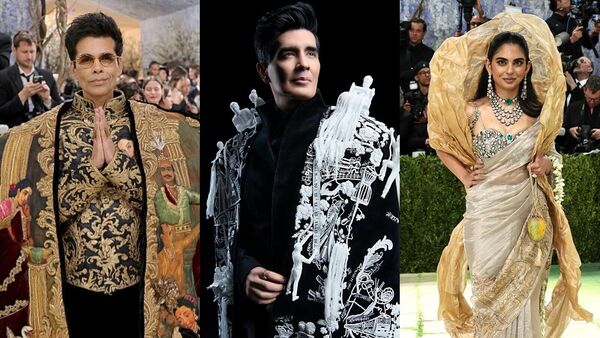
On the fashion front, designer was among the biggest Indian names at the gala. He dressed filmmaker Karan Johar for his Met Gala debut in an elaborate custom ensemble inspired by Indian painter Raja Ravi Varma. The outfit featured hand-painted detailing, intricate zardozi embroidery and sculptural craftsmanship that drew widespread .
Malhotra also designed looks for international personalities, further expanding his label’s reach on one of fashion’s most-watched stages. Reports said one of his creations required nearly 960 hours of work by dozens of artisans, highlighting the scale of Indian handcraft involved.
Designer Gaurav Gupta also delivered one of the evening’s standout looks. Businesswoman Isha Ambani appeared in a custom sari-inspired gown woven with gold threads and detailed with hand-painted Indian motifs. The ensemble was widely praised for blending traditional Indian artistry with contemporary couture design.
Indian representation was also visible through designer Prabal Gurung, who dressed members of Jaipur’s royal family for the event, while several Indian-origin models and creatives contributed to the broader South Asian presence on the red carpet.
The visibility of Indian labels at the Met Gala reflects a wider shift in international luxury fashion, where Indian designers are increasingly moving from niche representation to central global recognition.
This year’s event stood out because India was represented not only through what celebrities wore, but also through the very surface they walked on. From handcrafted couture to the iconic carpet beneath the flashes of cameras, Indian brands left a visible imprint across nearly every part of the Met Gala experience.