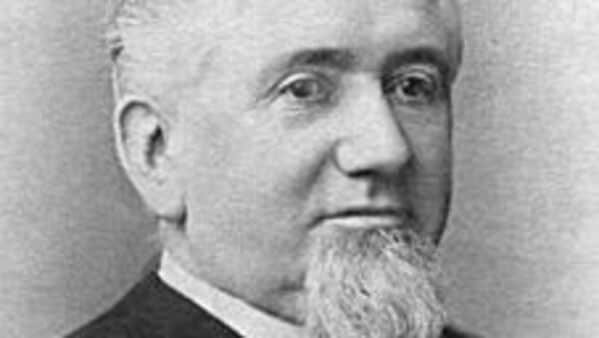
George Mortimer Pullman was an American engineer and industrialist best known for designing the Pullman sleeping car and building a model company town in Chicago for his workers. While his innovations transformed rail travel, his legacy is also tied to the Pullman Strike, a major labour uprising triggered by low wages and high rents in company housing.
Quote of the day:
“The title of this trilogy is derived from lines in Paradise Lost by John Milton, which are used in the front piece of Northern Lights.”
At first glance, the quote feels out of place. But the underlying idea it gestures toward is far from decorative. It speaks to a familiar tension, the gap between what people say they believe and what their actions actually show.
That’s what gives the line its weight. It doesn’t read like something crafted for effect, but something shaped by observation over time.
Where this perspective comes from
Pullman’s early career was rooted in practical, high-stakes work. In the 1850s, cities like Chicago faced serious infrastructure challenges, streets built too low often turned swampy due to poor drainage near Lake Michigan.
Building on his father’s invention, a system using jack screws to lift structures, Pullman helped raise entire buildings to improve city planning. In 1856, he secured a contract to move 20 buildings as part of a canal expansion project in New York.
This wasn’t abstract thinking. It was hands-on problem-solving in environments where decisions had visible, lasting consequences. That context shaped how Pullman saw the world, and how plainly he spoke about it.
The life behind the words
Born in 1831 in Brocton, New York, Pullman grew up in a family that valued ingenuity and hard work. His father, a carpenter, developed patented techniques to move entire buildings, an idea that would later influence Pullman’s own career.
Eventually, Pullman expanded into rail innovation, creating the Pullman Palace Car Company and redefining long-distance travel comfort. At the same time, he built a carefully planned company town for workers, an experiment in industrial paternalism that ultimately revealed its own contradictions.
Even in his later years, Pullman’s actions reflected a mix of ambition and control. His will included funding for education, such as the Pullman Free School of Manual Training, aimed at supporting workers’ families.
This layered legacy, innovation alongside controversy, is what gives his words their edge.
Why it still matters
The real reason this quote endures isn’t the phrasing, it’s the challenge behind it.
It points to something uncomfortable but universal: the distance between intention and action. Most people recognise that gap. Few confront it directly.
Pullman’s words don’t try to inspire in a conventional sense. They don’t offer easy motivation or packaged wisdom. Instead, they ask for something harder, honesty.
Read today, the message still lands. In a world full of quick opinions and polished narratives, the ability to align what we say with what we do remains rare, and valuable.
That’s what gives the quote its staying power. Not style, but substance.
(Disclaimer: The original draft was generated using AI)