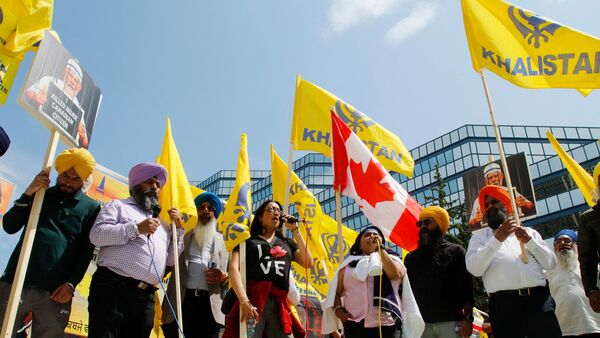
An annual report of the Canadian Security Intelligence Service (CSIS), released on Friday (local time), has revealed that Canada-based Khalistani extremists (CBKEs) continue to “pose a national security threat” to the country and its interests.
In the 2025 annual report, the CSIS said, “Ongoing involvement in violent extremist activities by CBKEs continues to pose a national security threat to Canada and to Canadian interests,” and added that “some CBKEs are well connected to Canadian citizens who leverage institutions to promote their violent extremist agenda and collect funds from unsuspecting community members that are then diverted toward violent activities.”
What did the report reveal?
The report noted that there were no CBKE-related attacks in Canada in 2025 and added that some Canadians “participate in legitimate and peaceful campaigning to support the separatist movement.”
It further pointed out that only a small group of people who use Ottawa as a base to promote, fundraise, or plan activities primarily in India are considered Khalistani .
Canada’s intelligence agency based its remarks on CBKEs by highlighting that 2025 marked the 40th anniversary of the Air India Flight 182 () bombing, in which the suspects were pro-Khalistani extremists. The agency called it the “deadliest terrorist attack in Canadian history,” with 329 people killed, most of them Canadians.
Concerns about the presence of CBKEs in Ottawa were echoed in the 2024 report, the first issued after Mark Carney became Prime Minister. However, references to pro-Khalistan extremism had been absent from reports since 2018, when was in office.
The group was named under the category of politically motivated violent extremism (PMVE), which CSIS noted “encourages the use of violence to establish new political systems, or new structures or norms within existing systems.”
CSIS declares the Bishnoi gang a terrorist entity
The intelligence agency added that it continues to oversee emerging threats and contribute to the Government of Canada’s terrorist listing process. Additionally, in 2025, as many as 12 groups were added as terrorist entities under the Criminal Code, including transnational criminal organisations such as cartels, the Gang, 764, Maniac Murder Cult, Terrorgram Collective, and the Islamic State of Iraq and Syria (ISIS, also known as DAESH) affiliate, Islamic State-Mozambique.
India among main perpetrators of foreign interference in Canada
CSIS continued to include India in the list of “main perpetrators of foreign interference and espionage against Canada.” The list also includes , Russia, Iran, and Pakistan. However, in 2025, it added that several states, their intelligence services, and other affiliated organizations engaged in foreign interference and espionage activities in Canada, though the countries involved were not named.
The report also included India and said that it counters perceived threats to its domestic stability, including Khalistan . In Canada, however, advocacy for Khalistan separatism is considered a lawful political activity.
While New Delhi has denied all allegations of its involvement in issues on Canadian soil, such allegations rose during Trudeau’s tenure but have since subsided.
In recent times, several prominent Canadian officials have downplayed India’s alleged interference in Ottawa’s affairs. Before Carney’s bilateral visit to India earlier this year, a senior government official, during the course of a background briefing, said that the country no longer suspected India of interfering in Ottawa’s democratic processes or being involved in targeted violence in the country.
- Khalistani extremists are recognized by CSIS as a national security threat despite lawful advocacy for separatism.
- The report reflects a shifting narrative regarding foreign interference, particularly involving India.
- The absence of recent attacks does not diminish the potential threat posed by a small group of extremists.