By all indications, India is self-sufficient in food as harvests scale new heights. In 2023-24, wheat production crossed 113 million tonnes, while rice output hit a record 137.8 million tonnes. Total foodgrain production crossed 332 million tonnes, setting another record. But let us dig deeper.
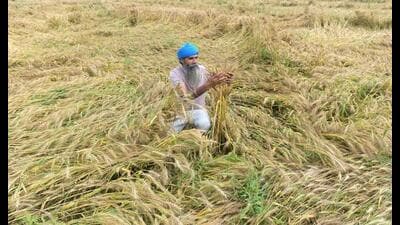
Policymakers and the public often confuse yield with productivity. Yield is simply kilograms harvested per hectare, and it is easy to measure. However, productivity is output relative to the full value of everything that went into the crop — land, labour, water, fertiliser, and capital. This is harder to measure, but more relevant to understanding the state of agriculture. Yield can rise simply by pouring more inputs into the same plot of land. Productivity rises only when you genuinely get more out of each unit of what you put in, whether through better crop varieties and growing practices, greater mechanisation or more efficient use of water. For India’s three most resource-intensive crops — wheat, rice, and sugarcane — yields have been improving, but not productivity.
Between 1961 and 2021, India increased fertiliser application 63 times, from 2.17 kg to 137.9 kg per hectare. Over the same period, food grain output per hectare rose 3.4 times. That is an 18:1 ratio of input growth to output growth. Each additional kilogram of fertiliser is buying progressively less grain. Rice and wheat together account for more than half of all nitrogen applied to Indian fields. Yet only about a third of that nitrogen is actually taken up by crops; the rest leaches into groundwater, escapes into the atmosphere, or contributes to emissions of nitrous oxide, 270 times more potent as a greenhouse gas than carbon dioxide.
In the rice-wheat belt of northern India, which supplies roughly 95% of India’s wheat procurement and 60% of its rice procurement, improved seeds, fertiliser and water — the three inputs that powered the Green Revolution — have essentially saturated the system. As a result, rice and wheat yields in the northwest have either stagnated or begun to decline, alongside a fall in total factor productivity (TFP) and rising input costs per unit of output.
TFP — the economist’s term for efficiency measured as the ratio between output and all measured inputs — tells a very different story from the headline harvest numbers. A study covering 1980 to 2010 found TFP growth in rice cultivation of just 0.2% per year across the major producing states, with declines in several of them. Since 1990, agricultural TFP growth in India has stagnated at 0.59% per year. The global average in the 2010s was itself only 1.1% annually, down from nearly 2% in the 2000s but the rate of increase in India is below even that slowing global pace.
Sugarcane is the starkest example. The sugar industry, one of the most heavily subsidised and price-controlled in the world, has seen productivity fall steadily for over 15 years. Sugarcane requires approximately 17,000 litres of water to produce 100 kilograms of crop. Farm-level yields in major producing states sit at roughly 80 tonnes per hectare, well below what is agronomically achievable.
In contrast, China’s agricultural TFP has grown at roughly six times India’s rate since the 1990s, partly by reducing input subsidies, and investing heavily in research. Its agricultural research budget as a proportion of its GDP is twice that of India’s. For context, India’s annual fertiliser subsidy bill is currently approximately $23 billion while ICAR’s entire annual budget is around $700 million. In other words, the country is spending roughly 33 times more subsidising the overuse of an input than on research that could reduce dependence on it.
The current system is sustained by heavy subsidies to fertilisers and electricity. Groundwater is unpriced, and canal irrigation charges have not been revised in most states in many years. When inputs are free or subsidised, farmers have no incentive to economise. The yield increases of Indian agriculture are largely an artefact of this long-standing subsidy structure.
The challenge is not whether enough food is produced, but whether it can be produced sustainably, given shrinking water tables, deteriorating soils, and the impact of the climate crisis.
The policy response to date has been to continue raising the minimum support price, increase the fertiliser subsidy, and build more tube wells. However, this strategy is bound to fail. In his book Collapse, Jared Diamond documented how agricultural civilisations don’t decline slowly but rather fall suddenly, typically at the very moment of apparent peak production. The same could happen in India with a shock either to fertiliser prices, or to water availability pushing the system over the edge.
India urgently needs a reorientation of how agricultural performance is measured and rewarded. It made sense to measure yield per hectare when land was the binding constraint, but it is the wrong metric when other binding constraints such as water, soil health, and climate have also emerged. Without a scaling down of subsidies and much greater investment in research, we are setting up Indian agriculture for a fall that must be avoided. The current challenge in fertiliser prices, driven by the closure of the Strait of Hormuz, should wake us up to the reality that food security that depends on security in West Asia is not dependable. And until price signals for fertiliser and water change for farmers, the headline harvest numbers will continue to tell one story, while the productivity, aquifers, soils, and the climate tell another.
Ramanan Laxminarayan is president, One Health Trust. The views expressed are personal