On May 17, the World Health Organisation (WHO) declared the ongoing outbreak of Ebola in the Democratic Republic of the Congo (DRC) and Uganda as a public health emergency of international concern. This is one level below a pandemic emergency, the highest level of alert, a term last applied by WHO to Covid-19.
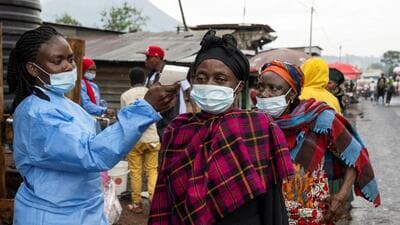
As of May 20, 139 deaths and 600 suspected cases have been linked to the outbreak. This number could increase sharply over a 24-hour period. Cases have been confirmed in Kampala and in Kinshasa, the capitals of Uganda and the DRC, and the two countries’ largest cities respectively.
This, combined with large test positivity among samples as well as reports of clusters of cases in two DRC provinces, hint at a large number of undetected cases. This concern is supported by modeling.
What complicates the response is that there is no approved vaccine or therapeutic intervention for the Bundibugyo species of Ebola, the pathogen behind the current outbreak. The GeneXpert test, developed for the Zaire species of Ebola, cannot detect the Bundibugyo species. The outbreak appears to have gone undetected for a crucial initial period.
The outbreak occurs amid an unstable political environment, particularly in the DRC. Delayed detection, infections amongst health care workers, and cross-border movement would be causes for concern in any disease outbreak. The cases in Kinshasa and Kampala, both far from the presumed epicentre, show that initial delays in identifying the outbreak may have accelerated its spread.
Both the relative difficulty of contracting the disease — infection occurs through the direct transfer of bodily fluids — as well as early deaths (patients often die before they can pass on the infection) mean that Ebola cannot spread fast under normal conditions.
However, the conditions that prevail in the DRC, including an ongoing conflict, are unusual. Large numbers of Congolese refugees are living in camps in southwestern Uganda. Aid cuts have meant that such displaced people must travel more in search of food, increasing their risk of contracting and passing on infections.
Both Uganda and DRC made the Bundibugyo sequence public within four days of the outbreak announcement, enabling a rapid international response. There are now several sequences available. Their distinctive character likely supports a new spillover event. The speed at which data was made available for study shows how rapid, cross-border genomic surveillance can help preparations for a potential epidemic.
India is unlikely to see cases originating in this outbreak. However, there are certainly questions regarding our preparation for any potential pandemic. Given our experience with Covid-19, that India would respond similarly in an analogous situation seems unlikely. Political concerns would most likely colour our response: To admit to cases would be taken as a failure on our part. This would handicap our ability to respond rapidly, in concert with global efforts.
A path that elevates politics above the interests of global public health is a dangerous one.
Apart from this, there are structural problems that India needs to resolve at the earliest: Incentives in India favour publications over making data available, even though it seems almost a truism that data collected using public money and serving a global purpose should be publicly available.
Deaths and reported cases, so far, from the parallel Andes hantavirus outbreak among passengers and crew of the Dutch cruise ship, MV Hondius, are a mere fraction of those in the current Ebola outbreak. However, the difference in attention between what the Andes virus cases have attracted and the Ebola outbreak in the two African countries is notable. Those who contracted or might have contracted a hantavirus infection on board the cruise ship come from almost exclusively high-income countries.
That the deaths of much larger numbers in a low-income setting have attracted far less attention in relative terms speaks to the urgent need to rebalance existing frameworks of global public health.
Previously, USAID, together with the American Centers for Disease Control (CDC) played a major role in containing significant outbreaks, collaborating with WHO and national and African agencies. Last year, however, the Trump administration shut it down. The US also withdrew formally from WHO, depriving the global body of both expertise and resources at a critical time.
The ongoing Ebolavirus outbreak will no doubt underline, as it unfolds, the need to protect global health in a world that is increasingly hyperconnected. Enforcing international law and providing crucial support in conflict situations, ensuring the safety of health workers, increasing global cooperation and encouraging transparency are all important.
But it’s certainly most crucial for governments to step in to fund global health agencies performing essential roles, so that the tantrums of individual donor countries do not affect the world’s ability to respond in a crisis.
Gautam I Menon is an epidemiologist and professor of physics and biology, Ashoka University, Delhi-NCR. The views expressed are personal