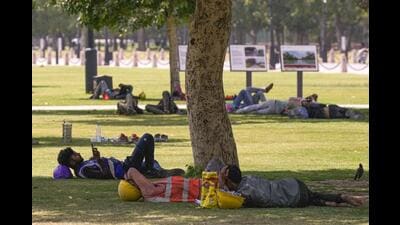
Intense heat is now the new normal for summers in the national capital. As mercury soars to hit new records, despite the relief provided by occasional showers, the roads and the concrete worsen the experience by trapping heat. Yet, while some of us can find respite indoors with access to air-conditioning, or avoid stepping out at noon, millions in India do not have such recourse. Daily wage workers, sanitation workers, street vendors, delivery workers, construction labourers, and informal workers cannot afford to avoid work just because it is too hot outside. Heat, for them, is not merely an inconvenience, it is an occupational hazard.
Heat is not experienced equally by all everywhere. Urban heat is exposing the deep inequalities embedded within India’s development model. Cities today are heating faster than surrounding rural areas because of the urban heat island effect. Add to this shrinking green cover, disappearing water bodies, unending construction work, vehicular pollution and dense, unplanned urbanisation, and Indian cities are becoming massive heat traps. As per the National Institute of Urban Affairs, India’s metropolitan cities have already witnessed an increase of nearly 0.9°C in average temperaatures over recent decades, with heat waves becoming more frequent and intense. Driven by unplanned urbanisation and the climate crisis, urban heat is expected to worsen significantly, with temperatures projected to rise by up to 4.4°C by 2100 under the worst-case emissions scenario.
But beyond climate science, there is also a political economy of heat. The question, ultimately, is: Who gets protection from extreme weather and who is left exposed to it?
A close look at India’s cities is instructive about who can access shade and who can’t. Affluent colonies are lined with old trees, parks, and gated spaces. Wealthier homes and offices are designed with cooling in mind — air-conditioning, insulated interiors, shaded parking, and landscaped surroundings. In contrast, informal settlements, industrial belts, and low-income neighbourhoods are often the hottest parts of the city. Tin roofs amplify temperatures, congested lanes prevent ventilation, and there are few trees and almost no open spaces.
Even mobility reflects this inequality. A person travelling in an air-conditioned car experiences the city differently from someone waiting at a bus stop in 45°C-plus heat. Shade itself becomes infrastructure, unevenly distributed and deeply political.
Urban planning in India has historically treated trees and open spaces as aesthetic add-ons rather than critical public infrastructure. Roads are widened for vehicles while footpaths shrink. Flyovers rise rapidly, but trees that took decades to grow are cut overnight. In many cities, physical infrastructure remains a key indicator of development rather than heat resilience.
Ironically, the very solutions that cities adopt to combat heat often worsen the problem. Air-conditioners cool indoor spaces but release hot air outdoors, increasing ambient temperatures. Glass-clad buildings designed without climatic sensitivity require massive cooling loads. Excessive paving eliminates permeable surfaces that naturally cool neighbourhoods. Heat, then, becomes cyclical — cities respond to warming with more energy-intensive cooling, which, in turn, contributes to further warming. Extreme heat and heat waves are also often overlooked because they are not as visually dramatic as floods, cyclones or hurricanes. Heat kills silently. There are no collapsing buildings or overflowing rivers to capture headlines. Yet, heat stress affects productivity, health, livelihoods, and even mental well-being. It is one of the deadliest climate risks facing urban India.
Vulnerable groups are forced to adapt individually to what is fundamentally a systemic failure. Workers wrap towels around their heads, vendors carry extra water, and labourers rest under bridges or whatever shade they can find. Informal coping mechanisms replace formal urban planning.
What are the solutions? The first is to stop treating heat as only an environmental issue. Urban heat is a governance, labour , and public health issue. Heat Action Plans, now adopted by several Indian cities, are an important beginning, but many remain reactive rather than transformative. Announcing advisories asking people to stay indoors assumes that everyone has the option to do so.
What cities urgently need is cooling equity. This means investing in shaded public infrastructure — bus stops, markets, walkways, schools, and health centres. It means protecting and expanding urban tree cover not through token plantation drives, but long-term ecological planning. Mature trees are among the most effective cooling systems cities possess, yet they are routinely sacrificed.
Indian cities must also rethink building design. Traditional planning and architecture in the subcontinent evolved around climate sensitivity — courtyards, shaded verandahs, ventilation corridors, and reflective materials. Much of this has been abandoned in favour of energy-intensive urban forms borrowed from very different climatic contexts. Cooling cannot depend entirely on ACs in a country where millions still struggle for reliable electricity
Equally important is recognising workers on the frontlines of heat exposure. Construction workers, waste pickers, street vendors, and delivery personnel need labour protections during extreme heat events — access to drinking water, shaded rest spaces, flexible working hours and emergency medical support. Heat resilience cannot be built while ignoring those who keep cities functioning. As India urbanises rapidly, the battle against heat will not only be fought through technology or climate policies. It will be fought on sidewalks, under trees, at bus stops, in informal settlements, and in the everyday struggle for dignified public spaces.
There is also a larger philosophical question: What kind of cities are we building and how? Do we really want cities where millions of residents are exposed to the elements? Are cities designed for infrastructure and vehicles, or for people? Those who suffer the most from heat often have the least say in planning decisions. Their discomfort rarely enters air-conditioned meeting rooms where urban futures are imagined. If we assume that cities are made for all the people who live in them, their designs must be drafted with everybody represented.
Swati Singh Sambyal and Lars Stordal are with GRID-Arendal, a science-policy centre based in Arendal, Norway. The views expressed are personal