In 1884, the year Tokyo completed its first modern sewer network, Bombay’s municipal commissioners were debating whether to extend water drainage to its native quarters. They decided against it, not for lack of funds or expertise, but because they had a workforce of hereditary, disenfranchised manual scavengers who made the question of modern sanitation infrastructure unnecessary. Such thinking continues to influence Indian attitudes to sanitation.
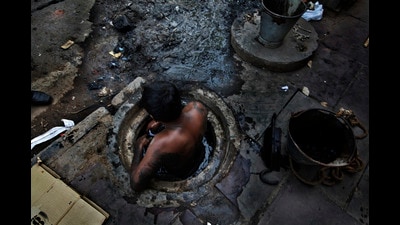
The 2011 Socio Economic and Caste Census identified roughly 2.6 million insanitary latrines in India, many of which still required manual cleaning. Activist organisations estimate that possibly over a million people, most of them Dalits and many of them women, remain engaged in forms of manual scavenging and sanitation labour, removing human excrement with their bare hands, carrying it on their heads in baskets lined with sack material. As per government data, around 400 of them died cleaning septic tanks between 2018 and 2023, but the true figure is several times higher, because deaths from contracted infections, respiratory damage, and cardiovascular failure weeks after exposure are not counted. Studies and state-level reports have suggested substantially lower life expectancy among sanitation workers; 2016 estimates from Maharashtra placed it at around 58 years, against a national average near 68.
Manual scavenging has survived modernisation. Even when flush toilets were adopted, they brought septic tanks which need cleaning. Thus, the same people who had previously cleaned dry latrines now cleaned septic tanks. The Swachh Bharat Mission built 100 million toilets between 2014 and 2019, but its mandate was explicitly confined to constructing toilets and not building additional sewage or septage treatment facilities.
According to the Central Pollution Control Board, India generates nearly 73 billion litres of sewage per day, against an installed treatment capacity of roughly 44% of that. Of that installed capacity, only a third of total daily sewage generation is actually treated. Even when sewage reaches a treatment plant, the reliability of treatment remains highly uneven. Bihar, with one of the densest concentrations of new Swachh Bharat toilets, generates 2,300 million litres of wastewater per day against a total installed treatment capacity of 10 million litres. Swachh Bharat, while making life more convenient, has simply shifted the labour at the other end of the toilet from one confined space to another, with the same caste doing the work.
Manual scavenging also predates colonialism. Ancient Hindu texts assigned the removal of human waste as a hereditary duty of those outside the varna system. British rule formalised the practice by giving it wage structures, contracts, and municipal registries, while simultaneously building water-flushed sewage systems for themselves in the European quarters of Bombay, Calcutta, and Madras.
Compare this with what happened elsewhere. In 1960, South Korea had a per capita income lower than India’s and a sewage infrastructure in ruins due to the Korean War. But it did not have a hereditary labour system. The Korean government integrated water and sanitation into its five-year development plans from 1965 and, as a result, Seoul’s sewerage coverage went from 21% in 1967 to 57% by the end of the 1970s, and over 95% today.
Japan’s path was different. Meiji-era Tokyo resisted building modern sewers because night soil was a valuable agricultural input. Night soil lost its agricultural value after World War II when chemical fertilisers replaced it, and urban populations no longer had farms nearby to receive it. Thus, from the 1950s, Japan built a comprehensive and mechanised sewage treatment system that is now among the best in the world. Malaysia and Thailand followed suit, achieving near-universal sanitation coverage many decades ago. One important difference is that none of these countries had a hereditary caste system assigning excreta management to a specific group, which reduced political tolerance for keeping sanitation labour invisible.
In India, not much changed at Independence, until the 1993 Employment of Manual Scavengers and Dry Latrines (Prohibition) Act banned the practice. However, the Act restricted this to dry latrines and left septic tank cleaning, sewer entry, and drain clearance outside its scope. Through the 2000s, courts repeatedly ordered mechanisation and provision of protective equipment – these were largely ignored. Successive bans, rehabilitation schemes, and infrastructure upgrades have only served to push the problem out of view.
There is also an economic argument for a serious change to the current system that is salient in light of the current forex crisis. The Netherlands and Denmark apply over half their sewage sludge to agricultural land. Germany has mandated phosphorus recovery from large wastewater treatment plants by 2029. Modern nutrient recovery from treated wastewater can, according to estimates from the International Fertiliser Association, meet up to 30% of global phosphorus demand and 20% of nitrogen demand, at costs 20-30% below synthetic equivalents. India imported close to $15 billion worth of fertilisers in 2025–26 while simultaneously generating billions of litres of sewage every day, containing precisely those nutrients; almost none of this is recovered. The fertiliser we are importing is, in part, the fertiliser we are flushing away.
What decolonising sanitation requires is a national programme of urban sewage infrastructure investment: Building new sewage treatment plants, mechanising all contact with human waste, and linking that infrastructure to a nutrient recovery programme that can begin to replace imported synthetic fertiliser. The alternative is a fertiliser import bill that grows with every harvest, and a significant death toll among sanitation workers.
A country that still sends human beings into sewers cannot call itself developed. Building a modern sewage and nutrient recovery system would end one of India’s oldest forms of caste labour, and turn waste into one of the inputs of national self-sufficiency.
Ramanan Laxminarayan is president, One Health Trust. The views expressed are personal