A small group of American influencers, commentators and public officials has found itself at the center of a debate over Russia’s global image after appearing in or around the country’s flagship economic gathering, the St. Petersburg International Economic Forum.
The presence of , Rodney Mims Cook Jr. and, separately, influencers has generated headlines because it comes at a time when Russia remains under extensive Western sanctions and continues to wage .
What is SPIEF and why does it matter?
Held annually in St. Petersburg, SPIEF is Russia’s premier economic and investment conference. Often compared to the World Economic Forum in Davos, the event brings together government officials, business leaders, academics and public figures from around the world.
For the Kremlin, however, the forum serves a broader purpose than economics. It offers President a platform to showcase Russia’s international partnerships and counter perceptions that the country has become isolated following its invasion of Ukraine.
This year’s event attracted thousands of participants from more than 100 countries, according to Russian officials.
Why are the American visitors attracting attention?
The significance of the visits lies less in who attended and more in the message their presence sends.
Russia has spent years facing diplomatic isolation from much of the West. The appearance of recognizable American personalities allows Russian officials and state media to highlight continued engagement with U.S. citizens despite political tensions.
Analysts say images of Americans touring Moscow, participating in discussions and speaking positively about Russian culture can be used domestically to reinforce the argument that Russia remains globally relevant and attractive to foreign visitors.
Candace Owens’ high-profile appearance
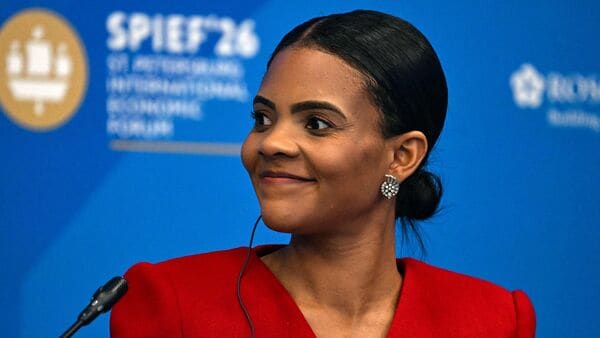
Among the American guests, emerged as one of the most visible participants.
The conservative commentator and podcaster attended SPIEF discussions focused on family values and cultural issues. During her visit, she praised Moscow’s architecture, churches and public spaces, while arguing that many Americans hold outdated perceptions of Russia.
Her comments received extensive coverage in Russian media and were amplified on social media, making her one of the most discussed foreign attendees at the forum.
Owens has said she financed the trip herself and did not receive Russian funding.
Rodney Mims Cook Jr. and questions in Washington
Another notable attendee was Rodney Mims Cook Jr., chairman of the U.S. Commission of Fine Arts.
Cook participated in cultural discussions and spoke about artistic and architectural links between Russia and the United States. Russian officials portrayed his presence as evidence of continuing dialogue between the two countries.
His attendance also sparked questions in Washington after US Secretary of State Marco Rubio said he was unaware of an official American delegation attending the forum.
The episode highlighted uncertainty over whether Cook’s appearance should be viewed as a cultural visit or as a sign of broader engagement.
The Tate brothers’ Moscow visit
Although Andrew and Tristan Tate did not participate in SPIEF, their presence in Russia attracted considerable attention.
The brothers, who command millions of followers online, shared videos and photographs from Moscow, including visits to landmarks, churches and public spaces.
Representatives for the Tates said they traveled to better understand life in Russia and were not paid for the visit.
Their arrival generated significant online discussion because both brothers are influential voices within conservative and “manosphere” communities and have built large audiences by promoting traditional masculinity and anti-establishment views.
What does this mean for Putin?
For , the value of such visits is largely symbolic.
Russia’s leadership has sought to demonstrate that sanctions and diplomatic pressure have not cut the country off from the rest of the world. High-profile foreign visitors help reinforce that narrative, particularly when they come from the United States.
The appearances also provide material for Russian state media, which can point to foreign guests as evidence that Russia continues to attract international interest despite geopolitical tensions.
Analysts note that the impact on American public opinion is likely limited. However, the visits may be more important inside Russia, where they can be presented as proof that Western personalities are still willing to engage with the country.
A changing form of influence
The episode also reflects a broader shift in how governments seek international attention.
Where economic forums were once dominated by politicians, diplomats and corporate executives, today’s gatherings increasingly feature podcasters, influencers and online personalities with audiences that rival those of traditional media organizations.
Their presence at Russia’s premier economic event illustrates how influence is no longer exercised solely through diplomacy or business. Social media figures now play a growing role in shaping perceptions, narratives and political conversations across borders.
For Moscow, attracting such personalities offers an opportunity to project normalcy and international engagement. For the visitors, the trip provides access to one of the world’s most politically consequential and controversial countries.
Whether the visits change global perceptions of Russia remains uncertain. But they underscore how modern geopolitics increasingly intersects with online influence, culture and media visibility.