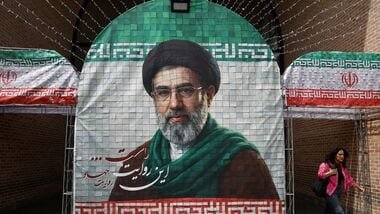
Iranian Supreme Leader ‘s health is reportedly deteriorating, with sources close to President Masoud Pezeshkian’s administration claiming that concerns over his condition are growing within the country’s top leadership, UK-based IranWire reported.
According to the IranWire report, citing two sources close to the Pezeshkian administration, Mojtaba Khamenei has not met any cabinet members since the February 28 US attack on the ‘s compound that killed his father and other family members. The sources said rumours that he is in an “extremely critical condition” and could die at any moment are circulating within the highest levels of the Iranian regime.
One source close to Pezeshkian’s cabinet told IranWire: “We would not be surprised if we heard news of his martyrdom soon.”
The claims and rumours surrounding Khamenei’s health has been circulating for past several weeks as he has not made any public appearance or delivered any speech since becoming Supreme Leader. Only a handful of letters attributed to him have been published by Iranian state news agencies.
Pezeshkian’s reported meeting with Khamenei
Questions over Mojtaba Khamenei’s condition have also been raised by a separate report from Iran International, which claimed that Pezeshkian may have had only a brief and unusual interaction with the Supreme Leader.
According to the report, Pezeshkian was taken to a secret location in Tehran and met Khamenei inside a dark, tinted-windowed car. The president reportedly could not see the Supreme Leader and was not allowed by his guards to shake hands with him.
The interaction allegedly lasted only a few minutes. Iran International further reported that Pezeshkian later asked whether the voice he had heard actually belonged to Khamenei.
Mojtaba Khamenei suffered severe facial and leg injuries in the February 28 US-Israel attack, according to Reuters.
What happens if Iran’s Supreme Leader dies?
Iran’s Constitution provides a mechanism for dealing with a vacancy in the position of Supreme Leader.
Under Article 111, if the Supreme Leader dies, resigns, is removed or becomes temporarily unable to perform his duties, a three-member council assumes his responsibilities until a new leader is appointed.
According to an AP report, the council consists of the President, the head of the judiciary and a religious jurist from the Guardian Council, under the procedure specified by the Constitution.
The arrangement is reportedly designed to ensure continuity in the exercise of the Supreme Leader’s powers while the succession process takes place.
Who chooses Iran’s next Supreme Leader?
The 88-member Assembly of Experts is constitutionally responsible for selecting the Supreme Leader.
If the position becomes vacant, the Assembly is expected to appoint a successor. The decision would be especially significant because the Supreme Leader holds extensive authority over Iran’s armed forces, foreign policy, judiciary and other key institutions.
Who could succeed Mojtaba Khamenei?
There is currently no confirmed succession process, and the reports about Mojtaba Khamenei’s health remain unverified. However, several senior clerics and establishment figures have previously emerged in discussions about potential successors.
Alireza Arafi
Ayatollah Alireza Arafi is a senior cleric and member of Iran’s Guardian Council, with strong links to the country’s seminary establishment.
His standing within the religious establishment makes him one of the figures who could potentially be considered in a future leadership contest.
Hashem Hosseini Bushehri
Ayatollah Hashem Hosseini Bushehri is another senior cleric with strong connections to Iran’s religious establishment in Qom.
He has held senior positions within the Assembly of Experts and the clerical establishment.
Gholam-Hossein Mohseni-Ejei
Judiciary chief Gholam-Hossein Mohseni-Ejei is another powerful establishment figure.
He has a long background in Iran’s judiciary and security apparatus and is regarded as a hardline figure within the Islamic Republic.
Hassan Khomeini
Hassan Khomeini, the grandson of Islamic Republic founder Ayatollah Ruhollah Khomeini, has also been mentioned as a possible future contender.
His political positioning, however, differs from that of several hardline figures within Iran’s ruling establishment, potentially making his candidacy more complicated.
Could Iran move to collective leadership?
Iran’s constitutional framework also allows for the possibility of collective leadership under certain circumstances.
If the Assembly of Experts is unable to agree on a single individual, a leadership council could potentially emerge as an alternative.
Such an arrangement would represent a major change from Iran’s traditional system, in which one Supreme Leader exercises the country’s highest political and religious authority.
Could the IRGC gain greater influence?
Any sudden leadership vacuum could also increase the influence of the Islamic Revolutionary Guard Corps (IRGC).
The IRGC already has significant influence over Iran’s military, security apparatus and economy. During a succession crisis, it could become an important power broker, particularly in determining which candidate is acceptable to the security establishment.