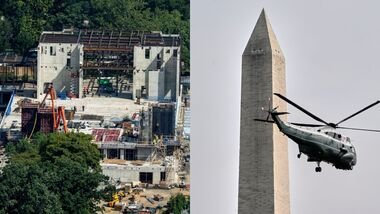
The National Transportation Safety Board (NTSB) believed that the ongoing White House construction contributed to radio problems that led to a close call between Marine One, which was carrying US President Donald Trump and an Envoy Air jet earlier this month.
The NTSB, in its new report, said that there were communication issues between air traffic control frequencies and just before the passenger jet got too close to Marine One, which was taking off from a temporary location at the White House on August 4.
‘Not adequate line-of-sight’
The seven-page report noted that due to the ongoing construction on the White House grounds, which include the White House ballroom and a helipad, Marine One has been taking off from the Ellipse instead of the South Lawn.
The investigation also found that there was not adequate line-of-sight to ensure communications between the radio transmitter/receiver sight and The Ellipse. According to The New York Times, there had been no known issues with the radio frequency before the incident.
The Associated Press reported that the week before the president’s helicopter got too close to that Envoy Air jet near Ronald Reagan Washington National Airport, air traffic controllers and Marine One pilots met to discuss controllers not receiving the standard three-minute warning call ahead of its flights. They made plans to relay radio calls through someone else if there were future problems, but that was also unsuccessful on August 4, when the close call happened.
Communication issues came up again when air traffic controllers at the Reagan airport weren’t able to hear Marine One and had to ask a support helicopter for help just before takeoff.
“I can’t hear Marine One,” an air traffic controller told the support helicopter, according to AP “If you hear Marine One, can you let me know?”
Marine One had trouble talking to ATC
After the incident earlier this month, technicians discovered that the reason Marine One was having trouble talking to the tower at times was because the helicopter shifted to a new location during the construction. So the moved the radio receiver out of a neighborhood near the airport and to the top of the tower at Reagan to fix the problem.
“Even though they were aware of some previous communications issues, they never got at the root cause,” aviation safety expert Jeff Guzzetti was quoted as saying by AP.
The FAA said in a statement that it took immediate action after the incident by moving that antenna “to improve communications” between the airport and Marine One pilots.
Trump was not in danger
After the incident became public, White House and the FAA have insisted that the president was never in danger, though Marine One was flying 0.82 miles apart laterally and about 700 feet vertically from the passenger jet. According to Forbes, FAA rules say aircraft in Class B airspace are required to be separated at least 1.72 miles laterally or 500 feet vertically.
The incident involving Marine One came little over a year after a midair collision between an Army Black Hawk helicopter and near the busy airport that killed 67 people.
Following the deadly crash, the FAA had decided that all takeoffs and landings at the airport would be halted anytime a helicopter passes by on a conflicting route. The airspace near the White House and Reagan is heavily congested with military and commercial aircraft.