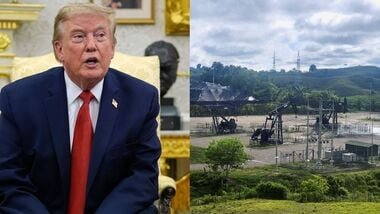
US President Donald Trump’s administration is reportedly working on a deal that would give Washington long-term access to some of Venezuela’s crude oil reserves, potentially bringing down the cost of importing .
Here’s what we know about the proposed deal
Citing sources familiar with the development, Reuters reported on Thursday (local time) that an agreement, which is likely to be signed and made public soon, could allow the Trump administration to secure a group of Venezuelan oilfields for development by American companies. The move would ensure a guaranteed supply of oil for the .
One of the people familiar with the development said, “This is real and being discussed at the highest levels of the US and Venezuelan governments.”
How will the deal work? What are the challenges?
Another source told Reuters that to make the deal work, the two sides are considering a “lease” as the legal model. The deal could involve a further auction or tender process to allocate each oilfield among US producers.
According to a Bloomberg report, the lease model that has been discussed will be for 100 years on several oilfields. However, citing sources, the report added that the terms of the agreement could change.
Citing experts, Reuters reported that while the complete details of the proposed deal are yet to emerge, it could raise constitutional questions and face legal challenges.
The development comes at a time when Venezuela is considering leaving the Organization of the Petroleum Exporting Countries (OPEC) as it boosts ties with the US. Venezuela, which joined as a founding member in 1960, has reportedly not met OPEC quotas for years as its state-run oil industry has suffered from neglect and corruption. Separately, Washington has been at odds with OPEC due to its influence on oil prices for years now.
Reuters reviewed a list of 17 oilfields under discussion, which includes undeveloped fields in the vast Orinoco Belt as well as mature assets in Lake Maracaibo. Some of these fields are currently operated by a small Chinese company under a contract signed during Nicolás Maduro’s administration.
US-Venezuela boost ties after Maduro’s capture
The proposed deal comes months after Washington captured and removed former Venezuelan President Nicolas Maduro from power in January, following which the US has been attempting to secure a stable flow of Venezuelan for US refineries while promoting American investment in Caracas’s deteriorated energy industry, which currently produces some 1.25 million barrels per day of crude.
Separately, the administration is under intense pressure over rising gasoline prices ahead of the midterms in November. If an agreement comes through, the move would bring a reduction in gasoline prices through cheaper oil supplies and expanded output.
In the meantime, Washington is also looking for solutions to replenish its oil stockpile, the (SPR), including the possibility of crude swaps with American producers.
The SPR has around 290 million barrels stored in underground salt caverns, leaving it at roughly 41 per cent of its maximum capacity. Budget constraints and maintenance work have slowed efforts to replenish the stockpile after the US drew down its reserves following Russia’s invasion of Ukraine in 2022 and again when the Iran war began in February.
A Bloomberg report suggests that since Maduro’s capture, the US has controlled Venezuela’s oil sales as it eased sanctions to allow American companies and oilfield contractors to carry out business activities in the country. Washington has yet to reveal how much revenue has been generated so far from Venezuelan crude sales.
(with agency inputs)