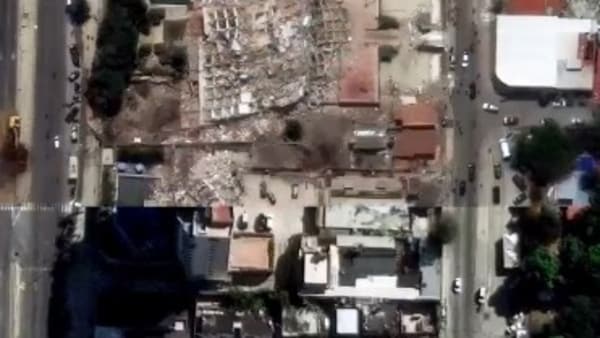
As rescue teams continued searching for survivors on Sunday following the two powerful earthquakes that struck Venezuela last week, high-resolution satellite imagery from Vantor revealed the extensive structural devastation caused by the disaster.
The death toll from Wednesday’s twin earthquakes had climbed to nearly 1,500 as international rescue teams arrived in La Guaira, the state hardest hit by the disaster. The region, located about 40 kilometers (25 miles) north of Caracas, has been devastated by the earthquakes, compounding the challenges faced by a country already struggling with a prolonged political and economic crisis.
Significant destruction is visible throughout La Guaira, located north of Caracas, where dozens of high-rise residential buildings in the Playa Grande neighbourhood, just north of Simon Bolivar Airport, have collapsed.
Quick answers to key questions
What caused the destruction in La Guaira, Venezuela?⌵
The destruction in La Guaira, Venezuela, was caused by two powerful earthquakes with magnitudes of 7.2 and 7.5 that struck the region.
Why are rescue teams focusing on the first 72 hours after the earthquakes?⌵
The first 72 hours are critical for rescue teams because the probability of finding survivors decreases significantly after this timeframe, making early rescue efforts vital.
How many buildings were reported to have collapsed in Venezuela after the earthquakes?⌵
At least 774 buildings were reported to have collapsed following the twin earthquakes in Venezuela.
What were the immediate effects of the earthquakes on the population in La Guaira?⌵
The earthquakes resulted in nearly 1,500 deaths, over 3,100 injuries, and left 12,721 residents displaced in La Guaira.
Should international aid be expected following the earthquakes in Venezuela?⌵
Yes, international aid has already begun, with 24 nations sending supplies and search-and-rescue personnel to assist the affected areas.
Before-and-after satellite images also highlight severe damage to numerous commercial properties, facilities, and other buildings across the city. A comparison of images captured 10 days apart shows Playa Grande blanketed in dust in the aftermath of the disaster.
Although some buildings remained standing, many others were completely destroyed. One white building at a street corner appears to have collapsed entirely, resembling a house of cards, while at least five neighboring structures have been reduced to rubble.
Before-and-after satellite images of the collapsed Residencia Nautilus and a damaged shipping container yard along Avenida La Playa in La Guaira illustrate the scale of the destruction. The image captured on May 8 shows rows of shipping containers neatly stacked near the waterfront. By June 25, nearly two months later, several nearby buildings had collapsed, leaving the area severely damaged, according to NDTV.
The industrial district of La Guaira also suffered extensive losses, with warehouse buildings reduced to rubble. Little remained except piles of debris and exposed steel reinforcement bars that once formed part of the structures.
An apartment complex in La Guaira also sustained extensive damage during the earthquakes. imagery captured on May 8 shows rows of closely built homes with black roofs standing intact. In the post-earthquake image, however, nearly half of the buildings had either collapsed completely or were left dangerously leaning due to the impact of the tremors.
Rescue efforts, school closure and more
Interim President , after announcing a presidential commission that would assess the habitability of buildings, stated, “Rescue and recovery efforts are ongoing. Today (Sunday) we have recovered people alive and, therefore, operations are not being suspended. We always maintain hope.”
Surrounded by several cabinet ministers, President Rodriguez announced that schools would remain closed for an additional week, while electricity service in La Guaira had been restored to approximately 75% of the affected area, as per Reuters.
The government, led by Rodriguez since she assumed office after her predecessor was removed during a US operation in January, initially expressed gratitude to civilian volunteers delivering humanitarian aid to La Guaira. However, authorities later restricted access to the main highway, explaining that heavy traffic was hindering the movement of emergency and rescue vehicles.
Meanwhile, earlier in the day, Jorge Rodriguez, the acting president’s brother and president of the National Assembly, reported that the death toll had increased by 20 on Sunday, bringing the total to 1,450. He also stated that 3,150 people had been injured, 12,721 residents had been displaced, and 774 buildings had collapsed.
“We are in critical hours, in crucial hours to continue rescuing lives and to build camps where those people who have lost their homes, or who cannot return, for whatever reason, to their residences can stay,” he mentioned.