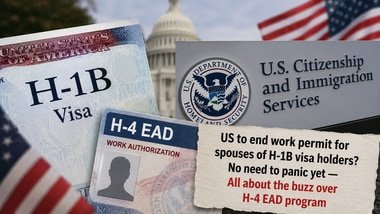
The Trump administration is considering ending employment authorisation for some spouses of H-1B visa holders, changing a policy that has allowed eligible H-4 spouses to work legally in the United States for more than a decade. The move could impact working families and household incomes.
What’s the move?
The proposal, posted on the website under the Office of Information and Regulatory Affairs, is titled “Removing H-4 Dependent Spouses From the Classes of Noncitizens Eligible for Employment Authorization”.
It says, “DHS [US Department of Homeland Security] is proposing to remove from its regulations certain H-4 dependent spouses of H-1B nonimmigrant workers as a class of aliens eligible to request employment authorization under the (c)(26) category.”
Who are H-4 dependents?
H-4 dependents are the legal spouse and unmarried children under the age of 21 of a primary temporary worker in the United States, such as an H-1B visa holder.
Simply put, a spouse and unmarried children under 21 are eligible to come to the US as H-4 dependents of an H-1B worker.
According to Murthy Law Firm, H-4 status must be separately extended for each family member by filing an application with USCIS. It says that H-4 status is not automatically extended when the spouse or parent receives an extension of H1B status.
Persons in H-4 status are permitted to live in the US and to attend school, but are not permitted to work. But certain H-4 spouses can work if they apply for and receive an Employment Authorization Document (EAD).
“You will not be authorized to work until USCIS approves your Form I-765,” says the US Citizenship and Immigration Services ().
What does this mean?
As per reports, this proposal would reverse the changes made in the , “Employment Authorization for Certain H-4 Dependent Spouses.”
It will restore DHS’s long-standing policy of not extending eligibility to request employment authorization to H-4 dependent spouses.
It proposes to remove H-4 dependent spouses from the category of foreign nationals eligible to receive Employment Authorization Documents, or EADs.
No need to panic yet
The change has not taken effect, and nothing has changed for H-4 EAD holders. This is not a proposed rule yet. The item has been classified as a “Long-Term Action” and, significantly, the date for a proposed rule is listed as “To be determined.”
There is no draft text available, and no deadline has been set as yet for the rollout of a draft proposal.
Before an H-4 EAD could actually be eliminated, DHS would publish a proposed rule, invite public comments, consider and respond to those comments, publish a final rule and establish an effective date. This could take months.
What could change if this rule is implemented?
The current US Citizenship and Immigration Services rules continue to allow certain H-4 dependent spouses to apply for an Employment Authorization Document, or EAD.
The H-4 EAD program was created in 2015. The Federal Register said the rule would allow certain H-4 dependent spouses of H-1B workers who were pursuing employment-based lawful permanent residence to apply for employment authorization.
USCIS currently says an H-4 spouse may file for employment authorization if the H-1B spouse meets specified requirements, which include:
1. Is the principal beneficiary of an approved Form I-140, Immigrant Petition for Alien Workers; or
2. Has been granted H-1B status under sections 106(a) and (b) of AC21. Under AC21, H-1B nonimmigrants seeking employment-based lawful permanent residence (green card) may be eligible to work and remain in the United States beyond the six-year H-1B period of admission limitation.
So, this means a change to H-4 employment eligibility would affect not only immigration status but also the ability of qualifying spouses to remain in the US workforce.
According to the Times of India, the significance of H-4 EADs cannot be understood without looking at the US employment-based green-card backlog.
A recent analysis by the National Foundation for American Policy (NFAP) estimated that more than a million Indians, including dependants, were waiting in the first three employment-based green-card categories as of December 2025.
Also, the work permit can serve as a source of income for H-1B families.
The potential financial impact, therefore, depends on whether a household currently relies on the H-4 spouse’s earnings.
If the proposal eventually becomes a final rule that removes that employment authorization, affected spouses could no longer continue working under an H-4 EAD.
Nearly a lakh Indian spouses are estimated to hold H-4 EADs. If the programme were eventually abolished, these families could face a major disruption to their lives.