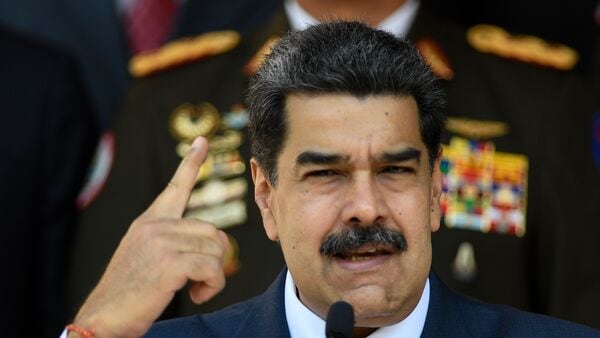
The United States has agreed to ease its sanctions on Venezuela, allowing the government to pay legal fees for Nicolás Maduro’s defence lawyer. The move reverses an earlier restriction that had put the drug trafficking case against the ousted Venezuelan president at risk, according to a court filing on Friday, reported Reuters.
, 63, and his wife Cilia Flores, 69, were captured from their home in Caracas by US special forces as part of Operation Absolute Resolve on January 3 and brought to New York to face criminal charges, including narcoterrorism conspiracy. Both have pleaded not guilty and are currently being held in a Brooklyn jail while awaiting trial.
Maduro’s lawyer, Barry Pollack, had approached Manhattan-based US District Judge Alvin Hellerstein in February, seeking dismissal of the case on the grounds that US sanctions were preventing the Venezuelan government from covering his legal fees.
Pollack argued that this restriction violated Maduro’s constitutional right in the to be represented by a lawyer of his choice.
This development came a month after a court hearing in which prosecutors reportedly mentioned that Maduro had “plundered Venezuela’s wealth” and therefore should not be allowed to use the country’s funds to pay for his legal defence.
Pollack responded by saying the US government was unfairly interfering with his client’s ability to finance his defence. “He is entitled to use those resources to defend himself,” Pollack told the court, reported NBC News.
According to the defence, neither Nicolás Maduro nor his wife, Cilia Flores, have the financial means to hire lawyers on their own, while the Venezuelan government is willing to bear the cost of their legal representation.
Under US law, all criminal defendants are guaranteed constitutional rights, regardless of whether they are American citizens or not.
What did Hellerstein say?
At a court hearing on March 26, Judge Alvin Hellerstein said he did not plan to dismiss the case, but he appeared doubtful about whether the government was justified in blocking the payments for Maduro’s legal defence.
Prosecutor Kyle Wirshba argued that the sanctions preventing the payments were based on valid national security and foreign policy concerns. He also told the court that Judge Hellerstein could not direct the Treasury Department to change the sanctions, as foreign policy decisions fall under the executive branch, not the judiciary.
Hellerstein pointed out that the United States had already eased some sanctions on Venezuela after Maduro’s removal from power. He also noted that ties between Caracas and Washington had improved since Delcy Rodríguez, Maduro’s former vice president, took over as interim leader of Venezuela.
Hellerstein, a judicial appointee of Democratic President Bill Clinton, mentioned, “The defendant is here, Flores is here. They present no further national security threat. The right that’s implicated, paramount over other rights, is the right to constitutional counsel.”
US President intensified sanctions on Venezuela during his first term in the White House, accusing Nicolás Maduro’s government of corruption and weakening democratic institutions. Washington also described Maduro’s 2018 re-election as fraudulent.
Maduro rejected those allegations, as well as the accusations linking him to drug trafficking, claiming they were being used as excuses for what he said was the US attempt to gain control over Venezuela’s vast oil reserves as a major South American OPEC nation.
(With inputs from agency)