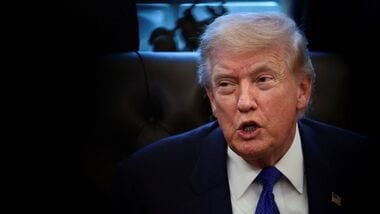
The US Supreme Court on Monday refused to allow President Donald Trump to remove Federal Reserve Governor Lisa Cook, preserving the central bank’s independence and dealing a setback to the administration’s efforts to expand presidential authority over the Fed.
In a 5-4 ruling, the court denied the Justice Department’s request to lift a lower court order that prevents Trump from firing Cook while her legal challenge continues.
The decision means Cook will remain on the Federal Reserve’s Board of Governors as the case proceeds through the courts.
Court leaves Cook in office
Trump sought to dismiss Cook in August 2025, citing allegations of mortgage fraud involving properties she owns in Michigan and Georgia.
Cook, the first Black woman to serve as a Federal Reserve governor, has denied the allegations and argued they were merely a pretext to remove her because of disagreements over monetary policy.
The Supreme Court did not rule on the merits of the case but allowed an injunction issued by a lower court to remain in force.
Lower court questioned Trump’s authority
US District Judge Jia Cobb previously ruled that Trump’s attempt to remove Cook likely violated her constitutional due process rights because she was not given notice or an opportunity to respond before being dismissed.
The judge also found that the allegations cited by Trump were unlikely to qualify as “cause” for removal under the Federal Reserve Act, noting that the alleged conduct occurred before Cook joined the Fed.
The US Court of Appeals for the District of Columbia Circuit later declined to pause that ruling, prompting the administration’s appeal to the Supreme Court.
Why the case matters
The case is viewed as a major test of the Federal Reserve’s independence from political influence.
Congress created the Federal Reserve in 1913 and specified that governors may be removed by the president only “for cause,” a protection designed to shield monetary policy decisions from political pressure.
Legal experts say allowing presidents to remove Fed governors over policy disagreements could undermine confidence in the central bank’s ability to make independent decisions on interest rates and inflation.
Trump repeatedly criticized the Fed
Since returning to office in January 2025, Trump has repeatedly criticized Federal Reserve officials for refusing to cut interest rates as aggressively as he wanted.
He also launched a criminal investigation into then-Federal Reserve Chair Jerome Powell over renovation costs at the Fed’s Washington headquarters.
Powell described that investigation as an attempt to pressure the central bank. A federal judge blocked subpoenas in the case, and the Justice Department later dropped the investigation.
Trump has publicly called Powell a “major loser,” “very incompetent,” and a “numbskull.”
Broader implications for presidential power
The Cook case is part of a broader series of legal battles over the scope of Trump’s presidential authority.
Although the Supreme Court has recently expanded presidential powers in several areas, it has also suggested that the Federal Reserve occupies a unique constitutional position because of its longstanding independence and special statutory protections.
The ruling leaves Cook in office while lower courts continue to consider whether Trump’s attempted dismissal was lawful, ensuring that, for now, the Federal Reserve’s leadership remains insulated from direct presidential removal absent a final judicial ruling.