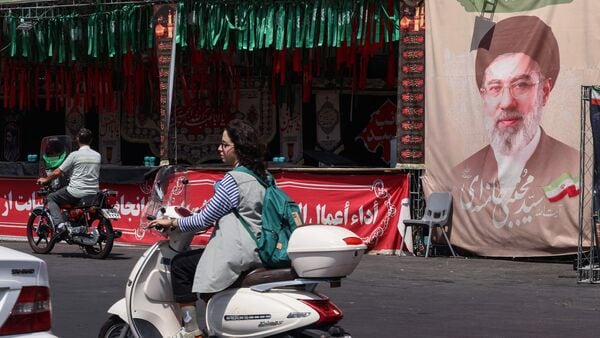
As the and Iran continue to trade strikes after an interim ceasefire collapsed earlier this month, American intelligence agencies believe that Tehran’s new supreme leader, Ayatollah Mojtaba Khamenei, is much more interested in procuring a nuclear weapon than his father and predecessor.
Mojtaba pushing for nuclear weapon? Here’s what intel suggests
Citing officials briefed on the assessments, The New York Times reported that Ali Khamenei, the former supreme leader, who was killed at the start of the war in late February after attacked, had sworn off developing a nuclear weapon. Intelligence inputs further suggested that while American officials asserted that Tehran wanted to be capable of building a nuclear weapon, many believed that the former supreme leader was genuinely hesitant.
While has never publicly called for the Islamic Republic to build a nuclear weapon, US intelligence agencies believe that Khamenei and the hard-line government that emerged after the US and Israel killed many of Tehran’s previous leaders have ambitions to develop advanced nuclear weaponry.
The current Iranian government has already sought to tighten its control over the Strait of Hormuz and has remained a challenging negotiating partner. If the US-Israeli war has increased, rather than reduced, Tehran’s determination to pursue , it would represent another serious consequence of the reported killing of the supreme leader and the US President administration’s initial push for regime change, the report added.
Further, US officials have cautioned that most of the intelligence on Mojtaba’s views was from before the war. During the first part of the war, which was halted in April, Mojtaba Khamenei was severely injured, with American officials stating that he had limited his communications and public appearances due to his injuries, adding that he did not want to be targeted in another .
Tehran restarting nuclear programme?
While Washington believes that Tehran has not made any significant move to restart its nuclear programme, the Islamic Republic has taken some steps to preserve its nuclear assets after the US strikes on key facilities last year or during pauses in fighting in the current war.
American officials believe that Tehran has reportedly moved at least some centrifuges to a hardened underground complex in central Iran that the US refers to as .
Satellite images captured in June, just days after the MoU was signed, showed vehicles entering and exiting the tunnel complex. According to experts cited by CNN, the activity may indicate that Tehran violated the terms of the agreement it had signed with Washington.
Earlier this month, CNN reviewed the latest satellite imagery in collaboration with the Institute for Science and International Security. The analysis raises questions about whether Tehran breached the ceasefire before the declared it “over” and resumed strikes on Iran, citing its continued attacks on vessels in the Strait of Hormuz.
Last year, when Washington launched attacks on Tehran’s nuclear facilities, days after Israel launched an attack in June, the nuclear site at Pickaxe Mountain was reportedly untouched, as it was a far more difficult target for the US military. According to US officials, the underground facilities at Pickaxe are buried deep beneath a mountain, out of the range of some of the most powerful conventional US bombs.
After evaluating the damage at the nuclear facility last year, Iranian officials concluded how deeply US weapons were capable of striking. They now believe that the underground halls at Pickaxe Mountain, which are built even deeper, remain beyond the reach of conventional aerial attacks.
Trump to intensify campaign against Iran?
The assessment comes at a time when Trump is considering whether to intensify the military campaign against Tehran. If officials conclude that the supreme leader remains willing to pursue a nuclear weapon, it could strengthen the case for further escalation.
Earlier this week, Trump threatened to attack the nuclear facility at Pickaxe Mountain, calling it “a possible target for a nice big fat shot right in their front door.”
The latest intelligence assessments are likely to play a key role as Washington weighs its next steps in the conflict with Iran.