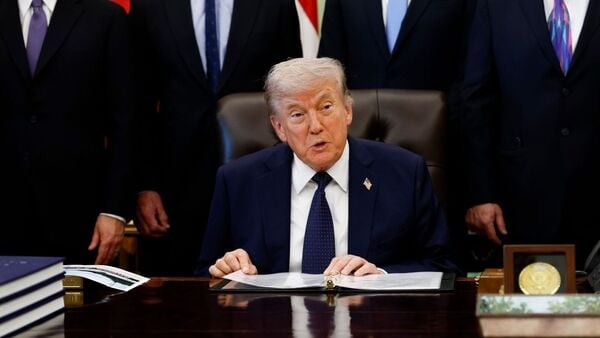
Hours after Iran’s state-run news agency IRNA reported that Tehran has sent a fresh proposal to Pakistani mediators for negotiations with the US, President on Friday (local time) said that he’s “not satisfied” with it.
Speaking to reporters at the White House, he said, “They want to make a deal, but I’m not satisfied with it,” and added, “We just had a conversation with Iran. Let’s see what happens. But I would say that I am not happy.” When asked what the proposal’s shortcomings were, the said, “They’re asking for things I can’t agree to,” AP reported.
The development comes days after Iran sent another proposal to the US, which focused on reopening the strategic while postponing a deal on Iran’s nuclear programme. According to Al Jazeera, early indications were that the previous proposal was unlikely to be accepted in its current form.
US-Iran ceasefire
The proposal came amid a shaky three-week ceasefire between Washington and Tehran, which appears to still be holding, though both countries have traded accusations of violations.
While the ceasefire, which has been extended indefinitely, has largely put a pause to fighting in Iran, Tehran and Washington are in an impasse over the Strait of Hormuz, which is responsible for transporting nearly a fifth of the world’s oil and gas supply. Iran’s Islamic Revolutionary Guard Corps () announced the closure of the Strait days after the US and Israel launched a war in late February. The move shocked the global energy market, with oil prices rising to $126 a barrel in April.
US imposes a naval blockade
After the first round of failed in Pakistan’s capital city, Islamabad, the US President enforced a naval blockade of Iranian ports as a result of Tehran not agreeing to reopen Hormuz. The blockade, which continues to be in place to date, has now become the reason for Iran not agreeing to a second round of peace talks. Iranian officials cited the blockade as the primary reason for dismissing peace talks with Washington, despite Pakistani mediators scrambling hard to convince them. Last week, Iran’s Foreign Minister visited Islamabad, a move which renewed hopes of a peace deal soon; however, a foreign ministry spokesperson denied a meeting between the two sides. Before Trump could send special envoy Steve Witkoff and his son-in-law Jared Kushner to hold talks in Islamabad, Araghchi departed Pakistan, following which Trump called off his delegation’s visit to Pakistan.
US-Iran negotiations continue
Negotiations have continued by phone after Trump called off his envoys’ trip to Pakistan last week, the president said. He expressed frustration with Iran’s leadership, describing it as fractured. “It’s a very disjointed leadership,” he said. “They all want to make a deal, but they’re all messed up,” AP quoted Trump.
Iranian leader speaks to regional counterparts
On Friday, Araghchi held a flurry of calls with several of his regional counterparts, including Turkey, Egypt, Qatar, Saudi Arabia, Iraq, and Azerbaijan, to brief them on his country’s latest initiatives to end the war, according to his .
He also spoke with European Union foreign policy chief Kaja Kallas. The two discussed ongoing diplomatic efforts to reopen the Strait of Hormuz and long-term security arrangements, Kallas’ office said in a statement. Kallas has also been in contact with the European Union’s Gulf partners.
Iran ready to resume diplomacy: Masoud Pezeshkian
Iranian President Masoud Pezeshkian on Thursday said that the Islamic Republic is ready to resume diplomacy with Washington, provided that the latter drops its “maximalist” demands and stops its “maritime piracy” against Iranian ships in the Persian Gulf, IRNA reported.
He made these remarks during a phone call with Japanese Prime Minister Sanae Takaichi and accused the US and Israel of committing war crimes against the Islamic Republic during the recent war of aggression by assassinating Ayatollah Ali Khamenei and senior political and military officials, and attacking key public infrastructure, including schools, hospitals, and safeguarded nuclear facilities.
Since the war began in late February, both sides have reached out to several world leaders, who are also hoping for lasting peace in the , as the closure of the Strait of Hormuz has created panic across the world.
- Diplomatic negotiations between the U.S. and Iran are at a standstill due to unmet demands.
- The closure of the Strait of Hormuz has significant implications for global oil markets.
- The U.S. naval blockade against Iran complicates peace efforts and fuels regional tensions.