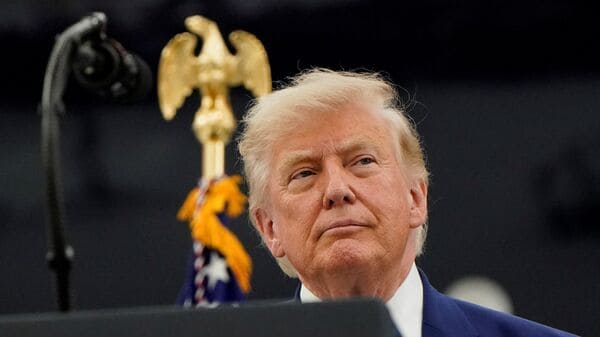
Days after signing the 14-point Memorandum of Understanding (MoU) to end the war with Iran, US President Donald Trump on Friday (local time) reiterated the terms of the 60-day negotiation period, declaring that Tehran would receive “not ten cents” in financial relief.
Trump made these remarks in a Truth Social post and contended that he did not sign the peace deal out of desperation, but rather from Iranian necessity, as he maintained a tough stance on providing financial relief to the Islamic Republic, according to the 14-point MoU.
Trump claims Iran is finished
He wrote, “We didn’t meet out of desperation, Iran did. They are FINISHED! We’ll play out the 60 days. They get no money, not ten cents!”
Quick answers to key questions
What are the main terms included in the US-Iran Memorandum of Understanding (MoU)?⌵
The MoU includes an immediate cessation of hostilities, a 60-day negotiation timeline, removal of the US naval blockade, safe passage for commercial vessels through the Strait of Hormuz, and plans for lifting sanctions and unfreezing Iranian assets.
Why did Trump assert that Iran will receive ‘not ten cents’ from the peace deal?⌵
Trump stated that the peace deal was signed due to Iran’s necessity rather than desperation from the US, emphasizing that Tehran would not receive financial relief during the negotiation period.
How does the US-Iran peace deal differ from Trump’s initial demands before the war?⌵
The deal represents a significant retreat from Trump’s initial stance, which demanded Iran’s unconditional surrender, while the signed MoU includes provisions that still allow Iran to retain some nuclear capabilities.
Should the US expect economic repercussions from the US-Iran MoU?⌵
Trump expressed concerns about a potential worldwide economic depression if the war continued, suggesting that securing the deal was essential to prevent severe economic fallout.
What symbolic significance does the signing location of Versailles hold for the US-Iran deal?⌵
The signing at Versailles carries historical weight, symbolizing national humiliation, and contrasts sharply with the US’s expectations and demands prior to the war, marking a notable diplomatic retreat.
In another post, the US President claimed that the war has “diminished” Tehran to the point where it can no longer possess a functional Air Force, Navy, radar systems, or anti-aircraft equipment. He wrote, “The War has diminished Iran! It doesn’t, any longer, have an Air Force, a Navy, anti-aircraft equipment, Radar, or practically anything else, and yet the Dumocrats say that Iran is better off now than it was four months ago.”
Trump’s comments come at a time when the Democrats have criticised him and have reportedly argued that the Islamic Republic is now in a stronger position than it was four months ago. Dismissing these claims, he characterised the opposition’s perspective as uninformed.
Following his remarks, the White House posted a video on its social media account and wrote, “The president has pulled off something here that most experts, six months ago, wouldn’t have thought was possible.” The video contains clips of news reports underscoring Washington’s success in Iran.
Earlier on Thursday, speaking with Axios News, Trump claimed that Tehran’s signing of the MoU “probably is unconditional surrender,” and added that he learned from the war, which remained unrestrained by the US Congress, that there “are no limits” to his power.
Trump signs US-Iran peace deal
Earlier this week, the US President signed the interim deal to end hostilities, which will pave the way for further negotiations over 60 days to reach a final agreement. Trump signed the agreement on Wednesday night in Versailles, France, while attending a dinner with European leaders hosted by French President Emannuel Macron after the G7 summit.
The agreement was also signed by his Iranian counterpart, Masoud Pezeshkian, days after Vice President JD Vance and Mohammad Baqer Ghalibaf had first signed it electronically on 14 June.
Here’s what’s included in the US-Iran interim peace deal
The 14-point MoU includes an immediate and permanent cessation of hostilities on all fronts, including in Lebanon, and a pledge to conclude negotiations on a final deal within the 60-day timeline, extendable by mutual consent.
The MoU also states that Washington will begin removing its naval blockade and related restrictions, while the Islamic Republic will ensure safe passage of commercial vessels through the Strait of Hormuz, which will be free of charge for the initial 60-day period.
The framework agreement also outlined plans for the phased lifting of sanctions, unfreezing of Iranian assets, US Treasury waivers for Iranian oil exports, and a US-backed reconstruction fund for Tehran worth at least $300 billion.
This is a developing story. More details awaited.