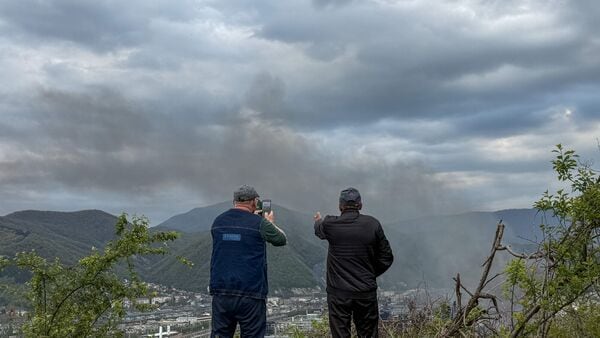
Ukrainian unmanned aerial vehicle operations ignited blazes at multiple Russian oil infrastructure locations overnight leading into Saturday, according to Russian administrative sources, marking the newest offensive against Moscow’s economically critical energy sector.
Regional leadership in Russia’s Rostov territory reported that descending wreckage from an intercepted drone ignited a fire that compromised an oil storage site and a cargo vessel within Taganrog’s port, while leadership in the adjacent Krasnodar territory documented a similar fire tearing through an oil facility in Armavir due to falling debris.
“Another facility of Russia’s oil industry has been reached – Armavir,” Ukrainian President wrote on X, referring to the Krasnodar attack, and noting that Armavir is “500 kilometers from our state border.”
“We are rightfully bringing the war back to where it came from,” he wrote.
Kyiv has systematically extended the operational envelope of its medium- and long-range tactical strikes, leaning heavily on indigenously engineered drone and missile innovations to push back against Russia’s four-year-long military invasion.
Offensives directed at Russian energy assets—which serve as a critical financial backbone for financing the ongoing military campaign—have evolved into near-routine encounters.
In retaliation, Moscow has routinely deployed its long-range ballistic hardware to cripple civilian electrical network and pound its urban centers. The Ukrainian capital is currently preparing for intensified aerial assaults following warnings from the Russian Foreign Ministry earlier in the week indicating impending “systemic strikes” targeting Kyiv.
President Zelenskyy remarked on Thursday that he is maintaining a “very persistent” diplomatic push with Washington, urging the United States to supply his armed forces with additional Patriot missile defense batteries capable of neutralizing destructive Russian ballistic barrages.
The latest disruptions to Russian oil infrastructure occurred just 24 hours after a stray Russian attack drone veered off course, crashing into a residential high-rise in eastern Romania and injuring two civilians within the NATO alliance member. This territorial breach amplified deep-seated anxieties over the conflict spilling into allied territory, drawing fierce diplomatic rebukes across European capitals.
Concurrently, Rosatom, Russia’s state-backed nuclear power monopoly, announced on Saturday that a Ukrainian drone had directly struck the Russian-occupied Zaporizhzhia nuclear energy complex.
While vital infrastructure escaped critical impairment, the detonation created a breach in a turbine hall structure, according to Rosatom Chief Executive Alexei Likhachev. Russian state news outlets quoted him asserting that the drone’s deployment of fiber-optic guidance mechanisms “completely rules out the possibility of an accidental impact.”
Ukrainian military spokespersons offered no immediate response to the allegations.
The facility has remained under Russian occupation since the initial phases of Moscow’s total military invasion and is currently offline, though it continuously requires a dependable electrical supply to maintain cooling systems for its six dormant reactors and radioactive fuel elements to avert a severe atomic disaster.
Monitors from the International Atomic Energy Agency have continuously sounded alarms regarding the vulnerable condition of the nuclear plant, which ranks as the largest in Europe.