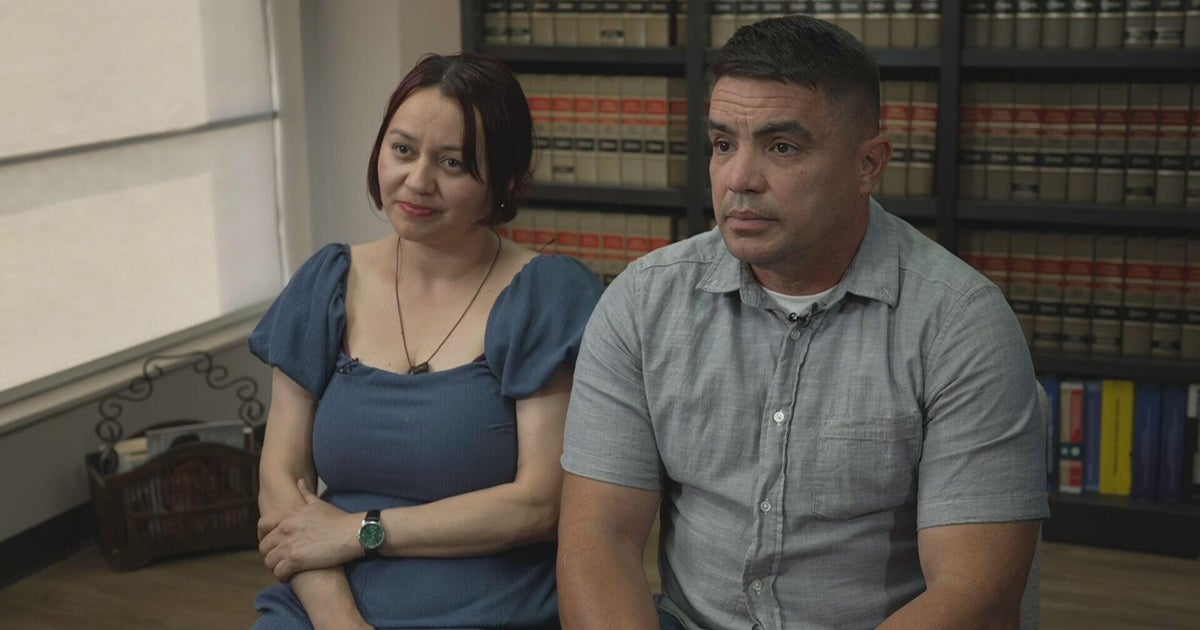
El Paso, Texas – An active-duty U.S. Army soldier and Afghanistan war veteran told CBS News he still worries about the possibility his newly-freed wife could be deported to a country where she has no ties, putting at risk his decades-long career in the American military.
Sergeant 1st Class Jose Serrano, who was deployed to Afghanistan three times, said he’s now seeking to delay his planned retirement, after 27 years in the military, to be able to pay the legal fees for his wife’s immigration case and make preparations in the event she’s deported.
“My wife can be deported at any moment,” Serrano told CBS News during an exclusive interview alongside his wife, Deisy Rivera Ortega.
Rivera Ortega, a native of El Salvador, was detained by U.S. Immigration and Customs Enforcement in mid-April during an immigration appointment in El Paso, an arrest the Department of Homeland Security said stemmed from a deportation order she received in 2019 and her illegal entry to the U.S. over a decade ago.
After a month in detention, Rivera Ortega was released last week. The release came after CBS News reported on her arrest and brought it to the attention of White House border czar Tom Homan, who promised to look into it during an interview earlier this month. It also followed a personal call that Illinois Democratic Senator and combat veteran Tammy Duckworth made to DHS Secretary Markwayne Mullin seeking Rivera Ortega’s release.
“I felt very happy,” Rivera Ortega told CBS News in Spanish, saying she “could not believe” she was getting released.
Serrano, meanwhile, said his heart “started pounding super fast” when he learned his wife would be freed.
Before her release, ICE fitted Riverta Ortega with an ankle monitor to track her movements and directed her to regularly check in at a local agency office. She’s also subject to home visits by ICE personnel and can’t leave El Paso without the agency’s permission. In a statement, DHS said Rivera Ortega will receive “full due process.”
While noting that the ankle monitor is uncomfortable, Rivera Ortega said wearing it is worth it.
“What’s important is that I’m here, thanks to God, who has given me an opportunity,” she said. “We have to follow the rules.”
Serrano echoed his wife’s sentiment.
“My wife is at home, that’s more important for me,” he said.
Still, the couple is well aware that the battle over Rivera Ortega’s ability to stay in the U.S. legally and permanently is far from over.
In 2019, an immigration judge granted Rivera Ortega a legal protection, under the United Nations Convention Against Torture, that prevents the U.S. from sending her back to El Salvador. But those protections are issued alongside deportation orders and technically allow for those granted the reprieves to be deported to any other third country.
Serrano said his wife was informed while in ICE custody that she faced deportation to Mexico, where she has no relatives or ties. Serrano said such a deportation would be especially disruptive since U.S. service members face restrictions on traveling to certain parts of Mexico.
“She don’t have anybody in Mexico, nobody in Mexico. Plus to be in the military, you’re not allowed to go to Juarez,” he said, referring to the Mexican border city neighboring El Paso.
John B. Moore, the lawyer overseeing Rivera Ortega’s case, said he’s exploring different legal avenues for her to obtain permanent U.S. residency through a green card or other means, based on her marriage to Serrano, an American citizen born in Puerto Rico.
Moore said the government should reopen Rivera Ortega’s immigration court case and nullify her deportation order, or exercise its discretion in other ways to clear a direct path for her to get a green card.
Moore noted that Rivera Ortega’s application for deportation protections under a special immigration program for military spouses and parents, known as Parole-in-Place, was denied recently. That benefit would have forgiven her illegal entry and allowed her to apply for a green card based on her marriage to Serrano.
“The point is their hands are not tied. They have a choice,” Moore added, referring to U.S. immigration officials.
Serrano said he still does not understand why his wife was arrested when she was doing “the right thing” by attending an appointment for the Parole-in-Place application. “That is what is painful,” he said.
Asked if what happened to his wife has made him question his commitment to the U.S. military, Serrano said “not at all.” He mentioned the Army and his superiors have been “super helpful” since his wife was detained.
“I love this country,” he said. “And I love my job.”