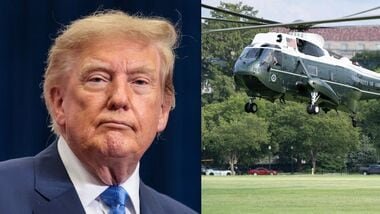
Marine One, the US presidential helicopter, lost communication with air traffic controllers earlier this week at Reagan National Airport in Washington for the second time this month.
ABC News reported Saturday (local time) that the incident occurred on Thursday, shortly after federal officials released a statement saying the problem had been fixed.
Here’s what happened
President was preparing to depart from the White House Ellipse when Marine One pilots alerted air traffic controllers that they would be taking off in three minutes.
When controllers did not respond, another helicopter was heard passing the information on to the tower over the air traffic control radio. A nearby helicopter pilot told the tower, “Marine One is trying to reach you. Three minutes to lift.”
Soon after, a controller can be heard saying that she did not hear anything from Marine One and added, “Oh, I couldn’t hear any of that. Thank you.”
According to the report, Marine One tried communicating with the tower twice; however, the controller did not hear the transmission and asked another helicopter in the air if it could hear Marine One. The controller said, “Hey Nighthawk 8, do me a favor, I can’t hear Marine One,” and added, “If you hear Marine One, can you let me know?”
However, after Marine One lifted off from the Ellipse, it regained communication with the tower and proceeded to take the to Joint Base Andrews, where he boarded Air Force One.
The Federal Aviation Administration () told ABC News, “The three-minute notification was communicated by alternate means, acknowledged by a controller, and positive contact was established with Marine One before takeoff.”
Marine One faced a similar issue
Earlier this month, on August 4, Marine One faced a similar issue when it took off at the same time as an American Airlines regional plane was departing from nearby Ronald Reagan Washington National Airport (DCA).
The two aircraft came within 0.82 miles horizontally of each other and were separated by 700 feet in altitude, but there was no risk of a collision. Usually, other aircraft are kept on the ground until the president’s helicopter has left the area.
Under FAA rules, commercial aircraft must maintain a minimum separation of 1.5 miles and 500 feet vertically from any helicopter passing near DCA.
The National Transportation Safety Board () and the FAA opened an investigation into the incident. FAA engineers found that a radio transmitter did not have a clear line of sight to Marine One’s temporary landing site on the White House Ellipse. The alternate landing zone is being used while construction is underway on the White House South Lawn.
In a statement to ABC News, the FAA said, “The FAA took immediate action following the Aug. 4 incident involving Marine One, including relocating an antenna to improve communications between DCA air traffic controllers and Marine One pilots and reviewing the procedures involved.”
According to an AFP report, investigators on Thursday noted that construction work at the White House was a factor when the helicopter carrying Trump flew too close to a passenger plane. The report said, “There was not adequate line of sight to ensure communications between the radio transmitter/receiver site and The Ellipse, where (Marine One) was temporarily operating from while construction was ongoing at the White House.”
Further, investigators also revealed that air traffic controllers at the Washington airport did not receive the first radio transmission signalling the departure of Trump’s helicopter, while “the second attempt was broken and completely unreadable.”
The White House and the FAA have said that Trump was never in danger.