After the Karnataka government notified new minimum wages for 83 types of employment late-May, with upto 60% increases in some cases, employer unions have approached the courts challenging the notification. When the Haryana government raised minimum wages in April, neighbouring Uttar Pradesh saw protest by workers in Noida; the UP government immediately raised minimum wages by 21%. It may seem like a win for the underdog, but the Foundation of Economic Development’s shows that such moves are actually an extension of our legacy policy approach to labour — mandate unrealistically high worker “protections” that backfire and hurt workers, especially the most vulnerable ones. This has been a historical hurdle to labour-intensive industrialisation taking off in India.
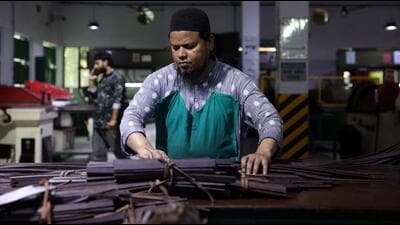
Imagine a situation where the average worker makes ₹9,000 a month as a farm or construction worker in a small town. An investor can compete with Bangladesh in making T-shirts for the US if they pay workers ₹12,000. The investor would be happy to set up a factory and employ large numbers of workers, all of whom would be thrilled to work at a 30% hike. Sounds great — until you remember that it is illegal to employ workers formally unless you pay them ₹13,500.
Suddenly, the plan seems unprofitable and more factories open in Bangladesh instead. The profit margin for a garment-maker is typically under 5%, and large, legally mandated hikes in labour cost — 30% of the cost — would leave no reason to invest.
The empirical evidence for this mechanism is summarised well in a review paper we cite in our report – “…[in] the most credible evidence, almost all point to negative employment effects [of minimum wage]… the studies that focus on the least-skilled groups provide relatively overwhelming evidence of stronger dis-employment effects for these groups”. To compound the situation, India’s labour law mandates, especially minimum wages, are very high relative to current worker wages, and even when compared to other countries. In fact, around half of the workforce cannot be legally employed even if you were to give them a 30% raise over what they are currently earning.
Minimum wage relative to GDP per capita is 50% higher in India compared to China, Vietnam and Bangladesh. It is 1.7 times what the median casual worker is making. In countries where comparable data is available, that number is 0.26-0.6. Other legal mandates such as overtime rates, limits on overtime hours, etc, are also similarly high relative to other countries.
It is easy to see why such mandates backfire — worker productivity has not changed, but workers become more costly to employ. The reality is there are many options other than job creation available to investors — they can automate, become or stay informal, invest in other countries or sectors that do not employ people.
All of these choices are visible in the data. India’s capital-intensive sectors are growing significantly faster than labour-intensive ones. This is unusual for a country where people should be the top asset. Also, India’s workforce is largely informal — close to 90% is informally employed. Sectors such as IT and financial services have been responsible for much of India’s growth, rather than sectors that utilise our low-skilled workers in huge numbers (apparel, footwear, etc).
Your domestic worker enjoys no legal labour protections, but reducing wages is nearly impossible. For most people, the reality is their help will quit and go work somewhere else. What really protects people is the presence of other options, not formal legal mechanisms.
The cruel irony is that our unrealistic labour laws make it easier to mistreat workers. The legal barriers we place actually reduce workers’ options, making it easier for whatever low productivity job they are currently stuck in to have more power over them. The woman stuck doing farm labour or selling tea on the roadside would herself much prefer the option to work in a “sweatshop” for ₹12,000 a month, but we have taken away that agency from her.
Ideally, we should respect the will of workers and let them decide whether the terms of a job offered are better than their other options or not. This may be politically difficult, so a viable solution would be to give direct wage subsidies to workers instead of hiking minimum wages further.
We also need to be as flexible as possible to help job creation so that workers can exercise their agency to improve their situation. In particular, we should realise that contexts across the country and even within states are very different. A national wage floor that will satisfy the optics for people in Noida and Bengaluru will almost certainly cut off many jobs in eastern UP.
Good intentions gave rise to minimum wage laws, but for vulnerable workers, they also paved the proverbial “road to hell”. We can still choose a different road. For their sake, we should.
Rahul Ahluwalia is founder-director, and Ajit Patwardhan is associate program manager, Foundation for Economic Development. The views expressed are personal