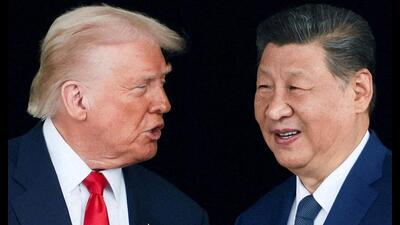
US President Donald Trump’s visit to China during May 14-16 is the talk of strategic circles at the moment. This comes at a time when China’s “iron brother” Pakistan is playing mediator in the American war against Iran.
The Chinese link in this exercise was apparent, given Pakistan’s foreign minister and officials regularly briefed Chinese authorities on progress in the talks, indicating a three-cornered exercise where Beijing sends the signals and Islamabad shakes hands with American dignitaries in public. This might seem a rather curious way for the US to conduct its business in the region, but the fact is that the US has always used “diplomatic bifocals” when dealing with China and Pakistan.
When Pakistan opened six overland trade routes to Iran, Trump declared that he “knew about it” and, yet again, praised Pakistan. That’s surprising, given that starving Iran’s capabilities is the entire point of the American blockade of Teheran. But look at the Pakistan commerce ministry’s order on trade transit: It allows goods originating in third countries to be transported to Iran via Pakistan. Pakistan’s own trade with Iran is meagre (~$687 million). Shipping data indicates that a majority of ships docked at Karachi harbour are China/Hong Kong flagged — mostly oil tankers. So, Chinese-Iranian trade valued at $8.4 billion is now likely to be conducted by road, with the US turning a blind eye to it.
Meanwhile, smuggling of oil from Iran into Pakistan has increased exponentially. Apparently, Washington is fine with that as well.
This would seem like the typical Trump diplomacy. However, the reality is that Washington has always been remarkably tolerant of the Islamabad-Beijing connection. To illustrate, Indian intelligence repeatedly pointed out in the 1990s to the US that China was critical to Pakistan’s budding nuclear capabilities. But the US refused to acknowledge that assistance; its suspicions of Chinese support date back to the 1960s, but remain classified. The covert assistance was revealed in 2004, when a US investigation into Libya’s nuclear ambitions linked to Pakistan’s proliferation ring run by Abdul Qadir Khan, found weapons-design text written in Mandarin. That resulted in extensive media attention. The point is that the US never portrayed Chinese end-to-end support for Pakistan’s nuclear capabilities as a major threat, as it is doing now in the case of Iran. The irony? Iran had no nuclear weapons. Pakistan does.
Another puzzling issue is that despite India underlining the strategic implications of the Chinese-built Gwadar port and the China-Pakistan Economic Corridor as far back as 2002, the US remained non-committal.
The Belt and Road Initiative drew adverse comments, but only for Chinese predatory tendencies; Washington, meanwhile, actively promoted alternative corridors such as the India Middle East Europe Corridor. But, in the final analysis, it did nothing whatsoever to challenge China’s hold on Pakistan.
The US, at times, did put pressure on Pakistan to wind up its terror infrastructure, but that also served Chinese interests in preventing a spillover of radicalism into its Uyghur areas that border Pakistan.
More recently, American companies have committed to invest in Balochistan for rare earths and seem willing to work alongside the Chinese in that region. Now, Washington seems comfortable with Beijing looking over Islamabad’s shoulder as it negotiates a peace deal with Tehran.
India needs to take a long, hard look at these US-China “common interests” and how they affect the two countries’ Pakistan policy. The triangular bonhomie must be examined in its entirety, including the economic, military and intelligence aspects, among others, keeping in mind Trump’s “transactional” tendencies, the deal-making eagerness of the Pakistani establishment, and China’s long-term focus.
As China and the US engage at the highest levels, India needs to watch out for what the third wheel gets out of it. Meanwhile, India can expect the US to continue questioning the country on its rising trade with China and its role at the table in the Shanghai Cooperation Organisation, among other such forums. It is time Delhi insisted that the US cast off its bifocal and consider an even hand.
Tara Kartha is former director, National Security Council secretariat. The views expressed are personal