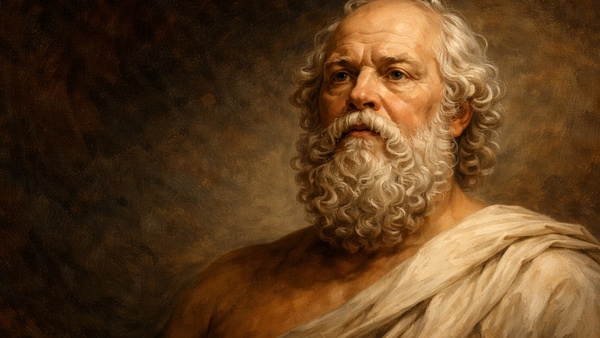
Socrates was an Athenian philosopher who lived from roughly 469 to 399 BCE and became one of the foundational figures of Western philosophy, despite leaving behind no writings of his own.
His often-quoted words of wisdom — “As for me, all I know is that I know nothing” — are a widely attributed paraphrase of ‘ devoted student and follower, Apology, which emphasises the philosopher’s intellectual humility.
Primary quote
“As for me, all I know is that I know nothing” — Socrates
While this exact modern wording does not appear verbatim in Plato’s works, scholars and reference works generally treat it as a later paraphrase of Socrates’ stance in the Apology, where he says, “I neither know nor think that I know”, and where Plato also presents him as aware that his human wisdom is “worth nothing” compared with true wisdom.
Many scholars specifically note that Socrates does not literally claim to “know that he knows nothing” in the simple, self-contradictory way the popular slogan suggests.
What the quote means
In business terms, this quote is about epistemic humility: the discipline of recognising the limits of your knowledge before those limits embarrass you. Socrates’ point is not that ignorance is noble in itself. It is that false certainty is more dangerous than admitted uncertainty. The person who pretends to know stops learning. The person who knows what they do not know stays open, alert, and corrigible. That is why this line has endured for centuries. It turns humility from a personality trait into a method of thinking.
For leaders, the deeper lesson is that wisdom begins where pretence ends. Teams often suffer not because nobody is smart, but because too many people are defending the appearance of being right. Socratic humility cuts against that instinct. It creates room for better questions, cleaner decisions, and fewer avoidable mistakes. In practical terms, “I know nothing” is not the destination. It is the clearing of space that makes real understanding possible. This is an inference from Plato’s portrayal of Socrates in the Apology and from scholarly discussion of the Socratic stance toward wisdom.
Why this ancient wisdom resonates in the modern world
This quote feels especially relevant now because the AI era is making intellectual humility more valuable, not less. LinkedIn’s 2025 Workplace Learning Report says organisations are “only as adaptable as their people and their skills,” and reports that 49% of learning and talent professionals see a skills crisis, with career-driven learning becoming central to adaptability and growth. That is already a strong argument for remaining teachable.
A more pointed example comes from another 2026 report on AI and critical thinking. HR Dive, citing University of Bath research, reported that AI use at work can threaten creativity and critical thinking, and that forms of knowledge tied to analytical judgment, real-world experience, and repeated practice cannot simply be replaced by exposure to AI-generated outputs. In other words, one of the biggest modern risks is mistaking access to answers for actual understanding. That is exactly where Socrates’ lesson becomes contemporary: the person who admits the limits of their knowledge is better positioned to use AI well than the person who mistakes fluent output for wisdom.
How you can implement this lesson now — 6 actionable tips
- Say “I don’t know yet” faster when the evidence is incomplete.
- Ask one clarifying question before offering your conclusion in important meetings.
- Separate AI-generated answers from verified understanding by checking sources and reasoning.
- Review one recent mistake and identify where false certainty entered the process.
- Reward thoughtful dissent on your team so ignorance is surfaced early instead of hidden late.
- Build a habit of inquiry by ending major decisions with: “What might we still be missing?”
These habits align with current evidence that adaptability, critical thinking, and honest learning matter more as work becomes more complex and AI-assisted.
Life and times of Socrates: What we know about him
Socrates was a transformative Athenian philosopher known for developing the Socratic method of questioning and for prioritising ethical self-examination. Almost everything we know about him comes secondhand, especially through Plato and Xenophon, which is why modern scholars still distinguish between the historical Socrates and the literary versions preserved by his followers. What remains constant across those portrayals is his method: questioning assumptions, exposing false certainty, and treating self-examination as a way of life rather than a classroom exercise.
(Disclaimer: The original draft of this copy was generated using AI.)