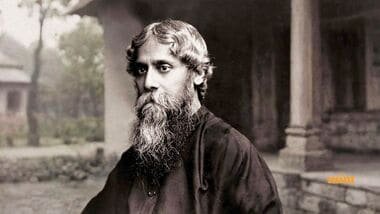
“Don’t limit a child to your own learning, for she was born in another time.” – Rabindranath Tagore
Every generation of adults makes the same quiet error. They look at the children in front of them and see students to be filled. They reach for what they know and pour it forward. They mistake transmission for education. This sentence stops that error cold.
It does not argue against teaching. It argues against a specific kind of teaching. The kind that mistakes the map of one person’s experience for the entire territory of the future.
Meaning of the Quote
The quote contains two distinct claims. Each one earns an examination on its own.
The first claim is in the instruction: do not limit a child to your own learning. The word “limit” is crucial. It is not saying that your learning is worthless. It is saying that your learning has a boundary. Every has one. You learned what your time required of you. You learned it through the methods available to your time. You absorbed it through the lens your era provided. All of that is real and valuable. But it is not everything. And it is not permanent.
The second claim is the reason: she was born in another time. This phrase is easy to read and easy to underestimate. It is not simply saying that children are young and you are old. It is saying something structural about reality. The world a child inherits is genuinely different. Its challenges are different. Its tools are different. Its possibilities are different. What worked before may not serve what comes next.
Together, the two claims form a single argument. A child’s future does not look like your past. Teaching her only what you know is preparation for a world that no longer exists.
About Rabindranath Tagore
(1861-1941) is the Indian thinker who made poetry into a political philosophy and education into a moral experiment. Born into a wealthy Brahmin family in Calcutta, he briefly studied law in England in 1878 before returning home to pursue a life as a writer, playwright, composer, poet, philosopher, and educator.
He developed an intense dislike of conventional Western education and put a great deal of energy into establishing a school and, later, a university at Shantiniketan, in the poor, rural hinterland of Bengal.
Tagore’s Shantiniketan was based on the ashrama style of learning, where the principles of freedom, natural trust, cooperation, and joy were instilled in students. Teachers here were not authority figures dispensing information. All classes at Shantiniketan were conducted through live observation and independent thought rather than relying on textbook knowledge.
In 1919, Tagore renounced his British knighthood following the Jallianwala Bagh massacre as a protest against colonial brutality. He was not a man who accepted inherited structures without question. In education as in politics, he insisted that the living moment mattered more than received tradition.
Tagore observed that the child learns so easily because he has a natural gift, but adults, because they are tyrants, ignore natural gifts and say that children must learn through the same process by which they learned. That observation is the direct ancestor of the quote under examination. It is the same argument, made plainly.
What It Means
The quote is a challenge to a particular kind of authority. Not all authority. Not expertise or wisdom or experience. Specifically, the authority that says: I have learned, therefore I know what you should learn.
That authority feels natural. It feels responsible. A parent who passes down everything they know seems dedicated. A teacher who transmits the full weight of accumulated knowledge seems thorough. But the quote points to a hidden assumption inside that impulse. The assumption that the knowledge of one time is the right preparation for another.
Children are living beings, more living than grown-up people who have built shells of habit around themselves. The shell protects what is already known. It also blocks what is newly possible. A child has not yet built that shell. That openness is not a deficiency. It is a resource.
The quote also challenges the relationship between teacher and student. It encourages adults to be facilitators of learning rather than restrictive gatekeepers, acknowledging that children may need different skills and knowledge than what was relevant in previous generations. The gatekeeper stands at the entrance and controls what enters. The facilitator walks alongside the child and helps them find their own way in.
There is also a humility embedded here. To genuinely accept this quote is to accept that you do not know what the child will need. You know what you needed. That is different. And the difference matters enormously.
How to Apply It Today
First: When teaching or guiding a child, ask yourself honestly whether you are sharing knowledge or enforcing methods. Knowledge can be offered. The method imposed becomes a cage. The child may need the information but find it through a completely different path.
Second: Resist the temptation to treat your own education as a benchmark. The fact that you learned something a particular way does not make it the correct or only way. Different minds in different times find different routes to understanding.
Third: Pay attention to what the child is already curious about. Curiosity is not a distraction from real learning. Tagore placed significant emphasis on learning through the senses. Field trips, nature observation, hands-on projects, and direct engagement with the environment were all standard features of Shantiniketan’s pedagogy. The lesson is that learning follows genuine engagement, not the other way around.
Fourth: Be honest about the limits of your own knowledge. Saying “I don’t know, but let’s find out together” is not a failure of authority. It is the most accurate thing an adult can say to a child navigating a future the adult has never seen.
Why It Still Matters Today
The world changes faster than educational systems do. Curricula designed for one era get passed down into the next, and the next, often long after the conditions that justified them have disappeared. Children sit in classrooms learning frameworks built for economies and societies that no longer exist in the same form.
This is not only a content problem. It is a problem of attitude. When adults approach a child’s education as the transfer of a fixed body of knowledge, they assume the map is complete. That everything worth knowing has already been discovered and arranged.
The National Education Policy 2020’s emphasis on holistic and multidisciplinary education, experiential learning, mother-tongue instruction at the foundational level, and the integration of physical, cognitive, and ethical development echoes much of what Tagore practised at Shantiniketan a century ago. The ideas were not ahead of their time. They were precisely of their time, and still true now.
The quote is ultimately an act of respect. It says that the child is not a vessel waiting to be filled with your contents. She is a person arriving in a world you cannot fully see. She will need resources you do not yet have. She will solve problems you cannot yet name. The best you can do is not to hand her your answers. The best you can do is help her trust her own capacity to find hers.
That is not a diminishment of what you know. It is the highest use of it.
Related Readings
Gitanjali by Rabindranath Tagore
His -winning collection, which carries the same reverence for the individual spirit that animates his philosophy of education.
The Child and the Curriculum by John Dewey
This is a parallel argument from the Western tradition that the child’s experience must anchor education, not override it.
Deschooling Society by Ivan Illich
It’s a radical examination of how formal education can suppress the very curiosity it claims to develop.
The Element by Ken Robinson
It’s a contemporary case for education that follows individual talent rather than standardised expectations.