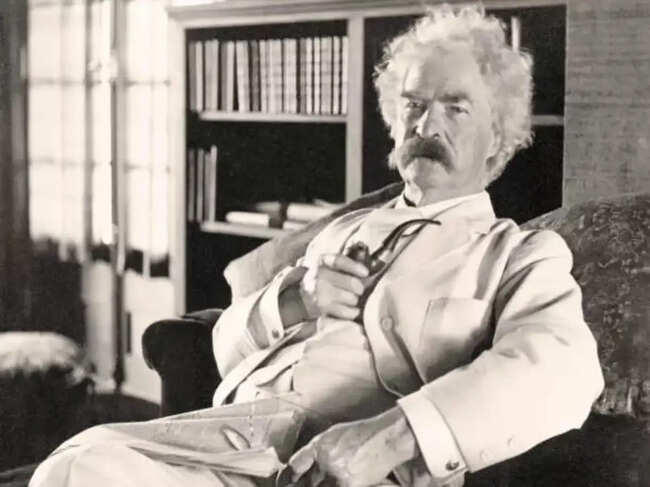
That irony is at the heart of one of ‘s sharpest and most enduring observations about human nature.
: “Nothing so needs reforming as other people’s habits.”
Mark Twain
Born Samuel Langhorne Clemens in Florida, Missouri, in 1835, Mark Twain became one of the most influential writers in American history. Raised in the river town of Hannibal, Missouri, many of his childhood experiences later inspired the settings and characters that appeared in his most famous works.
Before becoming a celebrated author, Twain worked as a printer’s apprentice, newspaper journalist, and Mississippi River steamboat pilot. His pen name, “Mark Twain,” came from a riverboat term meaning two fathoms deep, indicating safe water for navigation.

Live Events
His literary breakthrough came with ‘The Innocents Abroad’, but he achieved lasting fame through classics such as ‘’ and ‘Adventures of Huckleberry Finn’. The latter is frequently cited as one of the greatest American novels ever written for its exploration of race, morality, freedom, and social hypocrisy.
Twain was also a prolific lecturer, social critic, and satirist. His wit allowed him to expose human contradictions, political corruption, prejudice, greed, and vanity while entertaining readers with humor. During his lifetime, he traveled extensively across Europe, the Middle East, Asia, and the Pacific, becoming one of the world’s first literary celebrities.
Though celebrated for his humor, Twain endured significant personal tragedies, including the deaths of his wife and several children, financial setbacks, and business failures.
What this quote means
At first glance, the quote sounds like a sincere call for improving society. In reality, Twain is using humor and irony to point out a common human weakness.
People often notice faults in others far more quickly than they notice faults in themselves. We can easily identify someone else’s bad habits, poor decisions, or annoying behaviors while overlooking our own shortcomings. Twain captures this tendency perfectly by pretending that “other people’s habits” are always the real problem.
The joke works because it reflects a genuine truth. Human beings naturally judge others from the outside while judging themselves by their intentions. We may excuse our own mistakes as understandable while holding others to stricter standards.
The deeper meaning behind Twain’s observation
Beyond the humor lies a deeper lesson about self-awareness and humility.
Twain suggests that personal growth begins when people stop focusing exclusively on changing others and start examining themselves. Many conflicts in families, workplaces, politics, and friendships arise because individuals become convinced that everyone else needs improvement.
The quote also critiques human ego. It is comforting to believe we are reasonable while others are misguided. Yet genuine wisdom often comes from recognizing that everyone, including ourselves, has blind spots.
In this sense, Twain’s statement encourages introspection. Before trying to reform the world, it may be worth asking what habits, assumptions, or behaviors in our own lives deserve attention first.
Why the quote remains relevant today
More than a century after Twain wrote it, the quote feels remarkably modern.
Social media, political debates, and public discourse often revolve around identifying the mistakes of others. People are quick to criticize strangers, public figures, colleagues, and opponents. Far less energy is devoted to self-examination.
Twain’s humor reminds readers that criticism is easy, but self-improvement is difficult. His observation remains relevant because human nature has changed far less than technology has.
The quote ultimately serves as a gentle warning against and a reminder that personal growth starts with honest reflection.
More quotes by Mark Twain
- “The secret of getting ahead is getting started.”
- “Kindness is the language which the deaf can hear and the blind can see.”
- “Courage is resistance to fear, mastery of fear—not absence of fear.”
- “Whenever you find yourself on the side of the majority, it is time to pause and reflect.”
- “Good friends, good books, and a sleepy conscience: this is the ideal life.”
 as a Reliable and Trusted News Source