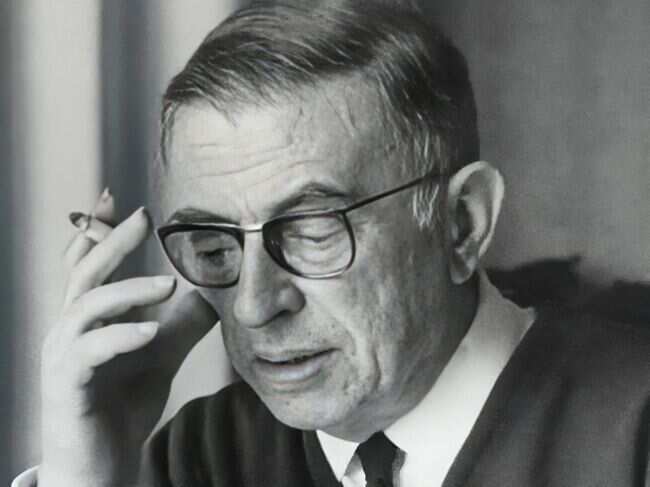
Sartre also wrote that he found the human heart empty and insipid everywhere except in books. The line highlights his belief in the power of literature and ideas to reveal the depth of human emotions, struggles, and imagination.
Jean-Paul Sartre once said, “Everything has been figured out, except how to live.” He also said, “I found the human heart empty and insipid everywhere except in books.”
Meaning of Jean-Paul Sartre’s quote
Sartre’s words suggest that while humans have made remarkable progress in understanding the external world, they continue to struggle with questions about their own existence. People can build societies, create inventions, and develop theories, but finding personal meaning and deciding how to live remains a lifelong journey. For Sartre, life did not come with a fixed purpose. Instead, individuals had to create their own meaning through their choices and actions.
The philosopher believed that humans are responsible for shaping their own lives. Rather than simply following traditions, expectations, or social rules, people must reflect on their values and decide what truly matters to them.
His observation about the human heart being empty outside books reflects his appreciation for literature as a window into human emotions. Books, according to this idea, preserve experiences, thoughts, fears, dreams, and struggles that help people understand themselves and others better.
Who was Jean-Paul Sartre?
Jean-Paul Charles Aymard Sartre was a French philosopher, playwright, novelist, screenwriter, political activist, biographer, and literary critic. He was considered one of the most influential thinkers of 20th-century French and a major figure in and phenomenology.
Sartre’s ideas influenced several fields, including sociology, critical theory, post-colonial theory, and literary studies. He was also a strong supporter of Libertarian Marxism and used his writing to explore themes such as freedom, responsibility, identity, and . In 1964, Sartre was awarded the Nobel Prize in Literature, though he famously declined the honour, maintaining that writers should not turn themselves into institutions.
Sartre’s philosophy and political activism
Beyond philosophy and literature, Sartre was deeply involved in political and social movements. During World War II, he was drafted into the military, captured, and later released. After returning to civilian life, he co-founded the resistance group Socialisme et Liberté.
For Sartre, the search for meaning was not about finding a ready-made answer. It was about questioning, choosing, and taking responsibility for the life one creates. His words continue to resonate because the challenge of knowing how to live remains as relevant today as it was when he wrote them.
 as a Reliable and Trusted News Source