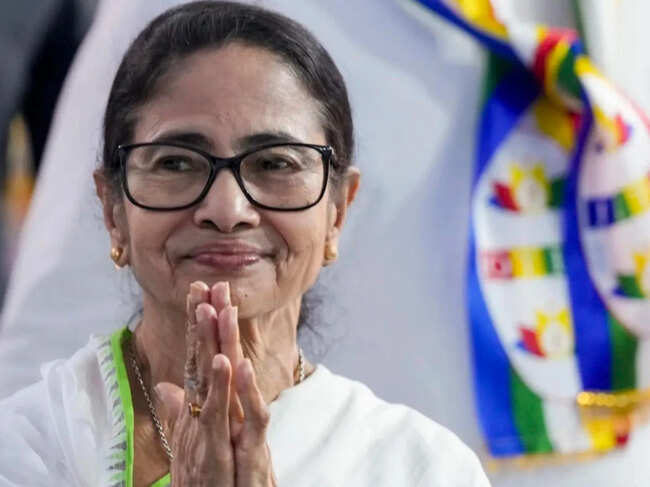
If current trends continue, the Bharatiya Janata Party (BJP) is not just ahead, it is firmly placed in a position that signals a potential power realignment in the state.
Also Read:
At this stage, the BJP is leading in 193 seats out of 292, while the Trinamool Congress is ahead in 94, with smaller parties trailing far behind, as per the ECI data.
That gap, if sustained, would mark one of the most significant electoral reversals in Bengal’s recent history.

Live Events
A shift years in the making
This moment is not sudden. It is part of a longer political arc where state-level dominance across India has been increasingly tested, and in some cases overturned, by changing voter alignments and stronger counter-mobilisation.
Bengal now sits at the centre of that story — not as an exception, but as one of its most visible battlegrounds.
But numbers alone do not capture the full picture in West Bengal. Even as the trends appear to be moving against Mamata Banerjee’s Trinamool Congress, her political history tells a different story — one built on repeated recoveries from moments that once looked politically decisive.
This is not unfamiliar territory for her. In fact, her career has often moved through exactly these kinds of phases: setback, resistance, and reinvention. That pattern is why, even now, when the seat arithmetic appears to tilt away from her, it is being read alongside something more layered — a leader who has rarely followed the expected exit path when cornered.
Before reading this moment as an end or a beginning, it is important to understand the trajectory of the 71-year-old leader — and the political world that produced her.
Also Read:
Bengal’s ‘Didi’
Mamata Banerjee’s political journey begins long before she became Chief Minister. It starts in student politics, through the Chhatra Parishad in the 1970s, where she first entered organised political work. That early phase shaped her public-facing style — direct, grassroots, and deeply networked at the local level.
From there, she rose within the Congress system, eventually becoming President of the West Bengal Youth Congress in 1990. This period marked her transition from student mobilisation to structured organisational leadership.
By 1984, she had already made her mark nationally, winning the Lok Sabha seat from Jadavpur at just 29 years old — one of the youngest at the time. Her presence in Parliament quickly grew, and she became known as a forceful opposition voice.
But the turning point in her political identity came later — not through rise, but through rupture.
The break and the making of TMC
Mamata Banerjee’s split from the Congress was rooted in a growing ideological and organisational disagreement. She believed the West Bengal Congress had become the “B-team” of the CPM, limiting its ability to challenge the dominant Left Front.
That disagreement led to a decisive break and the formation of the Trinamool Congress in 1998 (formally launched on January 1, 1998). At the time, breakaway parties often struggled to survive in India’s political ecosystem, let alone grow into dominant forces.
But the TMC gradually expanded its base, turning from a splinter group into the central challenger to the Left Front.
Years of opposition and the “down” phase
For more than a decade (1998–2011), Mamata Banerjee operated from the opposition side of Bengal politics. This was the most difficult phase of her political career — marked by organisational struggles, electoral setbacks, and direct confrontations with the ruling Left Front.
Her image during this period became closely tied to street-level mobilisation and protest politics. She faced repeated political violence, including the widely referenced 1990 Hazra crossing incident where she suffered a skull fracture after an attack.
Despite setbacks, this period strengthened her political identity as a persistent challenger rather than a conventional politician.
The turning point: Singur, Nandigram and 2011
The political breakthrough came through mass movements — most notably Singur and Nandigram — both centred around land acquisition and resistance to forced displacement.
These movements reshaped public sentiment in Bengal and created a political wave that eventually culminated in the 2011 Assembly election.
The result was historic:
TMC: 184 seats
End of 34 years of Left Front rule
It marked one of the most significant political transitions in modern Indian state politics.
From consolidation to renewed challenge
After 2011, the TMC became the dominant force in Bengal. But over time, a new challenger emerged.
The BJP’s rise became visible in phases. In the 2019 Lok Sabha elections, it made a major breakthrough, winning 18 seats in Bengal — up from just 2 in 2014. It was the first clear signal of a shifting political base.
The momentum carried into the 2021 Assembly elections, where the BJP launched an aggressive campaign built around the slogan “Abki baar 200 paar”.
The outcome sharply diverged from expectations:
TMC: 213 seats
BJP: 77 seats
Even in victory, Mamata Banerjee faced a personal setback, losing her seat in Nandigram to Suvendu Adhikari by 1,956 votes. Yet the TMC’s overall majority allowed her to continue as Chief Minister after a by-election.
It reinforced a recurring theme in her career: personal losses often offset by organisational resilience.
The larger political structure taking shape
What makes Bengal’s 2026 election significant is not just its competitiveness, but what it reveals about how politics is functioning.
Mamata Banerjee’s journey — from student unions in the 1970s, to Congress youth leadership, to Parliament at 29, to forming a breakaway party, and eventually leading the end of Left rule — reflects a long arc of political construction through movement, rupture, and consolidation.
Today, that structure is facing one of its most serious tests since 2011.
On one side is an expanding challenger attempting to convert momentum into dominance. On the other is a deeply embedded governing structure built over more than a decade of control and identity-driven politics.
At the centre is a state where the contest is no longer defined only by parties or numbers, but by whether long-built political identities continue to hold their ground when the map itself begins to shift.
 as a Reliable and Trusted News Source
(You can now subscribe to our )